
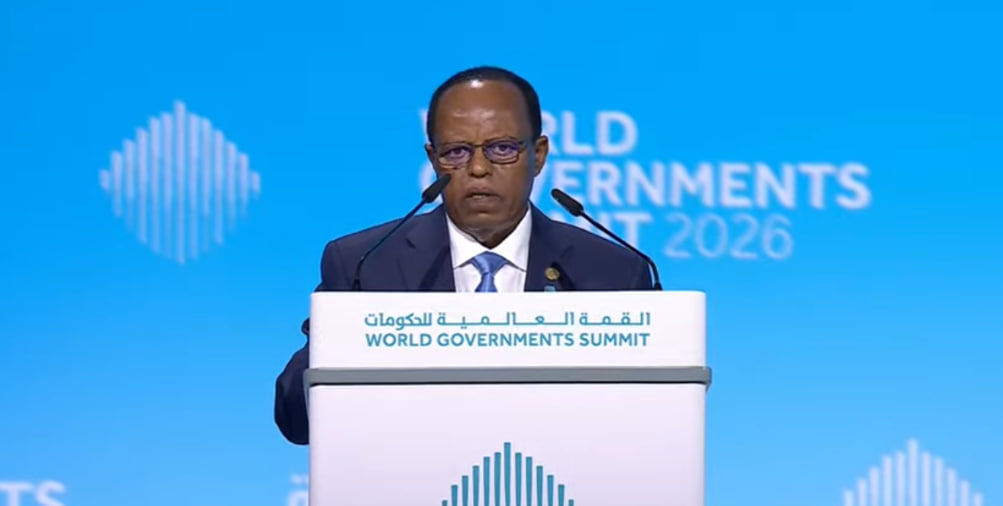
Red Sea Corridor Is Vital Artery for 12% of Global Trade, Requires Urgent and Cooperative Framework, President Taye Says
Addis Ababa, February 3, 2026 (FMC) – President Taye Atske-Selassie of Ethiopia told the World Governments Summit in Dubai that Africa must actively shape its future amid shifting global power dynamics, emphasizing integration, sustainable development, and trust-based partnerships.
He highlighted the Red Sea corridor as a vital artery, carrying about 12 percent of global trade, and called for an urgent, cooperative framework free from narrow strategic or geoeconomic interests.
The Ethiopian head of state said Africa does not aim to be a passive observer of global change, but an architect of its own destiny, noting that innovation in renewable energy, artificial intelligence, and digital finance provides tools to overcome longstanding development hurdles.
President Taye underscored the African Continental Free Trade Area (AfCFTA) as a transformative initiative that consolidates a market of 1.3 billion people with a combined GDP exceeding 3.4 trillion US dollars. He said AfCFTA, a flagship project under the African Union’s Agenda 2063, removes up to 90 percent of tariffs, strengthens regional production networks, and advances inclusive, sustainable socio-economic development.
He highlighted major continental transport corridors as critical to connectivity and regional cooperation, including the North–South Corridor linking Dar es Salaam to Africa’s copper belts, the Central Corridor connecting the Great Lakes region to the coast, the Lamu–South Sudan–Ethiopia Corridor, and the recently agreed Ethiopia–South Sudan infrastructure project.
Turning to Ethiopia’s national priorities, President Taye outlined three strategic pillars supporting regional and continental growth. First, energy: with the Grand Ethiopian Renaissance Dam now fully operational, Ethiopia generates over 6,000 megawatts of renewable electricity, contributing to Pan-African industrial connectivity.
Second, food security: Ethiopia has transitioned from wheat importer to Africa’s largest wheat producer and last year produced 640,000 tons of coffee, planting 8.5 billion high-quality seedlings.
Third, aviation and logistics: the country is constructing a US$12.5 billion international airport with capacity for 110 million passengers and over three million tons of cargo annually.
He acknowledged that Africa faces significant challenges, including infrastructure financing gaps, limited capital, and the need for stable trade routes. To address these, Ethiopia is empowering financial institutions, promoting innovative public-private partnerships, and encouraging African entrepreneurs and innovators to invest in the continent’s development.
Trust and dependable partnerships with global actors, he said, are essential. Citing Ethiopia’s experience under the African Growth and Opportunity Act (AGOA), he noted that abrupt policy changes once left more than 50,000 women unemployed, demonstrating the need for consistent and equitable engagement.
President Taye stressed Africa’s commitment to principled engagement in global governance, rejecting pressure to choose sides in international disputes. He called for patience, negotiation, and collaboration based on shared interests, emphasizing that the continent approaches global transitions with depth and careful self-assessment.
Concluding his address, he called for inclusive and cooperative global governance that fosters partnership rather than exclusion. “Africa is ready. Ethiopia is ready to connect and thrive in our own will, as equal partners to the world,” he said, highlighting the continent’s commitment to regional integration, sustainable development, and collaborative engagement with the international community.