
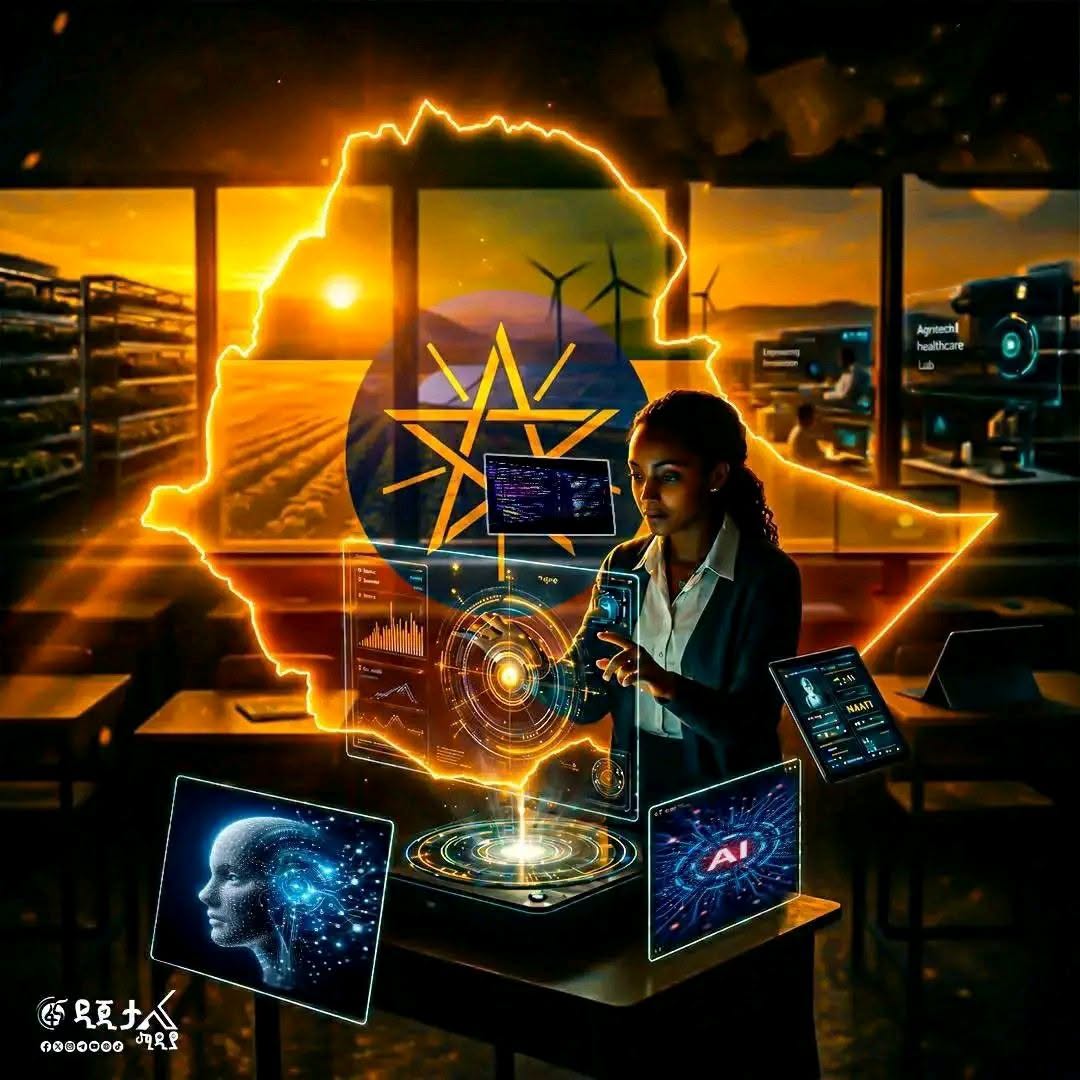
Millennia in Their Heritage, Tomorrow in Their Hands: Ethiopia’s Youth at a Historic Turning Point
Addis Ababa, August 12, 2026 (FMC) — Few countries carry the weight of history quite like Ethiopia. Its story reaches back across millennia, through kingdoms and civilizations, triumphs and trials, periods of grandeur and chapters of profound hardship. In more recent decades, the country has travelled an especially uneven road — marked by remarkable achievements and painful setbacks, extraordinary resilience and periods of conflict, ambitious development and persistent poverty.
Yet, beyond the turbulence of the recent past, another Ethiopia is beginning to come into view: more connected, more ambitious, increasingly confident in its capabilities and facing a future whose possibilities are as vast as its challenges.
And at the center of that emerging horizon stands its youth.
They are heirs to one of Africa’s oldest civilizations, but they are also citizens of a radically different world — a world of artificial intelligence, digital economies, frontier technologies, global connectivity and rapidly shifting patterns of work, wealth and power.
This is the generation standing between Ethiopia’s extraordinary past and its still-unwritten future.
It is the generation that must decide what to preserve, what to transform and what to build anew.
That is what gives Prime Minister Abiy Ahmed’s message marking International Youth Day a significance far beyond a commemorative occasion.
Saying that it is impossible to envision Ethiopia’s future without its youth, the Prime Minister described young Ethiopians as the country’s greatest opportunity — drivers of change, defenders of sovereignty and partners in building prosperity.
He said today’s youth are turning the page on division, conflict and poverty and writing a new chapter of Ethiopia’s history with courage, unity and purpose.
The message speaks to a striking reality.
Ethiopia’s youth are coming of age at a moment when the country is attempting to turn a complicated inheritance into a more hopeful future — and when Africa itself is entering what could become the defining demographic moment of the century.
The question is no longer simply what Ethiopia will do for its young people.
It is what Ethiopia’s young people can do with the extraordinary moment unfolding before them.
The heirs of an ancient story
There is something unusual about being young in a country whose historical memory stretches so far back.
For Ethiopian youth, history is not simply something encountered in textbooks. It is embedded in landscapes, monuments, languages, religious traditions, communities and a national consciousness carried from one generation to another.
But heritage, however magnificent, cannot by itself determine the future.
Every generation inherits a story and then faces the responsibility of deciding what to do with it.
The generation coming of age in Ethiopia today faces a particularly consequential choice: whether to merely inherit the achievements and challenges of the past or to use that inheritance as a foundation for creating something new.
Increasingly, the answer can be seen in action.
Young Ethiopians are entering construction sites, laboratories, technology hubs, factories, farms, universities and businesses with a different set of tools and expectations.
They are not waiting for history to end before beginning their own chapter.
They are writing alongside it.
The generation that builds
Look at Ethiopia’s changing physical landscape and another story begins to emerge.
Dams rise across rivers. Roads stretch toward new horizons. Airports expand. Industrial facilities take shape. Cities are being redesigned. Energy infrastructure grows. New enterprises emerge.
Behind all of this is something less visible than concrete and steel: human capacity.
Young engineers, architects, surveyors, technicians, project managers, skilled workers and professionals are becoming increasingly important to the country’s ability to conceive and execute complex projects.
The significance of this should not be underestimated.
A megaproject does more than produce a physical asset.
It produces experience.
It creates skills.
It transfers knowledge.
It builds confidence.
And when a young professional masters one complex undertaking, the country possesses something it did not possess before: another person capable of tackling an even more difficult challenge.
That is how national capability compounds.
One project becomes experience for the next.
One generation trains the next.
One ambitious undertaking makes the next ambition appear less impossible.
The Abbay and the architecture of confidence
Few projects illustrate this dynamic more powerfully than the Grand Ethiopian Renaissance Dam.
Rising on the Abbay River, the project has become one of Ethiopia’s most consequential national undertakings, built over more than a decade through an extraordinary mobilization of national resources and effort.
Its physical scale is unmistakable.
But there is another monument embedded within it — one made not of concrete, but of confidence.
For Ethiopian professionals who have contributed to the project, the experience represents accumulated knowledge in engineering, construction, project management, technology and technical operations.
That knowledge does not remain inside the dam.
It travels with the people who acquired it.
It moves to the next project, the next institution and the next generation.
The most enduring legacy of a major national undertaking may therefore be not only what it builds, but whom it builds.
From concrete to code
The frontier, however, is no longer only physical.
For today’s young Ethiopians, another vast construction site exists largely beyond the visible horizon.
It is digital.
The country’s Digital Ethiopia 2030 strategy places digital skills, infrastructure and innovation at the center of efforts to transform the economy and strengthen Ethiopia’s participation in the global digital economy.
That ambition has found a striking expression in the 5 Million Ethiopian Coders initiative.
Prime Minister Abiy recently called on young Ethiopians to expand the initiative’s reach to seven million participants by the end of the rainy season, underscoring the government’s effort to make digital skills a central part of the country’s future workforce.
The significance is larger than the number.
It represents an attempt to change what a young Ethiopian can imagine doing.
A young person once limited by geography can now learn from a global digital classroom.
A young entrepreneur once constrained by physical markets can potentially reach customers through digital platforms.
A programmer can write for an international market from Addis Ababa or another Ethiopian city.
A student can move from asking what job might be available to asking a more consequential question:
What can I create?
That is the psychological shift upon which economic transformation often depends.
Africa’s great demographic moment
This Ethiopian story is unfolding against one of the defining demographic transformations of the twenty-first century.
Africa is young.
More than 400 million Africans are between 15 and 35, according to the African Union, while around 60 percent of the continent’s population is under 25.
Ethiopia reflects that wider continental reality. Its youthful population represents one of its most significant potential sources of economic and social dynamism.
The implications are enormous.
Africa’s youth population is expected to continue expanding for decades, while the continent is projected to account for an increasingly large share of the world’s young people. Recent demographic projections indicate that Africa could be home to 46 percent of the world’s under-25 population by 2100.
That can become a demographic dividend of historic proportions.
But a dividend is not automatic.
Youth without opportunity can become frustration.
Youth without skills can become exclusion.
Youth without employment can become a source of social and economic pressure.
The great African challenge is therefore not simply having a young population.
It is turning youth into productive power.
The race is no longer only for resources
The global economy is changing faster than the economic vocabulary of previous generations.
Natural resources remain important. Geography remains important. Infrastructure remains important.
But increasingly, knowledge is the currency that determines who moves fastest.
Artificial intelligence is reshaping industries. Automation is changing work. Digital finance is transforming commerce. New technologies are opening frontiers that did not exist a generation ago. Global production networks are shifting.
And this transformation comes with both promise and peril.
The International Labour Organization reported this week that global youth unemployment rose slightly to 12.4 percent in 2025, with 67 million young people aged 15 to 24 unemployed worldwide. More than 257 million young people were classified as not in employment, education or training. At the same time, the ILO warned that artificial intelligence could further reshape youth employment.
For Ethiopia and Africa, therefore, the question is not simply how many young people will enter the workforce.
It is whether they will enter a workforce equipped for the economy that is actually arriving.
The question for Ethiopia is not simply how to participate in a changing world.
It is how to produce people capable of shaping it.
From population to power
This is where Ethiopia’s youth agenda intersects with the country’s broader development strategy.
Digital transformation, industrialization, infrastructure development, modern agriculture, tourism, science, technology and entrepreneurship all ultimately converge on one indispensable resource: people with the knowledge and skills to make them work.
Digital skills are economic infrastructure.
Scientific education is economic infrastructure.
Research capacity is economic infrastructure.
Entrepreneurship is economic infrastructure.
And the creativity of young people may become one of Ethiopia’s most valuable forms of capital.
The country’s recent push to expand digital skills reflects that recognition. Beyond the 5 Million Ethiopian Coders initiative, the wider Digital Ethiopia 2030 agenda seeks to create the human and technological foundations for a more digitally enabled economy.
The youth question, therefore, is not a separate chapter of national development.
It is woven through every chapter.
Sovereignty has acquired a new language
The Prime Minister’s description of young people as defenders of sovereignty also carries a meaning far beyond the traditional understanding of national defense.
In an interconnected world, sovereignty increasingly depends on what a country can do for itself.
Can it generate knowledge?
Can it develop technology?
Can it engineer complex infrastructure?
Can it produce skilled professionals?
Can it create competitive businesses?
Can it modernize agriculture?
Can it manage its digital systems?
Can it innovate rather than merely import innovation?
These are questions of national capability.
A young scientist working in a laboratory can therefore contribute to sovereignty.
So can an engineer designing infrastructure.
So can a programmer developing a digital platform.
So can an entrepreneur creating a competitive Ethiopian company.
The frontier of national independence has expanded.
It now runs through classrooms, laboratories, factories, technology centers and construction sites.
Green hands, long horizons
There is also a quieter revolution taking place beneath the noise of construction and technology.
Trees are being planted.
Land is being restored.
Young Ethiopians are participating in environmental initiatives whose benefits may be measured not in months or years, but in decades.
The Green Legacy Initiative offers an especially powerful metaphor for the relationship between youth and the future.
A tree planted today is an act of faith in tomorrow.
It is an investment made by one generation for another.
For a young population, environmental stewardship is not an abstract global slogan. It is a direct question about the kind of country they will inhabit as adults and the kind of country their children will inherit.
Development, therefore, cannot simply mean building upward.
It must also mean growing roots.
From beneficiaries to builders
Perhaps the most important shift taking place is psychological.
For years, development discourse often positioned young people primarily as beneficiaries: people who needed education, employment, training and support.
Those needs remain real.
But that cannot be the entire story.
Young people are also producers.
They are innovators.
They are employers.
They are researchers.
They are engineers.
They are farmers.
They are artists.
They are entrepreneurs.
They are citizens capable of solving problems that institutions themselves may not yet know how to solve.
The young should not simply be seen as a population requiring investment.
They should be seen as an investment capable of transforming the country.
That distinction can change everything.
The opportunity — and the unfinished work
None of this means romanticizing youth.
Youth is not automatically synonymous with innovation, competence or progress.
Ethiopia’s young people face serious challenges: employment, skills gaps, unequal access to opportunity, economic pressures and the demands of living in a rapidly changing society.
The global picture is equally demanding. The ILO’s latest assessment of youth employment is a reminder that even as technology opens extraordinary new possibilities, the world economy is struggling to create enough quality opportunities for young people.
Ethiopia therefore faces a difficult but historic task: converting a demographic reality into a productive demographic dividend.
That requires more than government programmes.
It requires schools that produce problem-solvers rather than examination-takers.
Universities that cultivate research rather than simply certificates.
Businesses willing to take risks on young talent.
Financial systems that give young entrepreneurs room to grow.
Digital infrastructure that reaches beyond major cities.
And institutions that treat young people not as recipients of policy but as partners in creating it.
The young should not simply be given a seat at the table.
They should increasingly be trusted to help build the table.
An ancient inheritance meets an unfamiliar future
The most fascinating aspect of Ethiopia’s youth story may ultimately be this tension between past and future.
The generation now coming of age carries an ancient inheritance into a radically new world.
They can hold a smartphone containing more information than entire libraries once did while speaking languages that have been passed down for centuries.
They can study artificial intelligence while standing within landscapes shaped by civilizations thousands of years old.
They can build modern infrastructure while drawing inspiration from an architectural and cultural heritage that predates many modern states.
They are not choosing between history and modernity.
They are attempting to carry one into the other.
That may be Ethiopia’s most distinctive opportunity.
The continent is watching itself change
What is happening in Ethiopia is part of a larger African story.
Across the continent, young Africans are entering a world in which the old economic assumptions are being challenged. The continent’s youthful population is becoming a potential source of innovation, labour, entrepreneurship and market growth at a time when many other parts of the world are ageing.
The opportunity is enormous.
But so is the competition.
Africa’s young people will not compete only with one another. They will increasingly compete and collaborate with young people everywhere in a global economy where talent can cross borders digitally.
That makes Ethiopia’s investment in youth a matter of international competitiveness as much as domestic development.
The country has ambitions to become more industrialized, more digitally capable, more connected and more competitive.
Its youth will determine whether those ambitions remain policy documents or become lived reality.
The page is turning
Prime Minister Abiy said young Ethiopians are turning the page on division, conflict and poverty and writing a new chapter with courage, unity and purpose.
The metaphor is apt.
A page does not erase the pages before it.
It carries them forward.
The next chapter of Ethiopia will inevitably inherit the successes, failures, wounds, achievements and lessons of the generations that came before.
But it will also be judged by what today’s generation chooses to add.
Will it build more than it consumes?
Create more than it destroys?
Innovate more than it imitates?
Cooperate more than it divides?
Will it transform talent into enterprise, education into knowledge, knowledge into innovation and innovation into prosperity?
Those questions will determine whether Ethiopia’s youthful population becomes a demographic advantage or simply a demographic statistic.
Tomorrow is already under construction
There is something extraordinary about a generation standing between millennia behind it and decades ahead of it.
It knows the weight of history.
But it also possesses tools history never had.
It can code.
It can connect.
It can design.
It can build.
It can invent.
It can communicate across continents in seconds.
And it can look at an ancient civilization and ask a thoroughly modern question:
What should the next chapter look like?
Ethiopia’s answer will not be written by government alone, nor by youth alone.
It will be written through the encounter between national vision and individual initiative, between public investment and private creativity, between accumulated wisdom and new ideas.
But one thing is increasingly clear.
The young Ethiopians of today are not standing at the edge of the country’s story, waiting for someone to hand them the pen.
They are already holding it.
And across construction sites, digital platforms, laboratories, businesses, farms, universities and green landscapes, they are beginning to write.
Millennia are behind them.
Tomorrow is in their hands.