
The Capital’s New Alchemy: Turning Waste Into Wealth, Energy and Opportunity
Addis Ababa, August 12, 2026 (FMC) — In a city where history, diplomacy, commerce and millions of daily journeys converge, the transformation of urban life is often written in places people pass without a second thought: along a freshly renewed corridor, beneath a cleaner skyline, beside a public space that has been given a new lease on life.
In Addis Ababa, one of the most consequential chapters of that transformation is unfolding around something cities everywhere must confront—waste.
For years, waste was largely seen through the narrow lens of collection and disposal. Addis Ababa is increasingly pursuing a different equation: what is discarded can be recovered, what is recovered can create value, and what once burdened the city can become part of its economic and environmental infrastructure.
Over the past five years, the capital has expanded an integrated waste-management system covering both solid and liquid waste, with substantial volumes entering reuse and recovery processes rather than simply ending their journey as refuse.
The change reaches far beyond cleanliness. Waste is being turned into compost for urban agriculture, while solid and liquid waste are also being harnessed as inputs for energy generation.
At the same time, the sector has opened opportunities for organized youth, women and community associations, creating livelihoods around collection, processing, recycling and resource recovery. The city is therefore beginning to treat waste not merely as something to remove, but as a resource whose value can be unlocked.
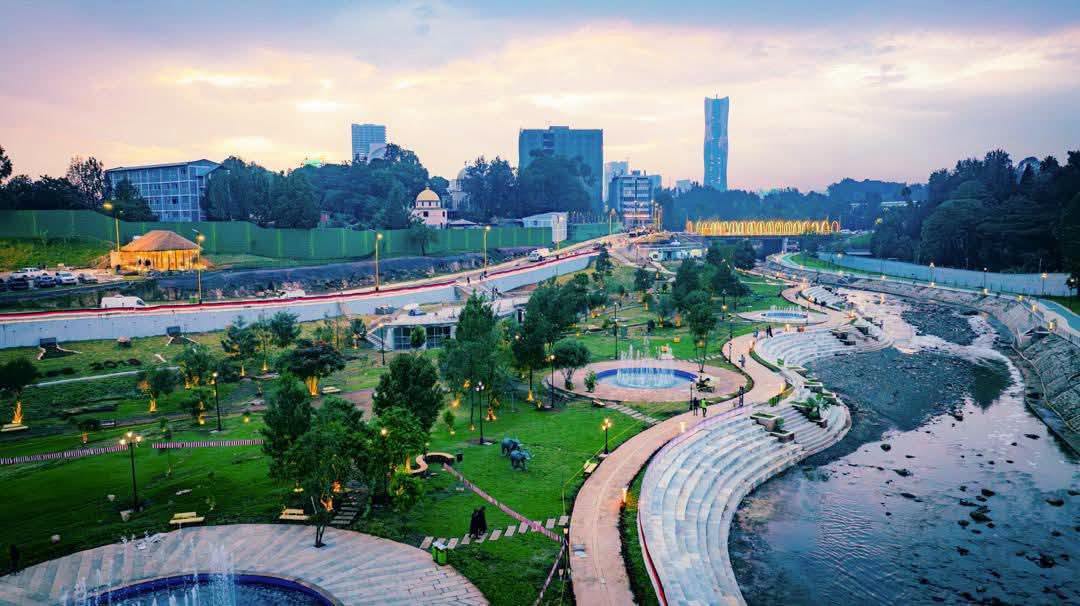
That shift is part of a wider urban renewal taking shape across Addis Ababa. The capital’s corridor development is reshaping major stretches of the city through improved mobility, pedestrian-friendly spaces, greenery, upgraded infrastructure and more organized public environments.
The significance of these projects lies not only in what they add to the physical appearance of the capital, but in how they connect different dimensions of urban life—movement, public space, environmental management, economic activity and the everyday experience of residents.
Together, these changes are giving Addis Ababa a new urban rhythm.
Cleaner surroundings complement renewed corridors; greener public spaces complement improved mobility; and better waste management reinforces the ambition to make the capital more livable and attractive.
Rather than isolated interventions, they are increasingly becoming threads of the same larger urban tapestry.
For Addis Ababa, the stakes extend well beyond its municipal boundaries. The city is the seat of the African Union and the United Nations Economic Commission for Africa and has long served as one of the continent’s foremost diplomatic crossroads.
Presidents, prime ministers, diplomats, international organizations, investors and visitors from across Africa and the wider world encounter Ethiopia through its capital. Its streets and public spaces consequently form part of the country’s image before the international community.
This makes the city’s physical transformation particularly significant.
A capital with continental diplomatic importance requires an urban environment capable of reflecting that stature—not merely through landmark buildings, but through the quality of its infrastructure, public spaces, mobility systems, environmental management and services.
The emerging waste-to-resource model also introduces an important economic dimension.
Compost production supports urban agriculture, resource recovery creates productive activity, and the participation of organized groups expands employment opportunities.
What begins as an environmental challenge can therefore travel through several stages—collection, processing, recovery and production—before emerging as an economic asset.
In that sense, Addis Ababa’s transformation is not simply about making a large and rapidly evolving metropolis cleaner.
It is about changing the relationship between the city and the materials it produces, the spaces its people share and the infrastructure that holds urban life together.
The progress has contributed to the capital’s growing appeal to both domestic and international visitors, while reinforcing efforts to position Addis Ababa among Africa’s cleaner and more attractive urban centers.
The city has also received recognition in African clean-city rankings, adding another dimension to an urban transformation increasingly visible to those who live in and visit it.
Yet the deeper story lies beneath the visible polish. A cleaner street is the final expression of systems working behind it; a greener corridor reflects decisions about how people should experience their city; and a converted waste stream represents an economic idea as much as an environmental one.
For Addis Ababa, the ambition is therefore larger than tidiness. It is the construction of a capital in which environmental responsibility, economic opportunity, modern infrastructure and public life reinforce one another.
The city is gradually turning the things it once had to manage into assets it can build upon.
And that may be the most revealing sign of its urban renewal: the capital is learning to see value where it once saw waste, and opportunity where it once saw only urban burden.