
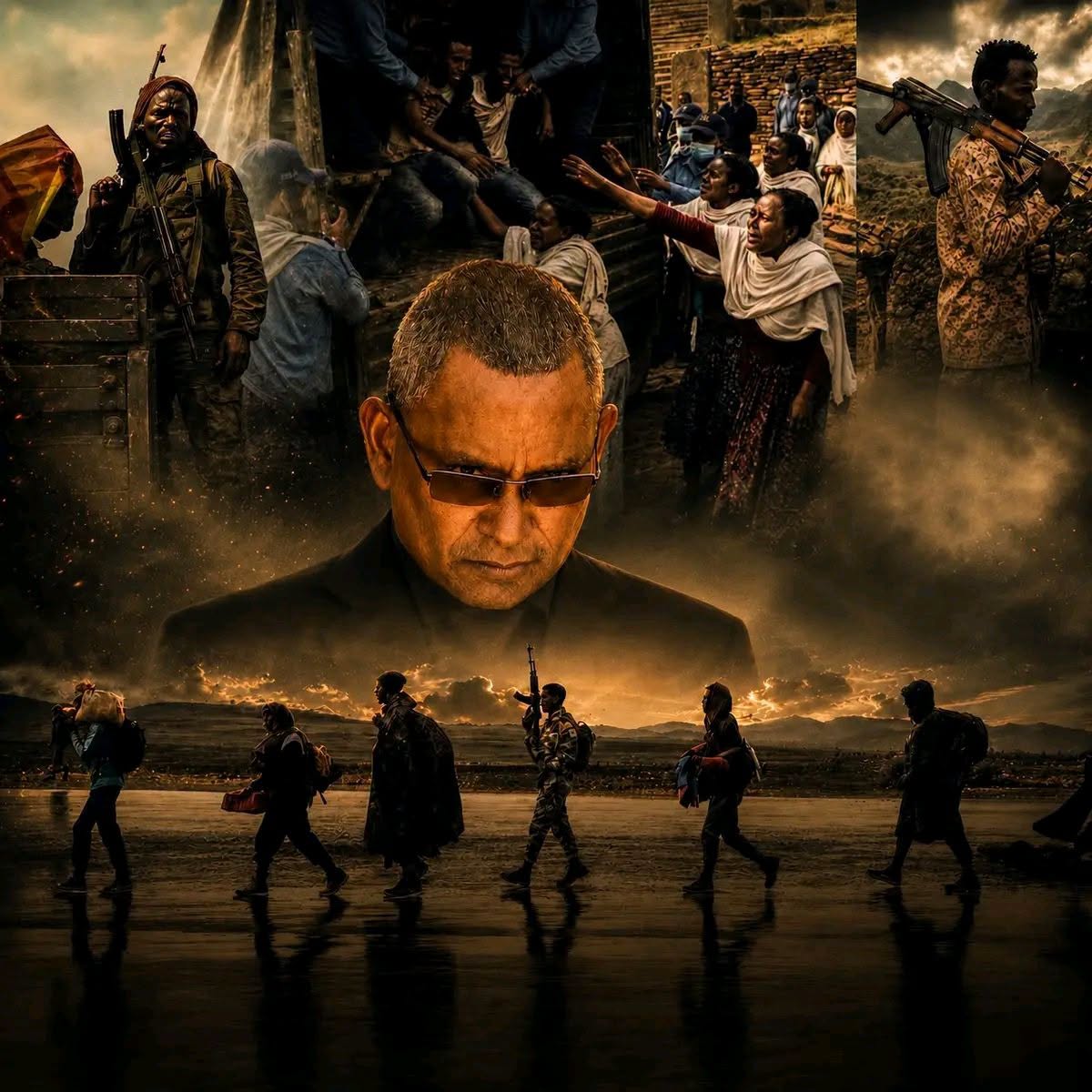
From Insurgency to Power, War and Rebellion: The Long Arc of the TPLF’s Political Survival
Addis Ababa, August 20, 2026 (FMC) — A political organization that began nearly five decades ago as an armed insurgency against Ethiopia’s Derg regime eventually rose to dominate the country’s political system for 27 years, lost federal power in the 2018 political transition, retreated to Mekelle, launched a devastating war against the federal government in 2020, and later received a renewed political opening when the Ethiopian Parliament removed its terrorist designation as part of a broader effort to advance peace.
Yet the organization’s subsequent conduct has again raised fundamental questions about whether it has truly broken with the political methods that have defined much of its history.
The Tigray People’s Liberation Front (TPLF), now a defunct, deregistered and outlawed organization, has traversed an extraordinary arc—from insurgency to state power, from entrenched rule to political retreat, and from renewed armed confrontation to a post-war struggle for political relevance.
Its history is therefore not simply a story of political transformation. It is also a record of how an organization repeatedly placed power, political survival and confrontation at the center of its strategy.
From its formative years, the organization pursued an armed struggle against the Derg and developed a political outlook that placed particular emphasis on Tigrayan identity and regional political interests.
Former TPLF founding member Dr. Aregawi Berhe, in his book A Political History of the Tigray People’s Liberation Front, has documented the organization’s early ideological trajectory, including positions articulated in its 1968 Ethiopian calendar manifesto.
That ideological orientation would later become deeply consequential for Ethiopia’s political order.
Following the overthrow of the Derg in 1991, the TPLF became the dominant force within the Ethiopian People’s Revolutionary Democratic Front (EPRDF), the coalition that governed Ethiopia for the next 27 years.
What followed was not merely a period of political administration. It was an era in which the TPLF exercised disproportionate political power over the Ethiopian state through the EPRDF structure, while critics and former members repeatedly pointed to authoritarian governance, political repression and a system that entrenched political control rather than building broad national consensus.
The organization’s influence extended far beyond Tigray. It became a central pillar of the political system, shaping national security, economic policy and the institutions of government.
Yet the same system eventually became the target of growing public resistance.
The 2018 political transition ended the TPLF’s dominance at the federal level. Rather than adapting to the new political reality as one actor within a changing national order, the organization retreated to Mekelle and increasingly positioned itself in confrontation with the federal government.
The confrontation ultimately crossed the line from political dispute to armed conflict.
In November 2020, TPLF forces attacked the Ethiopian National Defense Force’s Northern Command, turning an escalating political crisis into full-scale war. The attack struck at a federal military command entrusted with protecting Ethiopia’s territorial integrity and national security.
It was a decisive moment: an organization that had once exercised enormous influence over the Ethiopian state had chosen armed confrontation with that same state after losing its dominant political position.
The Ethiopian Parliament subsequently designated the TPLF as a terrorist organization.
That designation, however, did not become the final word.
The Ethiopian government demonstrated its unwavering commitment to lasting peace by implementing the Pretoria Cessation of Hostilities Agreement and repeatedly taking concrete steps to advance reconciliation, stability and development in Tigray and across the country. Parliament subsequently removed the TPLF from the terrorist designation list, opening a path for the region to move beyond war and for political actors to return to peaceful engagement.
The gesture was more than a legal adjustment.
It represented a political opening: a chance for the region to move beyond war and for political actors to return to peaceful engagement.
But the TPLF did not use that opening to establish an enduring political reset.
Instead, the organization continued to undermine the post-Pretoria political framework and sought to reassert its authority in Tigray. It eventually toppled the legally established Tigray Interim Regional Administration, further destabilizing the political order that the peace process was intended to preserve.
Its actions have also been linked to renewed regional military tensions and cooperation with external armed actors, including Eritrean forces, while armed movements and confrontations from areas along the Sudan border and elsewhere have added to fears of another descent into conflict.
The organization’s political status also underwent another decisive transformation for a different reason.
The TPLF ceased to exist as a legally registered political party after repeatedly failing to fulfill the legal requirements and obligations set by the Ethiopian National Election Board. Despite repeated requests from the Board to comply with the requirements governing registered political parties, the organization refused to fulfill its obligations. The Board was consequently compelled to deregister the party.
Its present status, therefore, is not simply a matter of political description. The organization is defunct because it failed to meet the legal requirements governing its continued registration as a political party.
That distinction matters.
The organization that once commanded the machinery of the Ethiopian state for nearly three decades no longer possesses the legal status of a registered political party. Its political decline has thus unfolded on two fronts: the loss of its federal power and, subsequently, the loss of its legal standing as a political organization.
The pattern is difficult to ignore.
When political power was available, the organization exercised it through a highly centralized system. When that dominance was challenged, it retreated to its regional stronghold. When political confrontation escalated, it turned to armed force.
When peace created an opportunity for political reintegration, the government opened a path back to peaceful politics. Yet the organization again became embroiled in confrontational politics, while ultimately forfeiting its legal registration by refusing to meet the requirements imposed on political parties.
This is the historical contradiction at the heart of the TPLF’s trajectory.
Its political narrative has often presented the organization as the defender of the people of Tigray. Yet its repeated resort to confrontation has imposed some of the heaviest costs on the very population it claims to represent.
Former TPLF founding member Dr. Gebru Asrat has also spoken about what he describes as the organization’s current use of fear and intimidation in Tigray, including the detention and persecution of women, young people and elderly citizens.
Such accounts point to another transformation: an organization that once justified armed struggle in the name of liberation is now facing criticism from figures who were themselves part of its founding generation over the methods it continues to employ.
The contradiction becomes even sharper when viewed against the organization’s 27 years of national dominance.
Rather than using state power to build an inclusive national political order, the organization’s rule entrenched a political system that critics argue deepened ethnic and linguistic divisions and weakened the foundations of national cohesion.
The result was a political architecture in which identity became an increasingly powerful instrument of political mobilization, while competing visions of Ethiopian statehood struggled for space.
That legacy continues to shape the country’s political landscape.
The TPLF’s story, therefore, cannot be reduced to the events of 2020 or to the post-Pretoria period. Its current conduct has to be understood against the longer history of an organization that spent decades moving between armed struggle, political domination and confrontation.
The organization’s own trajectory provides the chronology.
It began with armed insurgency.
It rose to become the dominant force within a government that ruled Ethiopia for 27 years.
It lost federal power.
It retreated to Mekelle.
It launched a war against the federal government.
It was designated a terrorist organization.
It was given a path back through a peace process that sought to end the war and restore political stability.
It then undermined the political arrangements created by that process.
And when it was repeatedly required to fulfill its legal obligations as a registered political party, it refused to comply, forcing the National Election Board to deregister it.
That history makes the current victimhood narrative increasingly difficult to reconcile with the organization’s own record.
An organization cannot repeatedly return to confrontation and then expect the consequences of that confrontation to disappear behind a carefully constructed narrative of victimhood.
Nor can international audiences fully understand the current crisis by examining only the latest episode while ignoring the decades of political evolution that preceded it.
The people of Tigray deserve something fundamentally different from another cycle of mobilization, militarization and political confrontation.
They deserve peace that is not merely a pause between wars. They deserve institutions that represent them without coercion, development that is not held hostage to political rivalry, and a political environment in which disagreements are settled through institutions rather than armed formations.
For Ethiopia as a whole, the lesson is equally clear.
A country cannot build durable peace while political organizations treat armed force as a fallback whenever they lose political influence. Nor can national cohesion be strengthened when political competition repeatedly turns identity and regional grievances into instruments of confrontation.
The TPLF’s nearly five-decade trajectory offers a stark illustration of the consequences.
Its history began with a rebellion against state power. It ended up controlling that state for 27 years. It then fought the state it once helped shape, was designated a terrorist organization, received a political opening through a peace process, subsequently returned to a confrontational path, and ultimately lost its legal status as a registered political party after refusing to fulfill the obligations required to maintain that status.
The question now is not merely what the TPLF was.
It is whether the political culture it represented can ever become something fundamentally different.
For Ethiopia, and particularly for the people of Tigray, the answer cannot be another cycle of armed politics. It must be a decisive break with the logic that political survival requires perpetual confrontation.
The country’s future depends on replacing that logic with national cohesion, constitutional politics, peaceful political competition and an unwavering commitment to sovereignty and development.
The past five decades have shown where the politics of armed confrontation can lead.
Ethiopia cannot afford to repeat the cycle.