
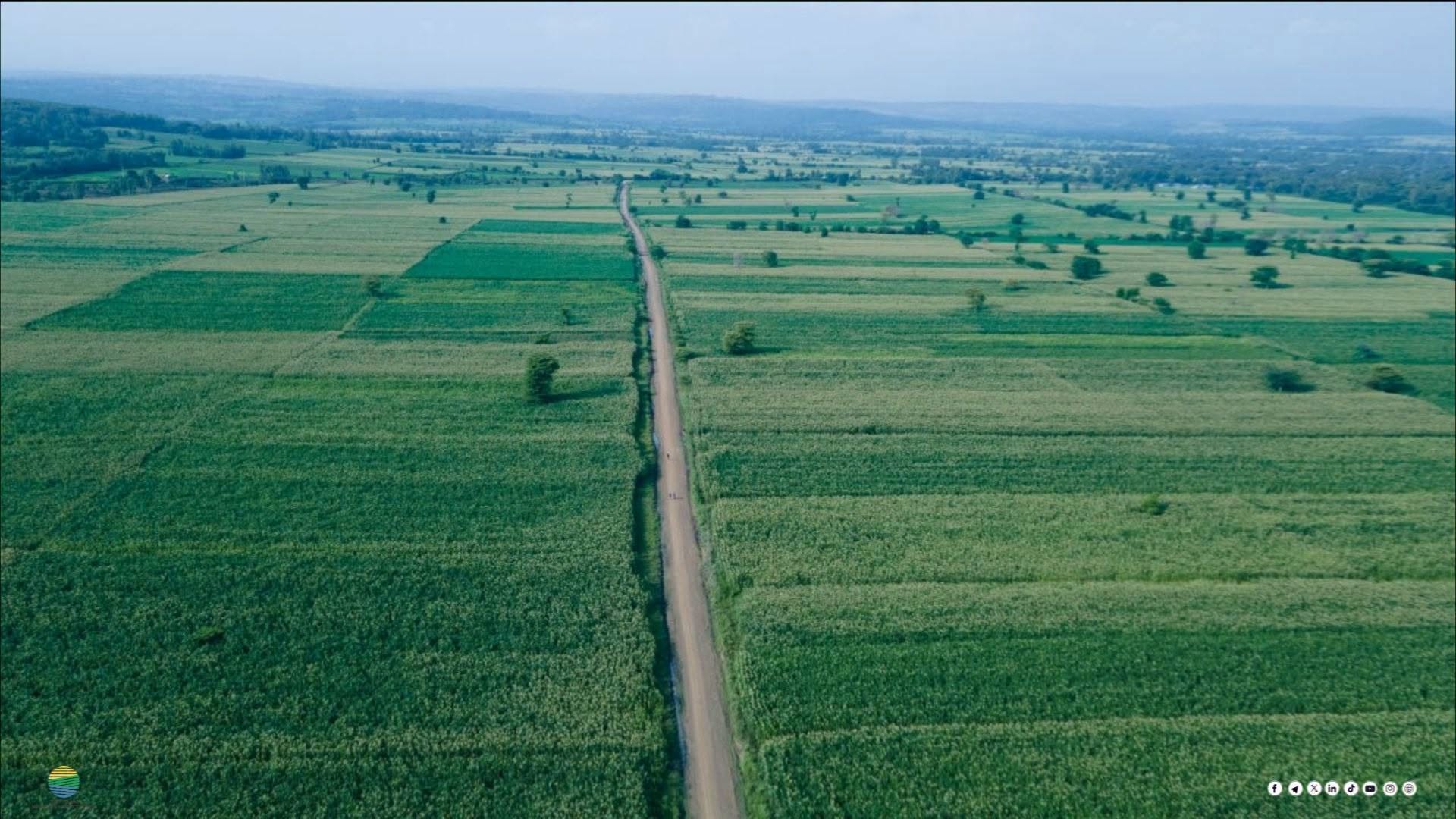
Ethiopia’s Fields Are Becoming a Laboratory for Africa’s Next Agricultural Revolution
Addis Ababa, September 21, 2026 (FMC) — Some agricultural transformations are measured in harvests. Others are measured in the number of assumptions they force an entire sector to reconsider.
Across Ethiopia, an increasingly important experiment has been unfolding not inside a single research station or demonstration plot, but across millions of hectares: what happens when improved varieties, irrigation, mechanization, cluster farming, extension systems, climate information and new production practices are taken from the laboratory and pushed toward national scale?
The answer is beginning to reshape the country’s agricultural trajectory—and to attract attention well beyond its borders.
The transformation is particularly visible in wheat. Ethiopia’s rapid expansion of irrigated wheat production brought together several elements that are often treated separately in agricultural development: heat-tolerant varieties, irrigation, improved agronomic practices, organized production, research, extension and market linkages. By 2023, heat-tolerant irrigated wheat production had reached about one million hectares, with average productivity of around four tonnes per hectare, according to research documented through the FAO agricultural knowledge platform. The approach was identified as having potential relevance for wider African food-security efforts.
That is what makes the Ethiopian experience more consequential than a single crop story.
The country has increasingly been using agriculture as a field for systems integration—bringing technologies, institutions and production models together and testing what happens when they operate at scale.
Cluster farming is one such experiment. Rather than leaving millions of smallholders to confront modern agricultural markets and technologies individually, production is increasingly organized around coordinated areas and common production practices. Ethiopia says its cluster-farming system now involves about 9.5 million farmers cultivating 12.8 million hectares, with reported gains in productivity and farmer incomes.
Irrigation represents another major shift.
For generations, much of Ethiopian agriculture has been tied closely to the rhythm of seasonal rainfall. Expanding irrigation changes that equation by allowing farmers to manage water rather than simply wait for it. It can create additional production seasons, diversify crops and reduce exposure to erratic rainfall. The World Bank has identified irrigation as a central pathway for increasing agricultural productivity and strengthening food security in Ethiopia, including through multiple cropping seasons and greater production of diverse and drought-resistant crops.
The significance is not simply that more land is being irrigated.
It is that the production calendar itself can be redesigned.
The same logic extends to seeds. Improved varieties adapted to different agro-ecological conditions—including heat-tolerant wheat—are allowing production systems to move into environments once considered considerably more difficult. Research on Ethiopia’s irrigated wheat expansion has highlighted the role of improved varieties, cluster farming, research institutions, extension services and private-sector actors in bringing these technologies together at scale.
Mechanization adds another layer.
Agricultural modernization cannot be reduced to putting tractors into fields. It involves changing the economics and timing of land preparation, planting, harvesting, threshing, transport and post-harvest handling. Ethiopia’s agricultural development priorities explicitly include expanding mechanization alongside irrigation, horticulture, private-sector participation and institutional capacity.
And increasingly, the experiment is becoming digital.
Weather and climate information, for example, can become a production input in its own right. Research involving Ethiopian farming households found that access to weather and climate services was associated with productivity increases of 27 percent for maize and 17 percent for wheat, underscoring the potential value of information alongside physical inputs such as fertilizer and improved seed.
Taken together, these developments point toward a different understanding of agricultural innovation.
The important question is no longer only whether Ethiopia can produce a better seed, introduce a new machine, expand irrigation or teach a better farming technique. The larger question is whether these components can be assembled into a functioning production system and reproduced at national scale.
That is where Ethiopia’s agricultural experience becomes potentially continental in significance.
Africa does not lack agricultural potential. It has land, water, diverse agro-ecologies, a vast farming population and enormous domestic and regional markets. What has often been missing is the capacity to convert those assets consistently into productivity, reliable supply, commercial value and food-system resilience.
Ethiopia’s ongoing experiment is therefore less about discovering one magical agricultural solution than about testing how several solutions can work together.
Its emerging model is built around a simple but powerful proposition: productivity can be engineered.
Water can be managed. Production seasons can be extended. Varieties can be adapted. Farms can be organized. Information can reach farmers. Machinery can reduce bottlenecks. Research can feed directly into production. Markets can pull output through the value chain.
None of these changes eliminates the country’s agricultural challenges. Ethiopia still faces droughts, floods, pests, conflict-related disruptions, market constraints and serious food-security problems in vulnerable areas. FAO continues to report significant food-security pressures, particularly in pastoral regions affected by climatic and economic shocks.
But precisely because the challenges remain, the scale of the agricultural experiment matters.
Ethiopia is testing whether a predominantly smallholder agricultural economy can progressively move from vulnerability toward greater productivity, diversification and resilience without waiting for every constraint to disappear first.
That makes the Ethiopian countryside something more than the traditional backdrop to a national development story.
It is becoming a living testing ground for African agricultural transformation.
The most consequential harvest may therefore not be measured only in tonnes of wheat, maize, coffee or other crops. It may be measured in knowledge: which technologies work in which environments, which production systems can scale, which institutional arrangements improve farmer productivity, and which combinations can turn Africa’s enormous agricultural potential into dependable food and economic capacity.
If those lessons can travel—from Ethiopia’s irrigated lowlands to other African production zones, from research institutions to farmers, and from individual crops to entire food systems—the experiment taking place in Ethiopian fields could ultimately become part of something much larger.
Not simply an agricultural transformation in one country.
A laboratory for the continent.