
From Arsenal to Intelligence: Ethiopia’s Rise in Military Technology, Intelligence and Indigenous Capability
Addis Ababa, September 22, 2026 (FMC) — Across the world, the foundations of military power are being reshaped by technologies that have narrowed the distance between the factory, the laboratory and the battlefield—making industrial capacity, intelligence, research and technological expertise increasingly inseparable from the strength of national defence.
The decisive advantage in the conflicts of the twenty-first century is no longer determined by hardware alone. It increasingly depends on who can design, adapt, manufacture, maintain and continuously improve the technologies that shape the modern battlespace—from unmanned systems and advanced engineering to artificial intelligence, cyber capabilities, electronic warfare and data-driven intelligence.
Ethiopia is positioning its defence transformation within that wider shift.
The country is not beginning with the creation of a defence industry from scratch. It is building on an established industrial base while undertaking reforms that are expanding its technological depth, manufacturing capacity, research capability and ability to develop systems domestically. The emerging direction is a move from producing essential military equipment toward cultivating the knowledge, engineering and technological ecosystem behind increasingly sophisticated defence capability.
That transition is already visible across several fronts.
At the centre is a stronger emphasis on indigenous production. Ethiopia’s Homicho Ammunition Engineering Complex has expanded its manufacturing capacity to produce a broad range of munitions, while the country has also begun exporting ammunition. In March 2025, Prime Minister Abiy Ahmed said Ethiopia had secured ammunition export contracts worth more than 30 million US dollars over a three-month period, underscoring how domestic defence production is increasingly being linked to industrial capability and external markets.
The significance extends beyond ammunition.
Ethiopia has also moved into the domestic production of unmanned aerial vehicles. SkyWin Aeronautics Industries, inaugurated in 2025, manufactures UAVs for civilian and military applications. The establishment of such production capacity has brought drone development into the country’s broader pursuit of technological self-reliance, with an emphasis on locally developed systems and continued research into smart sensor technologies.
The Ethiopian Air Force illustrates how far the transformation is reaching.
Over recent years, the Air Force has expanded capabilities in aircraft maintenance, upgrading, spare-parts production and unmanned aircraft manufacturing, while moving from predominantly analogue systems toward digital technologies. Its leadership has also reported a significant expansion in production, with locally manufactured components and spare parts being produced at substantially larger volumes than previously possible. The resulting capabilities are increasingly supporting technical cooperation with other African countries in areas including training, aircraft and helicopter maintenance and technology transfer.
This is where defence industry begins to acquire a broader strategic meaning.
A country that can maintain and upgrade its systems locally is less dependent on external supply chains. A country that can manufacture components develops engineering knowledge. A country that can design unmanned systems develops expertise in software, electronics, sensors and automation. And a country that connects these capabilities with research institutions begins to accumulate technological depth that can extend well beyond the defence sector.
Ethiopia’s reforms are increasingly attempting to build that depth.
The establishment of the Defence Engineering Industry Group under Council of Ministers Regulation No. 567/2025 provides an institutional framework for the defence engineering sector. At the same time, defence research and development has been given greater prominence, with work on a national defence R&D framework incorporating artificial intelligence and emerging trends in cyber and technological warfare and encouraging stronger links between military institutions and academic research.
The next layer is intelligence.
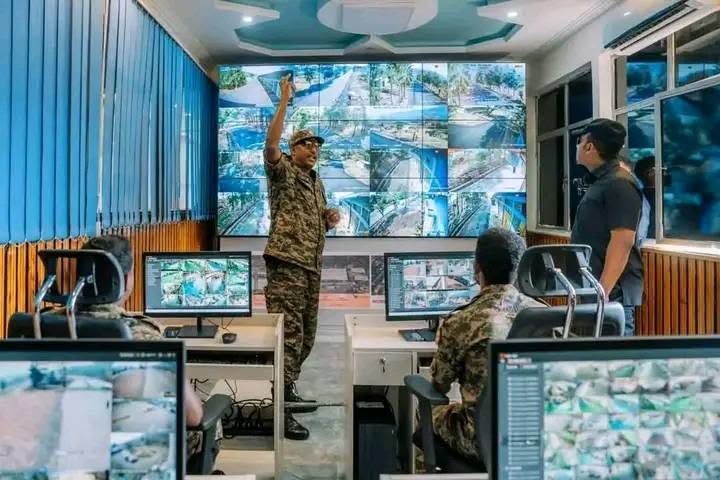
The modern defence establishment operates in an environment in which information can be as consequential as physical equipment. Detecting threats, processing vast quantities of information, securing communications and networks, understanding electronic activity and converting data into timely decisions increasingly require sophisticated digital and analytical capabilities.
That is bringing artificial intelligence directly into Ethiopia’s defence transformation.
In August 2026, the Ethiopian National Defence Force and the Ethiopian Artificial Intelligence Institute signed an agreement focused on applying AI to areas including logistics, training, cybersecurity, military healthcare, air-force operations and electronic warfare. The agreement reflects an effort to move AI from a civilian technology field into a component of national defence capability.
The technological ecosystem supporting that ambition is also expanding.
The Ethiopian Defence University inaugurated an Advanced Central Laboratory in July 2026 with specialized facilities covering cybersecurity, artificial intelligence, communications, automation, 3D printing, CNC machining and prototyping. The facility is designed to connect academic knowledge with practical applications in national security, technology and industry.
Taken together, these developments point to a different conception of defence strength.
The modern military professional is increasingly required to understand not only tactics and command, but also data, networks, autonomous systems, cyber operations, engineering and emerging technologies. The modern defence institution must therefore be connected to universities, laboratories, engineers, scientists, programmers and manufacturers.
That is the deeper significance of Ethiopia’s defence reforms.
They are widening the meaning of self-reliance—from the ability to supply a force with essential equipment toward the ability to generate more of the knowledge, technology and industrial capacity required to sustain and advance that force.
The implications are also continental.
Africa’s security environment is increasingly shaped by technologies whose development and control have traditionally been concentrated outside the continent. Building indigenous capacity in military engineering, unmanned systems, cybersecurity, maintenance, research and technological adaptation therefore carries significance beyond national borders. Ethiopia’s expanding technical cooperation with other African countries—including training, maintenance, repair and technology transfer—shows how domestic capability can become a platform for wider continental cooperation.
That direction is also reflected in Ethiopia’s defence-technology diplomacy. In 2026, Ethiopia and Liberia agreed to deepen cooperation in military industry, technology transfer and training, explicitly linking defence cooperation with a broader African effort to strengthen continental capacity in security and defence.
The objective, therefore, is larger than replacing imported equipment with locally manufactured alternatives.
It is about moving further up the technological value chain.
Manufacturing creates industrial experience. Engineering creates problem-solving capacity. Research creates knowledge. Digital systems create information advantage. Cybersecurity protects the technological environment. Artificial intelligence expands the ability to analyse and respond. Unmanned systems bring software, electronics and autonomy into the operational domain.
When these capabilities begin to reinforce one another, defence industry becomes part of a country’s wider technological architecture.
That is the trajectory now visible in Ethiopia.
The country’s defence establishment is seeking to turn existing production capacity into deeper indigenous capability; to connect military manufacturing with engineering and research; to move further into unmanned and digital technologies; and to develop the human capital required to operate at the increasingly sophisticated intersection of defence and technology.
The journey is neither complete nor simple. Advanced military technology demands sustained research, skilled personnel, industrial supply chains, investment and continuous innovation. But the direction of reform is increasingly clear.
Ethiopia is moving from a model centred primarily on acquiring and maintaining military capability toward one that places greater emphasis on creating, adapting and sustaining capability at home.
In that transition lies the larger story.
For Ethiopia, indigenous defence technology is becoming not merely a question of military supply, but of technological sovereignty, industrial competence and strategic resilience.
For Africa, it points toward the possibility of a security architecture in which more of the continent’s critical technologies can be understood, developed, maintained and produced within the continent itself.
And in a world where technological capability is rapidly becoming inseparable from strategic power, the distance between an arsenal and an intelligence-driven defence establishment is no longer measured simply in weapons.
It is measured in knowledge.
Ethiopia is building that knowledge into capability.