
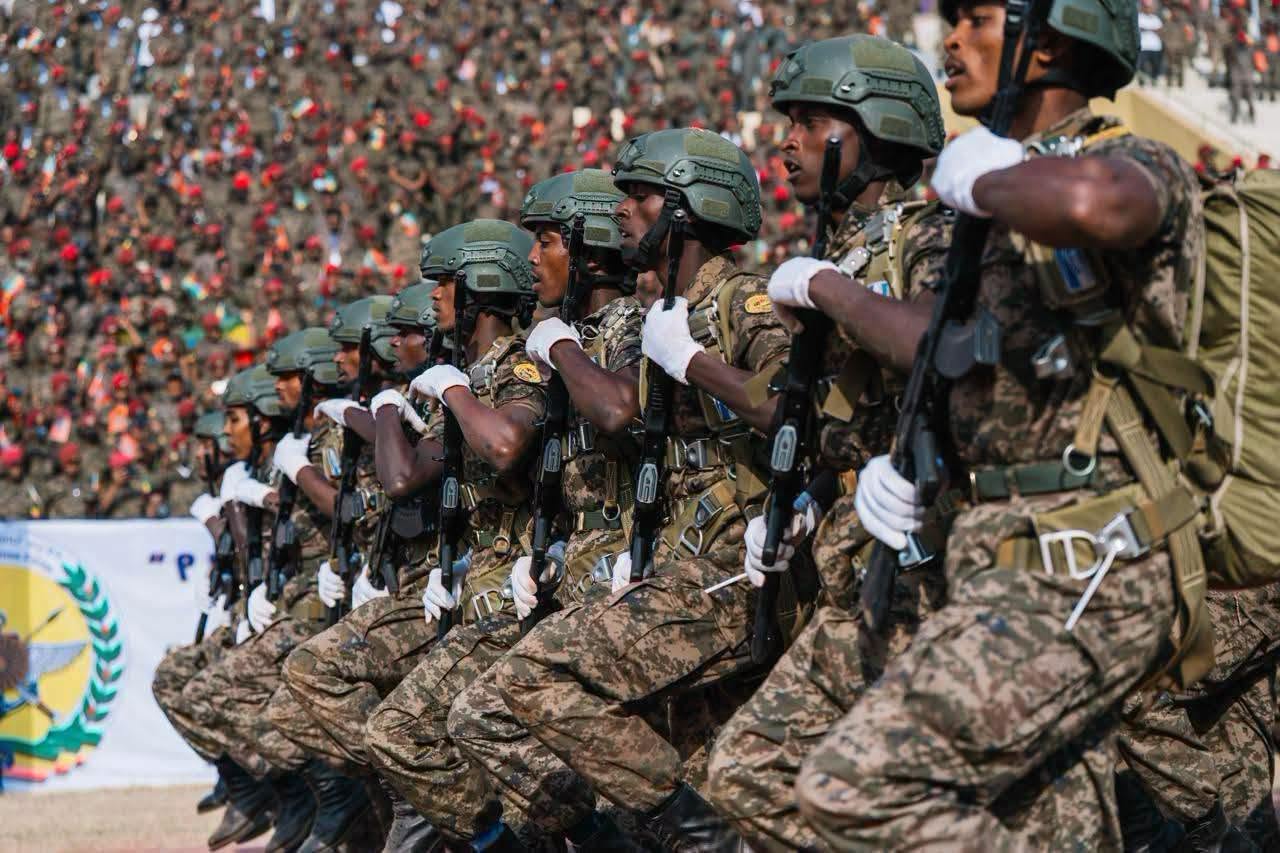
From Historic Might to Modern Power: Ethiopia’s Defence Transformation
Addis Ababa, September 28, 2026 (FMC) — There are moments in a nation’s history when preserving strength is no longer enough; strength itself must evolve.
For Ethiopia, whose military tradition is deeply woven into the history of its sovereignty, independence and national identity, the challenge in recent years has been to carry that legacy into a battlefield being transformed by technology, information and intelligence.
That transformation is now taking shape.
Over the past eight years, Ethiopia’s defence sector has undergone a broad restructuring aimed at building a more professional, unified, technologically capable and operationally ready force. The objective has increasingly moved beyond expanding hardware to strengthening the institutions, skills, systems and domestic capabilities that turn technology into effective national defence.
The result is a defence force being prepared for a fundamentally different era.
The modern battlefield is no longer defined by manpower and conventional weapons alone. Information, precision, cyber capabilities, electronic warfare, unmanned systems, artificial intelligence and rapid decision-making increasingly determine military effectiveness. Ethiopia’s defence modernization is responding to that changing reality.
One of the clearest signs of this shift is the growing place of artificial intelligence.
In August, the Ethiopian National Defence Force signed a cooperation agreement with the Ethiopian Artificial Intelligence Institute to explore AI applications in logistics, training, cybersecurity, military healthcare, air operations and electronic warfare. The move signals a transition in which advanced technology is becoming part of the institutional architecture of defence rather than remaining an external tool.
Unmanned technology is opening another frontier.
The development of domestic drone capability and the establishment of a Drone Technology Center through cooperation between the Information Network Security Administration and the Ethiopian Air Force are connecting research, engineering, innovation and defence requirements. Such initiatives point toward a longer-term ambition: developing technological capability at home, from research and human capital to production and deployment.
The transformation also reaches into the country’s air power.
Ethiopia has outlined a five-year roadmap for expanding Air Force capability and moving toward more advanced combat technologies, while emphasizing that sophisticated platforms must be matched by highly trained pilots, engineers, technicians and commanders.
The message is increasingly clear: modern defence is as much about knowledge and precision as it is about equipment.
That principle is visible across the wider force.
Military education and specialized training are being aligned with emerging technologies and contemporary operational requirements, while reforms have sought to strengthen organizational structures, readiness, professionalism and coordination.
Special Operations Command, for example, has been reorganized through the integration of airborne, commando and special anti-terrorist capabilities, reflecting a move toward more specialized and coordinated formations.
At the same time, Ethiopia is seeking to strengthen the industrial foundation beneath its defence capability.
Domestic production of defence equipment and ammunition, together with work in drones, research and technology, is intended to expand indigenous capacity and reduce dependence on external supply chains.
This is a critical dimension of modern defence: the ability not only to acquire capability, but increasingly to maintain, adapt and develop it.
For Ethiopia, the significance extends beyond the military sphere.
A defence system that can learn, innovate and sustain itself strengthens the resilience of the state as a whole.
It protects the infrastructure, institutions and economic gains upon which development depends, while creating demand for advanced skills in engineering, aviation, computing, electronics, artificial intelligence and other fields.
The transformation also carries a regional dimension.
Ethiopia has for decades contributed personnel to international peacekeeping, and its defence institutions remain part of the wider African security architecture. As the Horn of Africa faces interconnected security challenges, the modernization of Ethiopia’s defence capabilities adds another dimension to its regional role.
Recent regional discussions have continued to emphasize collective approaches to peace, security and resilience across the Horn.
Yet perhaps the most important feature of this transformation is the continuity beneath the change.
The Ethiopia of today is not abandoning the military tradition inherited from earlier generations. It is attempting to equip that tradition for a world in which the character of conflict has changed dramatically.
The courage of the soldier now meets the precision of the engineer. Experience meets data. Training meets simulation. Aviation meets artificial intelligence. The battlefield of the future increasingly belongs to those who can connect human judgment with technological intelligence.
That is where Ethiopia’s defence transformation is heading.
The next five years will place greater emphasis on advanced technology, indigenous defence production, specialized human capital, research and innovation, and the continued modernization of land, air, cyber and maritime capabilities. The direction is toward a force that can continuously learn and adapt as technology itself moves forward.
The history remains the foundation.
But history alone cannot defend the future.
Ethiopia’s long military legacy is now being carried into a new age—one in which national strength is increasingly measured not only by what a country possesses, but by what it can learn, build, innovate and sustain.
From historic might to modern power, Ethiopia’s defence transformation is, at its core, a story of renewal: an enduring national tradition being reshaped to meet the demands of the technological age.