
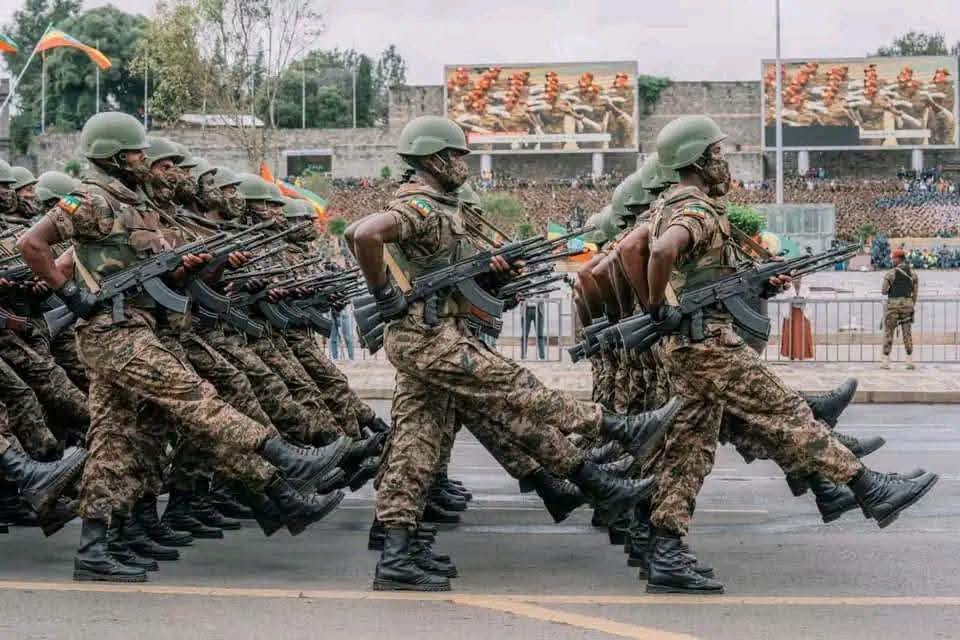
Ethiopia’s Defence Force Rises Above Regional Threats, Anchoring National Power
Addis Ababa, October 4, 2026 (FMC) — National interest is the central thread binding a state’s survival, sovereignty, security and prosperity.
It is the foundation upon which a nation protects its independence, drives economic growth and advances its diplomatic interests.
But national interest cannot be safeguarded by declarations alone. It requires an organized national effort, a determined state structure and a capable defence institution equipped with trained personnel, modern technology and the means to respond to the threats of its time.
For Ethiopia, whose ambitions extend beyond its own borders toward becoming an economic force in Africa and a pillar of peace and stability, the protection of national interest has become inseparable from the development of credible national capabilities.
At the centre of that effort stands the Ethiopian National Defense Force.
Among the country’s strategic priorities, securing sustainable access to the sea has emerged as one of the defining national interests of the present generation.
It is not simply a political question or a matter of geography. It is tied to Ethiopia’s long-term peace, economic development, national security and capacity to play a greater role in regional stability.
That makes the ability to protect national interests equally consequential.
Ethiopia has therefore been strengthening its defence institution in response to a rapidly shifting geopolitical environment, investing in trained human capital, technology and modern military capabilities to create a reliable foundation for safeguarding the country’s sovereignty, national survival and strategic interests.
The transformation goes beyond numbers.
A modern military cannot measure its strength by the size of its ranks alone. Ethiopia’s defence-building effort is increasingly focused on creating a force that combines intellectual capacity, physical readiness, professional discipline and strategic understanding.
The emphasis is increasingly on officers and combat personnel grounded not only in battlefield tactics but also in military science and strategic knowledge.
The Defense University and various military academies are playing a central role in this process, providing training in leadership, the laws governing armed conflict and advanced military sciences. The objective is to cultivate a force capable of fulfilling its national mission with greater discipline, professionalism and effectiveness under demanding conditions.
This shift from numerical strength toward quality, knowledge and preparedness represents a fundamental change in the character of military capability.
The same transformation is taking place in the technological domain.
In twenty-first-century warfare, information can determine the outcome of an operation long before conventional firepower is brought to bear. The ability to gather, process, protect and act upon information has consequently become a critical dimension of military power.
Ethiopia’s defence institution has been advancing its technological capabilities in areas including cybersecurity, artificial intelligence and digital communications, reflecting an understanding that the modern battlefield extends far beyond physical terrain.
The integration of satellite and radio communication technologies across land, air and maritime capabilities is strengthening the exchange of information and supporting more coordinated operations. The ability to monitor developments in real time and transmit strategic decisions rapidly is becoming an increasingly important component of operational effectiveness.
Technology, however, is only as powerful as the institution capable of using it.
This is why Ethiopia’s investment in human capital, military education and technological capability is being matched by efforts to strengthen its operational readiness and modernize its military equipment.
The force has expanded its access to modern combat capabilities across land and air domains, including advanced fighter aircraft, unmanned aerial systems, heavy weapons, air-defence systems and modern armoured platforms.
These capabilities are intended not merely to increase the military’s arsenal, but to strengthen Ethiopia’s strategic position and create a credible capacity to deter threats before they reach the country’s territory.
Deterrence, after all, is most effective when national capability makes aggression an unattractive proposition.
The emerging Ethiopian defence architecture is consequently built around several mutually reinforcing pillars: professional human capital, advanced military education, technological transformation, modern equipment and increasingly integrated operational capabilities.
Together, these developments are reshaping the institution’s capacity to respond to a security environment that is itself becoming more complex.
Ethiopia’s defence force is consequently being positioned not simply to respond to threats after they emerge, but to anticipate changing security conditions and maintain the strategic balance necessary for the country to pursue its national interests.
Prime Minister Abiy Ahmed has repeatedly emphasized that the Ethiopian National Defense Force is not defined merely by the size of its personnel. Rather, he has underscored the importance of building a strategic force equipped with modern and sophisticated military capabilities capable of safeguarding Ethiopia’s national interests.
The broader vision is to connect the courage inherited from previous generations with the technology and knowledge of the present age, creating a reliable national force capable of protecting Ethiopia’s interests whenever and wherever the national mission demands.
This is ultimately the significance of Ethiopia’s military transformation.
The country is not seeking strength as an end in itself. It is building the capacity required to protect sovereignty, preserve peace, secure national interests and create the conditions in which development can proceed without external coercion.
A strong economy requires security. Development requires stability. Diplomacy carries greater weight when backed by national capability. And a country pursuing a larger role in Africa must possess the institutional strength to shoulder the responsibilities that come with that ambition.
The Ethiopian National Defense Force therefore occupies a position far beyond the traditional image of a military standing guard at the frontier.
It is increasingly becoming one of the institutional pillars supporting Ethiopia’s national resilience.
Day and night, its personnel carry a responsibility that extends from the protection of the country’s territorial integrity to the preservation of the peace and security upon which Ethiopia’s development depends.
The transformation underway is ultimately about turning national ambition into national capability.
For Ethiopia, sovereignty is not merely a constitutional principle. It is a responsibility that must be defended, sustained and made tangible through institutions capable of protecting the nation’s choices.
The Ethiopian National Defense Force is being built for precisely that purpose: to stand as a decisive shield of national interest in an increasingly unpredictable region, while giving Ethiopia the strategic confidence to pursue peace, development and its place in Africa on its own terms.