
From the Caribbean to Asia, Across Africa: The World Welcomes Ethiopia’s New Chapter with Messages of Hope, Partnership and Solidarity
Addis Ababa, October 8, 2026 (FMC) — From the Caribbean to Asia and from the heart of Africa to the shores of the Indian Ocean, messages arriving in Addis Ababa following Prime Minister Abiy Ahmed’s re-election have carried a strikingly broad geographic reach—and, beyond the formal congratulations, a range of references to Ethiopia’s development, partnerships, peace, regional cooperation and place within Africa’s wider future.
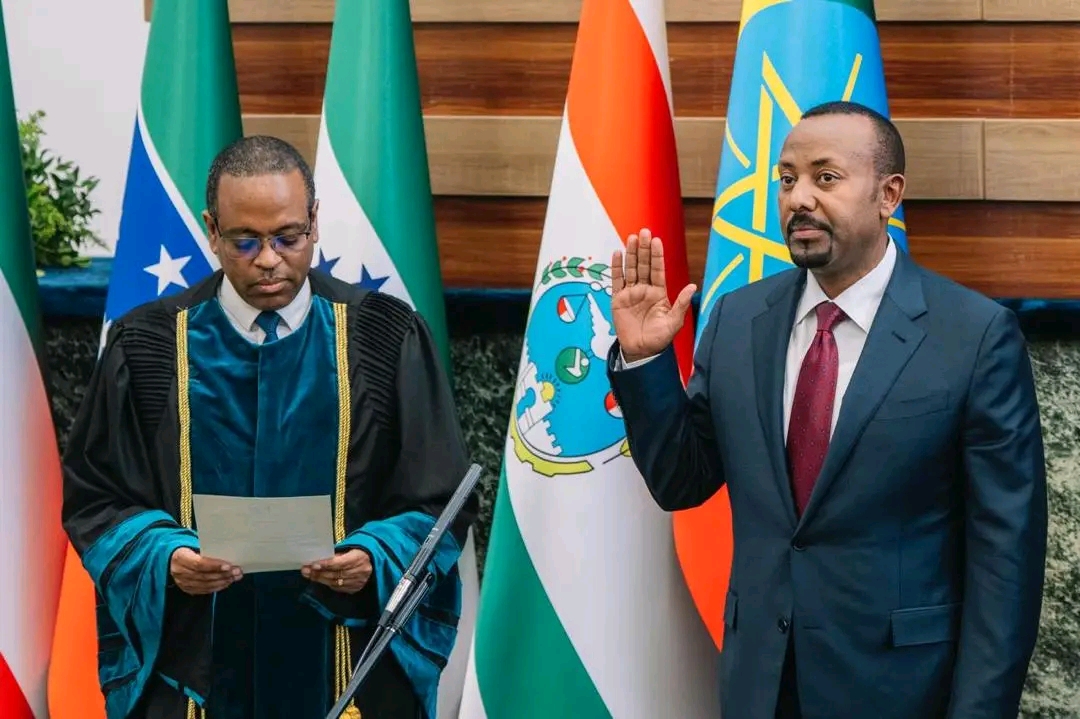
Ethiopia’s opening of its 7th parliamentary term on October 5, the re-election and swearing-in of Prime Minister Abiy Ahmed for another five-year term, and the formation of the new federal government have therefore been accompanied by a diplomatic chorus extending well beyond the country’s immediate neighborhood.
For Ethiopia, the messages offer more than ceremonial greetings. Taken together, they provide a window into how a new political chapter in Addis Ababa is being received across different regions and diplomatic settings, while placing Ethiopia’s domestic political transition within a broader African and international conversation.
At the continental level, the response has carried particular institutional weight.
African Union Commission Chairperson Mahmoud Ali Youssouf congratulated Prime Minister Abiy Ahmed on his re-election and placed Ethiopia’s new term within the wider continental agenda, pointing to the country’s special position as host of the AU headquarters and what he described as Africa’s diplomatic capital. He expressed readiness for continued cooperation with Ethiopia in advancing Africa’s integration, peace, security and development agenda.
Current AU Chairperson and President of Burundi Évariste Ndayishimiye likewise extended congratulations, expressing hope for the continued growth, unity and prosperity of the Ethiopian people and linking closer engagement with Ethiopia to sustainable peace, regional stability, stronger cooperation and shared economic development across Africa.
The significance of such messages lies partly in what they reveal about Ethiopia’s continental setting. Addis Ababa is not simply the seat of a national government beginning another five-year term. It is also home to the headquarters of the African Union and a longstanding center of continental diplomacy. The formation of a new government in Ethiopia consequently takes place within a political and diplomatic environment in which developments in the country intersect with wider African priorities.
That regional dimension is reflected in messages from neighboring and East African countries.
Kenyan President William Ruto described Prime Minister Abiy Ahmed’s renewed mandate as a vote of confidence in his leadership and vision for Ethiopia, while expressing Kenya’s interest in continued cooperation for the benefit of the two peoples, the region and the wider global community.
Tanzanian President Samia Suluhu Hassan highlighted the longstanding and deep fraternal ties between Tanzania and Ethiopia and expressed readiness to deepen cooperation for the benefit of their peoples and the African continent.
From neighboring Djibouti, President Ismaïl Omar Guelleh congratulated Prime Minister Abiy while specifically hailing Ethiopia’s economic rise and reaffirming the friendship and solidarity between the two “sister nations.”
The regional messages collectively bring development, economic progress, cooperation and stability into the diplomatic picture surrounding Ethiopia’s new political chapter. They also underline the extent to which Ethiopia’s trajectory is viewed through a regional lens, given its demographic weight, economic significance, diplomatic role and strategic position in the Horn of Africa.
The response has not been confined to Africa.
From the Caribbean, Jamaica’s Prime Minister Andrew Holness extended heartfelt congratulations to Prime Minister Abiy Ahmed and pointed to the longstanding friendship between Jamaica and Ethiopia. His message also recalled Ethiopia’s support for Jamaica’s recovery following Hurricane Melissa, including the deployment of a technical assessment team and Ethiopia’s commitment to support the rebuilding of a school.
That Caribbean message adds another dimension to the emerging picture: Ethiopia’s relationships and expressions of solidarity are reaching beyond its immediate geographic neighborhood, connecting Addis Ababa with countries and communities separated from the Horn of Africa by vast distances but linked through diplomacy, shared interests and people-to-people ties.
In Asia, Indian Prime Minister Narendra Modi extended congratulations and best wishes to Prime Minister Abiy Ahmed on his re-election while emphasizing that India greatly values its Strategic Partnership with Ethiopia.
Modi also recalled his visit to Ethiopia last December and his more recent meeting with Prime Minister Abiy in New Delhi, expressing his readiness to work closely with the Ethiopian Prime Minister to further deepen cooperation and friendship.
The message is particularly notable for the way it combines a personal recollection of recent high-level encounters with an explicit reference to the strategic character of the India–Ethiopia relationship—placing the new Ethiopian governmental chapter within one of Addis Ababa’s important partnerships beyond Africa.
From the Gulf, UAE President Sheikh Mohamed bin Zayed Al Nahyan also sent congratulations to Prime Minister Abiy Ahmed on his reappointment, joined by UAE Vice President, Prime Minister and Ruler of Dubai Sheikh Mohammed bin Rashid Al Maktoum and UAE Vice President, Deputy Prime Minister and Chairman of the Presidential Court Sheikh Mansour bin Zayed Al Nahyan.
The breadth of these messages matters.
It is one thing for a newly formed government to receive routine diplomatic courtesies. It is another for messages from different regions and institutions to repeatedly touch upon themes such as development, economic progress, peace, stability, cooperation, friendship, shared prosperity and Africa’s integration.
That breadth does not erase the complexity of Ethiopia’s political journey, nor does a congratulatory message constitute an endorsement of every aspect of the country’s domestic trajectory. But it does provide a visible diplomatic snapshot of the moment: Ethiopia’s new governmental chapter is being observed and engaged with across multiple geographic and political spaces.
The messages also arrive at a moment when Ethiopia itself is seeking to articulate a more expansive national trajectory.
The June 1, 2026 general election preceded the opening of the 7th parliamentary term, after which the newly constituted House of Peoples’ Representatives re-elected Prime Minister Abiy Ahmed and he took the constitutional oath for another five-year term. The transition has subsequently moved from electoral contestation into the institutional formation of a new federal government.
The sequence places the international reaction within the context of an identifiable constitutional and political process: an election, a newly constituted Parliament, the formation of government and the assumption of a new executive mandate.
For a country whose capital has long served as a meeting point for African diplomacy, Ethiopia’s political developments inevitably carry a continental dimension. The African Union’s presence in Addis Ababa, Ethiopia’s role in regional affairs, its expanding international partnerships and its historical diplomatic weight all mean that the country’s political transitions are watched through more than a purely domestic lens.
The messages now arriving from Africa, the Caribbean, Asia and the Gulf consequently offer a mosaic of how different parts of the world are engaging with Ethiopia at the beginning of another five-year chapter.
Some speak of friendship. Others emphasize economic progress, cooperation, peace, stability or shared prosperity. Others look toward strategic partnerships and continued high-level engagement.
Together, they point to a simple but consequential reality: Ethiopia’s new political chapter is unfolding in a country whose national trajectory is closely intertwined with the wider African and international landscape.
As the 7th parliamentary term moves from inauguration into governance, the diplomatic messages surrounding its opening have already placed Addis Ababa in a conversation extending well beyond Ethiopia’s borders—a conversation in which democracy, development, partnership, peace and Africa’s collective future increasingly intersect.