
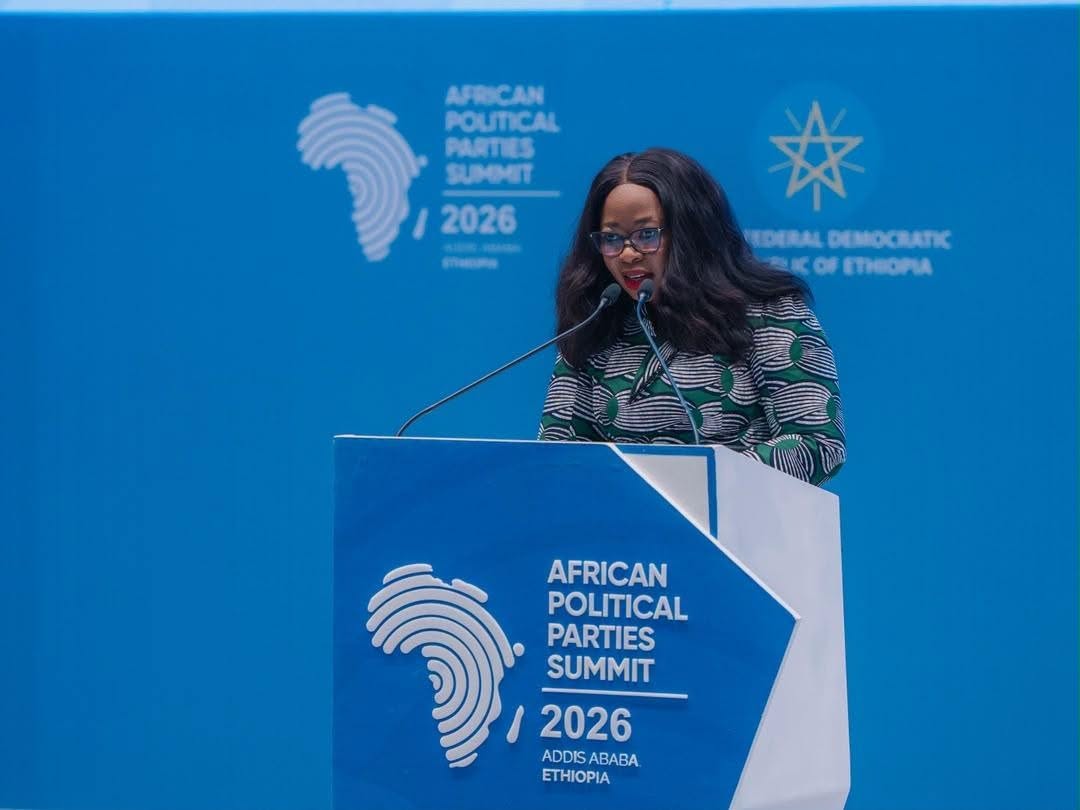
Africa Governance Centre Chair Calls on Political Parties to Prepare for Government Before Winning Power
Addis Ababa, November 6, 2026 (FMC) — Political parties must build the policy expertise, institutional capacity and leadership skills required to govern before assuming office, rather than begin preparing only after winning elections, Chair of the Africa Governance Centre Benedicta Lasi has said, underscoring the importance of political preparedness to Africa’s economic transformation.
Addressing the Second African Political Parties Summit in Addis Ababa, Lasi argued that elections alone cannot equip parties with the knowledge needed to manage ministries, negotiate major contracts or steer national economies. She said the quality of governance is shaped long before a party takes office, through the people it selects, the policies it develops and the preparation it undertakes.
“An election can place a party in government overnight, but it cannot supply overnight knowledge required to run a ministry, negotiate a major contract, or manage the national economy,” she said.
Lasi emphasized that Africa’s development ambitions require continuity beyond electoral cycles, noting that major economic undertakings such as building industrial capacity, expanding power systems and improving agricultural productivity demand longer timeframes than the four- or five-year terms of elected governments.
She warned that countries bear a heavy cost when political transitions interrupt development work that remains necessary, making it essential for parties to prepare leaders and develop policies capable of sustaining national priorities across changes of government.
In this regard, she identified party schools, research institutions and policy institutes as essential platforms for testing proposals, building sector-specific knowledge and preparing future public officials before they assume responsibility.
Lasi said the Africa Governance Centre established the African Political Parties Initiative to create a continental platform through which political parties can exchange experience on policy preparation, governing and the transfer of knowledge across political transitions.
Launched by Ghanaian President John Dramani Mahama in Accra on March 7, 2025, the initiative brought together more than 30 political parties from over 20 countries at its inaugural summit. It has also established partnerships with political party organizations in Latin America and the Caribbean and Asia, extending the exchange beyond Africa.
She said an intercontinental dialogue among political parties was launched in Seoul, South Korea, in September this year, with plans to continue the engagement in Türkiye next year.
Turning to the relationship between political parties and national economic performance, Lasi cited Ethiopia’s investments in infrastructure, energy, industry and productive activity, alongside real GDP growth of 9.2 percent in the 2024/25 fiscal year.
She congratulated the Ethiopian Government and people, while stressing that the lasting test of transformation lies in what the country can build and produce for itself.
She also pointed to Ghana’s Gold Board initiative as an example of how policy proposals can survive electoral changes.
According to Lasi, a proposal advanced by the opposition in 2020 was retained in the party’s 2024 election manifesto and implemented after it returned to power, contributing to an increase in Ghana’s gold export earnings from 10.3 billion dollars in 2024 to 21 billion dollars in 2025.
The Africa Governance Centre chair further highlighted the continent’s annual development financing gap of more than 400 billion dollars, despite over four trillion dollars in resources held within Africa. She called for political parties to work with governance institutions and international partners to advance agreed development objectives.
She said the African Union’s Agenda 2063 and the African Continental Free Trade Area (AfCFTA) would pass through multiple national elections before their objectives are fully realized, making stronger engagement between the AU and political parties important for sustaining implementation through political transitions.
Lasi also announced the Centre’s intention to advance an African Political Parties Agenda 2040, which she said would establish standards for parties in areas including internal democracy, national development visions and leadership training.
The proposed agenda would also address the participation of women and young people, including building the capacities of young women and the next generation to contribute meaningfully to the continent’s development.
Welcoming participants to Addis Ababa, she said Ethiopia’s transformation offered an opportunity for African political leaders to learn from the country’s experience, exchange ideas and strengthen their commitment to advancing their nations.