

Ethiopia Empowering Communities to Restore Landscapes and Strengthen Food Sovereignty – Agriculture Ministry
Addis Ababa, January 15, 2026 (FMC) — Ethiopia is turning the tide on decades of land degradation through an innovative approach that places communities at the center of environmental restoration and food production, according to Prof. Eyasu Elias, State Minister for the Natural Resources Sector at the Ministry of Agriculture.
In an exclusive interview with Fana Media Corporation, the State Minister noted that the country has historically struggled with degraded landscapes, recurrent droughts, floods, and famines, which have undermined both livelihoods and national food security.
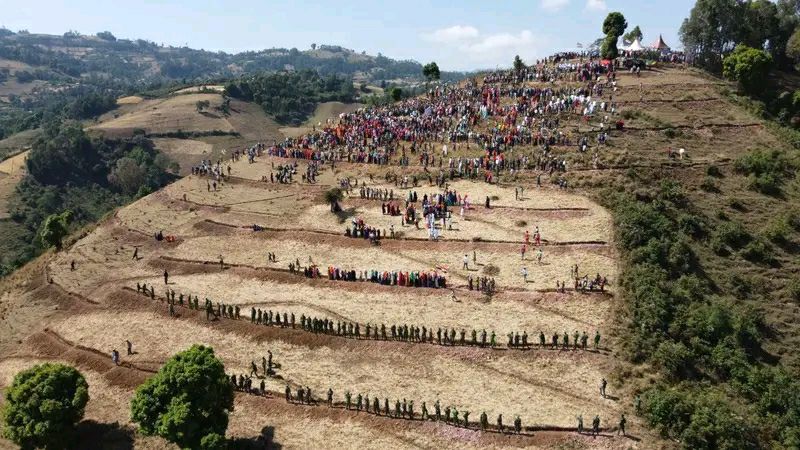
Since the 2018 government transition, Ethiopia has adopted a community-driven model to rehabilitate watersheds and restore productivity, he said.
“At the heart of our approach is empowering communities to own and manage restored landscapes,” Prof. Eyasu explained. “Through legal frameworks, including Proclamation 1223-2020, communities now form Watershed User Cooperatives, giving them the mandate to maintain and sustainably use rehabilitated lands.”
The strategy has combined soil and water conservation measures—such as terraces, check dams, and boundaries—with the integration of agroforestry seedlings. Over the past seven years, these efforts have not only increased vegetation cover but also boosted crop productivity and diversified household food sources.
Maize yields have risen from 2.5 to 4.2 tons per hectare, while wheat production grew from 2 to 3.6 tons per hectare. Fruit trees planted on homesteads and conservation structures are contributing to household nutrition, livestock feed, and additional income opportunities, the State Minister Pointed out.
This integrated approach is part of broader efforts to achieve food sovereignty, ensuring that Ethiopian households can decide what, when, and how to produce, rather than depending on external imports.
The restoration work has also recharged groundwater resources, enabling multi-cropping and dry-season farming initiatives, including the government’s Dry Season Climate-Resilient Wheat Production Program, which has transformed Ethiopia from a net wheat importer to self-sufficiency, with the potential to begin exporting.
Community participation is central to the program’s success. Across regions, households contribute 40 to 60 days of labor annually, planting trees, constructing terraces, and maintaining conservation structures. “These farmers are custodians of the landscape,” Prof. Eyasu said. “We are exploring ways to reward their efforts through social services, including schools, clinics, maternal health, and school feeding programs, ensuring that community contributions are both recognized and sustained.”
The Green Legacy initiative, which has distributed billions of seedlings for both agroforestry and environmental restoration, complements these community-driven efforts. By combining legal empowerment, practical training, and targeted interventions, Ethiopia is creating resilient landscapes, strengthening food security, and fostering socio-economic benefits for households nationwide.
Through this holistic model, Ethiopia aims not only to restore degraded lands but also to provide a replicable blueprint for community-led environmental management, linking ecological restoration directly to the well-being and agency of its citizens, the State Minister asserted.