
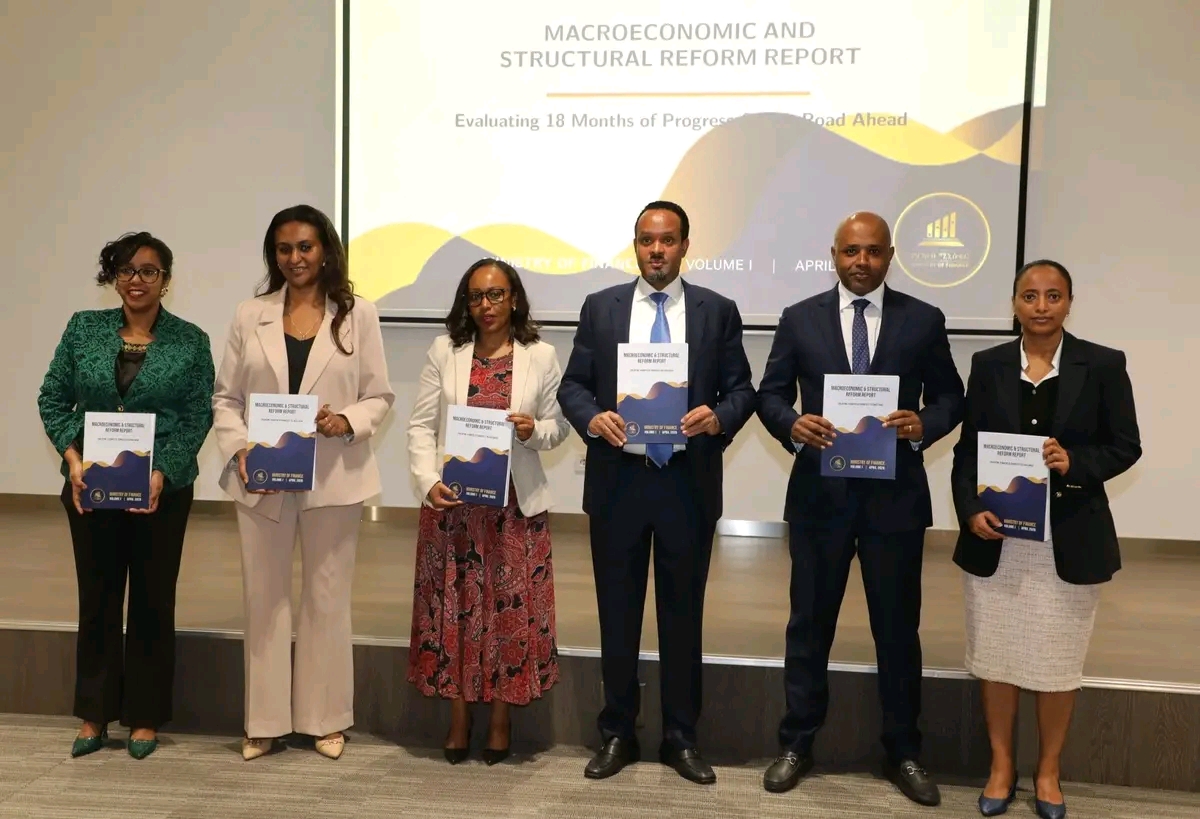
Ethiopia Showcases Strong Economic Gains, Reform Progress in Landmark Macroeconomic Report
Addis Ababa, April 7, 2026 (FMC) — The Government of Ethiopia has officially launched its Macroeconomic and Structural Reform Report during a high-level event held at the Commercial Bank of Ethiopia.
The report, covering 18 months of performance, was produced by a collaborative team of Ethiopian economists and provides a rigorous, evidence-based assessment of the country’s economic trajectory and the tangible gains achieved under the second phase of the Home-Grown Economic Reform program.
Minister of Finance Ahmed Shide highlighted the significant progress recorded under the leadership of Prime Minister Abiy Ahmed. He noted that a high-level macroeconomic coordination platform has been established, supported by a robust technical team drawn from key economic institutions, think tanks, and international partners.
He explained that the platform has enabled continuous monitoring of the country’s economic landscape, allowing authorities to anticipate potential risks and respond with timely, coordinated policy measures.
“The Ministry of Finance, together with our partner institutions, is committed to making this a regular exercise, producing high-quality analytical outputs that inform policy and strengthen accountability,” he said.
Minister of Planning and Development Fitsum Assefa stated that Ethiopia has sustained broad-based economic growth averaging 7.5 percent annually over the past eight years, driven by expansion in agriculture, industry, and services. She added that the report demonstrates reforms are taking hold, coordination is improving, and the economy is responding.
Despite a complex global environment and internal shocks, the report indicates that early indicators for FY2024/25 are encouraging, with improved foreign exchange reserves and declining inflation.
Minister Fitsum further noted that the government is establishing a macroeconomic data exchange system to enable real-time sharing of indicators and enhance consistency across public institutions.
Governor of the National Bank of Ethiopia, Eyob Tekalign, emphasized that the report reflects growing technical capacity within government institutions to utilize high-frequency data and advanced analytical tools. He stressed that “stability is a system outcome,” requiring alignment between fiscal and monetary policies rather than isolated interventions.
The report outlines key milestones in Ethiopia’s ongoing reform agenda. Among them is the transition to a market-determined exchange rate, introduced in July 2024, which has begun addressing exchange rate misalignments and strengthening export performance.
The government has also advanced fiscal and monetary reforms, including shifting to an interest-rate-based monetary policy framework and ending direct advances from the National Bank of Ethiopia to the budget, with the aim of fostering a more sustainable fiscal environment.
Parallel reforms have modernized tax administration through digitalization, e-filing, and risk-based audits, enhancing revenue mobilization and supporting broader macroeconomic stability.
Stefan Dercon, who supported the work, commended the report for being locally designed and owned. He noted that, unlike reforms undertaken under external pressure in many countries, Ethiopia’s efforts reflect a clear determination to pursue a homegrown agenda, enhancing credibility and ownership.
As Finance Minister Ahmed Shide previously underscored, the reform momentum is “real and irreversible,” aimed at positioning Ethiopia as a competitive, private-sector-led economy that is “open for business.”