
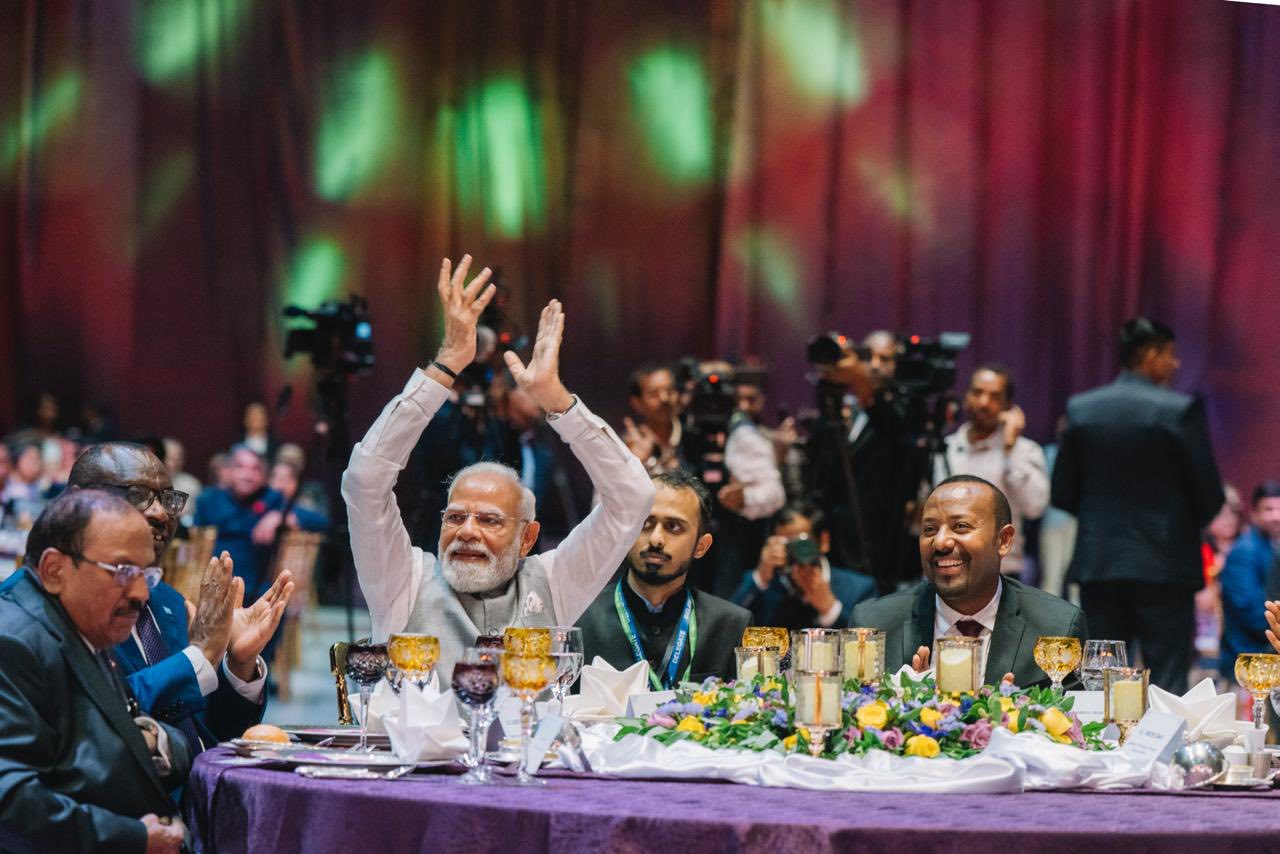
Strengthening Bonds Across Centuries
Addis Ababa, December 17, 2025 (FMC) — Indian Prime Minister Narendra Modi’s inaugural official visit to Ethiopia has been hailed as a historic milestone in a relationship that spans millennia, from ancient trade networks linking Axum and India to contemporary strategic, economic, and cultural cooperation.
Modi concluded his first-ever official visit to Ethiopia at noon today, marking a significant diplomatic milestone that both countries say has elevated their long-standing relations into a new phase of strategic partnership.
The high-level visit, characterized by intensive political engagement, symbolic gestures and substantive policy commitments, underscored Ethiopia and India’s shared intent to deepen cooperation across economic, political, security and multilateral fronts.
Strategic Partnership and Expanded Cooperation
During the visit, Prime Minister Modi held extensive bilateral talks with Prime Minister Abiy Ahmed, culminating in a joint decision to formally elevate Ethiopia–India relations to the level of a Strategic Partnership — a move officials say reflects growing convergence of interests between the two countries amid shifting global dynamics.
The Strategic Partnership framework agreed by the two leaders is expected to broaden cooperation in priority areas including trade and investment, technology and innovation, agriculture, clean energy, health, digital transformation, and capacity building. Both sides emphasized that the agreement is not merely symbolic, but a practical roadmap for sustained and institutionalised engagement that aligns with each nation’s development priorities and economic aspirations.
Ethiopia’s leadership stressed that the partnership reflects the country’s emphasis on national capacity, sovereignty, and mutual respect, and that it will be guided by principles of equality, shared benefit and African‑led development priorities.
Security and defense cooperation also featured prominently during the visit. Building on a defense cooperation agreement signed earlier this year, Ethiopia and India reaffirmed their commitment to closer military collaboration, including capacity building, cyber security cooperation, defense industry linkages and joint research initiatives. Officials described the expanded security dialogue as part of a broader effort to promote regional stability, maritime security and counterterrorism cooperation, particularly in the context of the Horn of Africa and the Indian Ocean region.
Parliamentary Address and Shared Vision
A central highlight of the visit was Prime Minister Modi’s address to a joint session of Ethiopia’s House of People’s Representatives and House of Federation, delivered in the presence of Prime Minister Abiy Ahmed, Ethiopian lawmakers and senior officials.
In his address, Prime Minister Modi emphasised shared civilisational heritage, the depth of people‑to‑people ties, and common democratic values, while outlining a forward‑looking vision for cooperation in agriculture, digital public infrastructure, healthcare, climate action and Global South solidarity. Addressing the parliament he repeated his commitment to strengthening ties across multiple sectors and underscored the importance of reciprocal respect and cooperation.
Prime Minister Abiy Ahmed, in his engagements throughout the visit, reiterated Ethiopia’s position that strategic cooperation with India should be rooted in mutual benefit, respect for sovereignty, and alignment with Ethiopia’s development strategies. He highlighted the importance of partnerships that augment national capacity, support job creation, and contribute to sustainable economic transformation.
Symbolic Engagements and Cultural Diplomacy
Modi’s visit was marked by several symbolic and culturally significant engagements that resonated deeply with Ethiopia’s national identity and historical narratives. These moments were widely interpreted as expressions of mutual respect and acknowledgement of profound historical connections between the two nations.
Adwa Victory Memorial: Prime Minister Modi laid a wreath at the Adwa Victory Memorial, paying tribute to Ethiopia’s celebrated 1896 victory over colonial forces. Ethiopian leaders and observers described this act as a reaffirmation of Ethiopia’s centuries‑old commitment to sovereignty and dignity, and a gesture that reverberates across Africa and the Global South.
Great Honour Nishan of Ethiopia: In a rare and significant ceremony, Prime Minister Abiy Ahmed conferred the Great Honour Nishan of Ethiopia, the country’s highest civilian award, on Prime Minister Modi. The conferment was presented as not only recognition of Modi’s role in strengthening bilateral cooperation, but as a tribute to decades of India’s engagement with Ethiopia’s development and diplomacy. In his remarks after receiving the award, Modi expressed gratitude to the people and government of Ethiopia and noted that the honour reflects the enduring friendship between the two peoples.
National Palace Museum Visit: On arrival, PM Modi was personally welcomed by PM Abiy at Addis Ababa Bole International Airport and taken to tour the National Palace Museum, where Ethiopia’s historical legacy is preserved. The museum tour was described by Ethiopian officials as a demonstration of Ethiopia’s cultural depth and narrative of statehood, and an opportunity for the Indian leader to directly engage with the country’s history.
Science Museum Tour: Modi also visited the Science Museum, where Ethiopian and Indian officials discussed the role of science and innovation in national development. The visit highlighted both countries’ focus on technological advancement and the potential for collaboration in research, digital infrastructure, and innovation ecosystems.
Friendship Park and Friendship Square: The Indian Prime Minister’s tour of Friendship Park and Friendship Square, modern urban public spaces developed under Ethiopia’s national initiatives, was framed as highlighting the country’s commitment to community engagement, urban development, and public diplomacy.
Green Legacy and Tree Planting Ceremony: In a widely noted and symbolic act, both leaders participated in tree planting as part of the ‘Ek Ped Maa Ke Naam’ initiative from India and Ethiopia’s Green Legacy programme — which has overseen the planting of billions of tree seedlings since 2019. The shared activity was portrayed as a powerful symbol of joint commitment to climate action and sustainable development.
Multilateral Alignment and Global South Advocacy
The visit was not limited to bilateral dimensions; it also underscored growing alignment between Addis Ababa and New Delhi on multilateral governance and Global South priorities. Both Prime Ministers reiterated their commitment to strengthening the voice of the Global South and advancing reforms in international institutions to better reflect contemporary geopolitical realities.
Ethiopia’s recent accession to BRICS and its expanding role in emerging economy groupings featured prominently in discussions. India welcomed Ethiopia’s active participation in BRICS and extended an invitation to future collaborative platforms, including the AI Impact Summit and the 2026 BRICS Summit hosted by India.
Cooperation within the G20 framework, Africa–India engagement initiatives, and commitments toward climate leadership and sustainable development were also highlighted as areas of strategic convergence. Both sides expressed readiness to work together in global climate negotiations, particularly in the lead‑up to COP 32.
People‑to‑People Ties and Development Cooperation
Beyond state‑to‑state relations, the visit showcased the depth of people‑to‑people connections that have sustained Ethiopia–India relations across generations. These ties include educational exchanges, cultural linkages, and community interactions that have shaped mutual understanding and cooperation.
India reaffirmed its long‑term commitment to capacity building through training, scholarships, and technical assistance, with a focus on programs like the Indian Technical and Economic Cooperation (ITEC) initiative and expanded scholarships for Ethiopian students. Both leaders highlighted cooperation in healthcare delivery, pharmaceuticals, digital governance, agricultural innovation, and vocational skills development as key elements that benefit citizens of both countries.
Healthcare collaboration, particularly support for infrastructure and professional training, was emphasised as an area of shared concern, reinforcing the humanitarian dimension of the partnership.
Current Status of Bilateral Relations and Prospects
Ethiopia and India have maintained diplomatic relations since 1948, and the partnership has expanded steadily across trade, investment, education, development cooperation, and multilateral engagement. Indian companies have been among the leading investors in Ethiopia, operating in sectors such as textiles, manufacturing, agriculture, pharmaceuticals and services. These private investments have contributed to employment, technology transfer, and economic diversification.
Economic collaboration gained new impetus during this visit, with both sides expressing intent to deepen bilateral trade and streamline investment frameworks. Ethiopia’s economic progress in recent years — including strong GDP growth and rising foreign direct investment — was highlighted by PM Abiy as a foundation on which to build further cooperation. Indian investment was identified as a key contributor to these developments.
The elevation to a Strategic Partnership is expected to provide a structured institutional platform for future cooperation, with joint working groups and intergovernmental mechanisms poised to monitor and implement agreed initiatives. Analysts note that this framework positions Ethiopia to play a more influential role in regional and global affairs while tapping into India’s expanding economic and technological reach.
A Defining Moment in Bilateral Engagement
As Modi departed Addis Ababa today, Ethiopian and Indian officials described the visit as a defining moment in the long arc of bilateral relations — one that not only reinforced historical bonds but also charted a pragmatic, forward‑looking path for deeper and more structured cooperation in an interconnected world.
Prime Minister Abiy Ahmed stressed that the partnership’s expansion aligns with Ethiopia’s development priorities and regional leadership, while India reaffirmed its commitment to supporting Ethiopia’s growth trajectory and shared global objectives.
The visit has set the stage for concrete projects, institutionalised dialogue, and sustained engagement, signalling a new era of Ethiopia–India cooperation that blends historical depth with contemporary strategic purpose.