
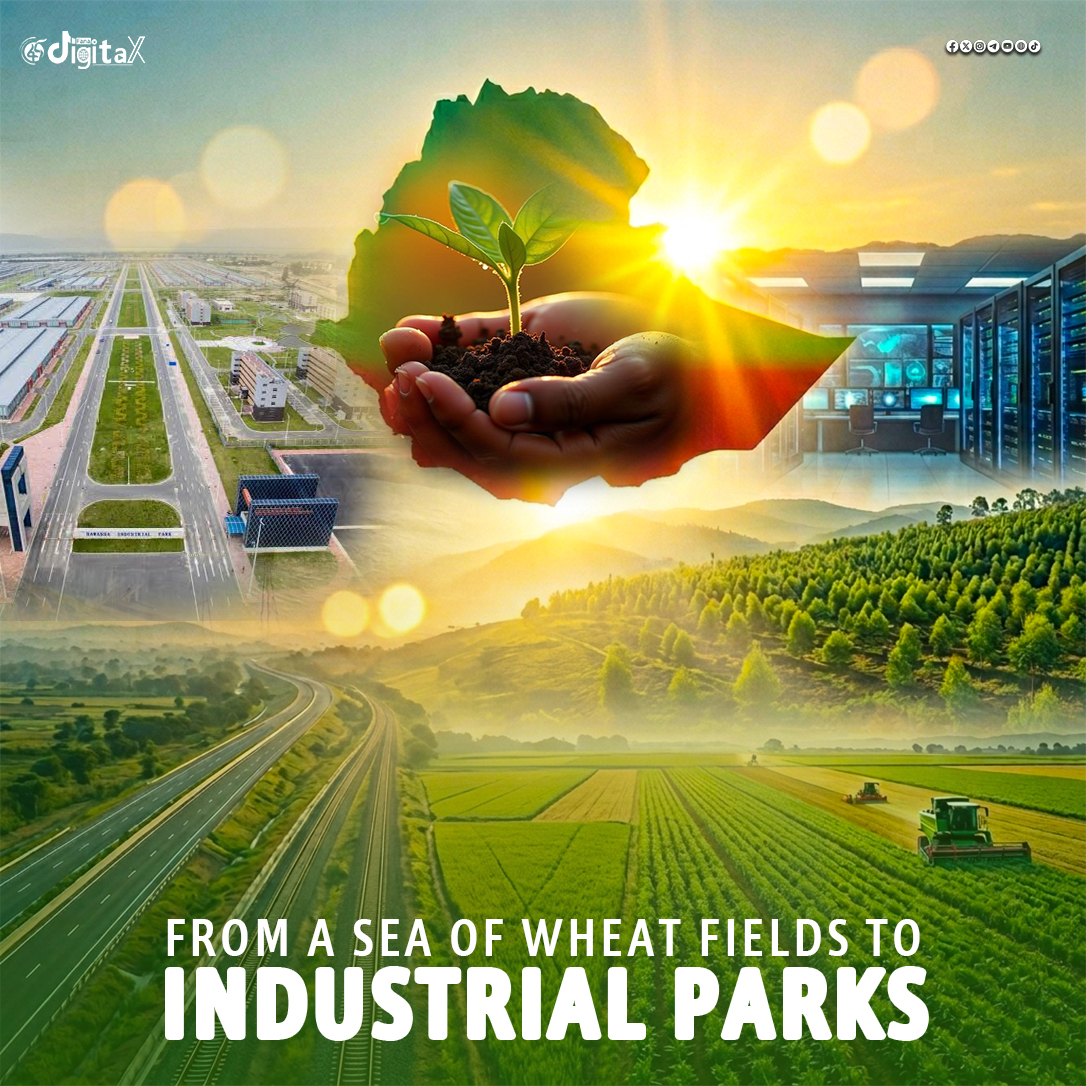
𝗙𝗥𝗢𝗠 𝗔 𝗦𝗘𝗔 𝗢𝗙 𝗪𝗛𝗘𝗔𝗧 𝗙𝗜𝗘𝗟𝗗𝗦 𝗧𝗢 𝗜𝗡𝗗𝗨𝗦𝗧𝗥𝗜𝗔𝗟 𝗣𝗔𝗥𝗞𝗦, 𝗘𝗧𝗛𝗜𝗢𝗣𝗜𝗔 𝗜𝗦 𝗕𝗨𝗜𝗟𝗗𝗜𝗡𝗚 𝗔𝗡 𝗘𝗖𝗢𝗡𝗢𝗠𝗬 𝗗𝗥𝗜𝗩𝗘𝗡 𝗟𝗘𝗦𝗦 𝗕𝗬 𝗖𝗢𝗡𝗦𝗨𝗠𝗣𝗧𝗜𝗢𝗡 𝗔𝗡𝗗 𝗠𝗢𝗥𝗘 𝗕𝗬 𝗣𝗥𝗢𝗗𝗨𝗖𝗧𝗜𝗩𝗘 𝗖𝗔𝗣𝗔𝗖𝗜𝗧𝗬
Addis Ababa, June 25, 2026 (FMC) – Ethiopia’s ongoing economic transformation is being driven by a government-led development strategy under the leadership of Prime Minister Abiy Ahmed and his administration, which has prioritized structural economic reform, productivity expansion, and long-term capacity building. Through coordinated policy direction across agriculture, industry, mining, infrastructure, and digital systems, the country is progressively reorienting its economic model toward production-led growth, domestic value creation, and structural resilience.
Agriculture remains the foundational pillar of this transformation and has undergone significant modernization in recent years. Wheat production has expanded considerably through irrigation development, mechanization, and improved agricultural input systems supported by sustained government intervention. These measures have strengthened domestic food supply, reduced import dependency, and advanced national food self-sufficiency objectives.
Beyond cereal production, agricultural diversification has accelerated through structured government programs targeting livestock, dairy, poultry, and apiculture development. This diversification is reshaping rural economies, broadening income sources for smallholder farmers, and strengthening national nutritional security. Increasingly, agriculture is being repositioned not only as a subsistence base but as a commercially integrated sector within a wider production ecosystem.
These agricultural gains reflect sustained government investment in productivity-driven rural transformation, aimed at linking primary production with industrial processing and national markets.
Industrial development is simultaneously undergoing structural revitalization. Manufacturing recovery initiatives have brought previously inactive factories back into operation while enhancing output capacity in functioning industries. Import-substitution policies, implemented under the government’s broader industrial strategy, are gradually replacing imported goods with domestically produced alternatives across key sectors including construction materials, textiles, food processing, and chemicals.
This shift is improving industrial utilization rates and strengthening domestic production ecosystems. It also reflects a deliberate policy direction to build a more self-reliant industrial base capable of supporting long-term economic expansion.
Mining has emerged as a strategic pillar within this production-oriented framework. Regulatory reforms and institutional restructuring led by the government have strengthened formal production channels, reduced informal leakage, and improved sector transparency. Gold remains a major export driver, while expanding exploration activities in strategic and energy-transition minerals such as lithium are positioning Ethiopia within global supply chains.
The transformation of the mining sector is also increasingly linked to domestic industrial demand, reducing reliance on imported inputs and reinforcing internal economic linkages.
Infrastructure development continues to function as the backbone of Ethiopia’s growth architecture. Large-scale investments in transport corridors, logistics systems, energy infrastructure, and industrial parks are being implemented as part of a state-led development strategy aimed at improving connectivity and reducing economic friction across production zones.
Industrial parks and integrated agro-industrial zones are playing a central role in clustering production activities, enhancing efficiency, and facilitating export-oriented manufacturing. These spatial development strategies are reshaping the geographic organization of economic activity across the country.
Energy infrastructure remains a critical enabler of this transformation. Government-led hydropower and renewable energy expansion projects are increasing electricity availability for industrial, urban, and potential regional use. This expanding energy base is becoming a structural foundation for industrialization and broader economic modernization.
Digital transformation is adding a new structural layer to this emerging economic model. The expansion of digital payment systems, service integration platforms, and national digital identity infrastructure is improving efficiency across financial systems, governance processes, and service delivery mechanisms. These reforms are reducing transactional costs and strengthening coordination between economic actors and state institutions.
Taken together, these developments reflect a deliberate reconfiguration of Ethiopia’s economic structure under a coordinated government-led reform agenda. Agriculture, industry, mining, infrastructure, energy, and digital systems are increasingly functioning as interconnected components of a unified production system.
This shift marks a structural transition in which Ethiopia’s economic trajectory is being shaped less by consumption dynamics and more by expanding productive capacity, value-chain integration, and long-term economic resilience.