
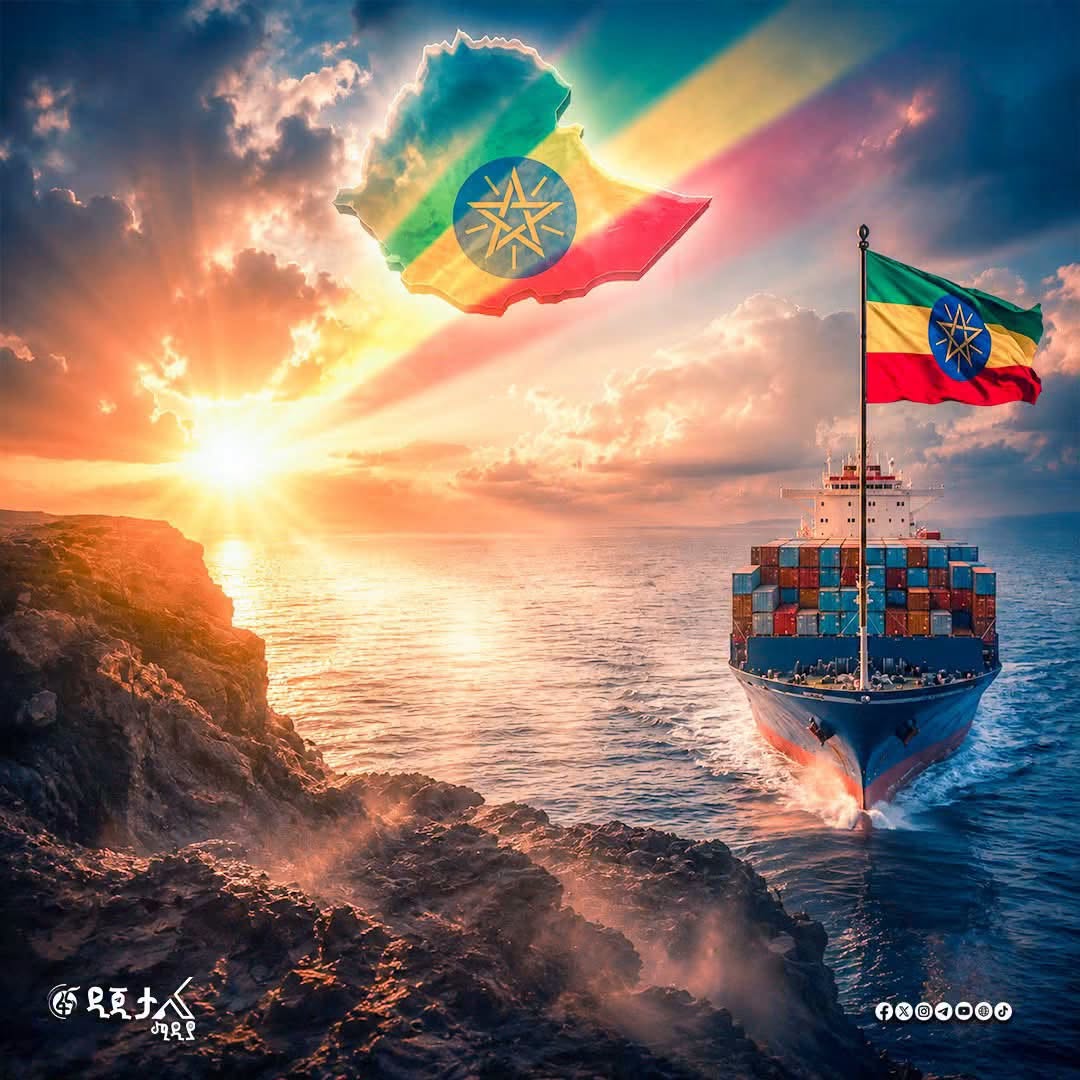
Why Must Ethiopia’s Maritime Need Be a Regional Zero-Sum Game?
Addis Ababa, August 14, 2026 (FMC) — Geography can be generous, but it can also be unforgiving. For Ethiopia, it has left a paradox at the heart of the country’s economic story: a nation of more than 130 million people, endowed with vast productive potential and positioned at the crossroads of the Horn of Africa, yet separated from the sea by a line drawn across the map.
That line has carried a heavy price.
Every year, billions of dollars follow the long road from Ethiopia’s markets to ports beyond its borders and back again. Distance becomes cost; dependence becomes vulnerability; geography becomes an economic burden. For a country whose economy is expanding and whose ambitions reach far beyond its borders, remaining permanently dependent on external maritime gateways is increasingly difficult to reconcile with the demands of long-term economic security.
Ethiopia’s maritime quest, therefore, is not a luxury knocking at the door of national policy. It is necessity knocking with increasing force.
But there is another way to read this story.
The question need not be framed as Ethiopia versus its coastal neighbors. There is a more compelling possibility: Ethiopia’s search for maritime access and its neighbors’ possession of strategic coastlines could become complementary pieces of one regional economic puzzle.
The coast has the gateway.
Ethiopia has the market.
The corridor can connect them.
And when geography becomes connected by commerce, what once looked like separation can begin to resemble opportunity.
Yet Ethiopia’s relationship with the sea cannot be understood through economics alone. For Ethiopia, the sea is not an entirely unfamiliar horizon. Long before modern borders redrew the political map of the Horn, the civilizations that flourished in the Ethiopian highlands were deeply connected to the Red Sea world. From the era of Aksum onward, the Red Sea served as a commercial artery, a strategic frontier and a gateway through which Ethiopia engaged with wider civilizations.
Its connection to the Red Sea was not merely a matter of proximity. It was woven into the country’s political, commercial and strategic history.
But Ethiopia’s separation from the sea was not simply the work of geography. History, power and geopolitics also played their part. Over the course of the colonial era and the geopolitical struggles that reshaped the Horn, successive territorial arrangements and external interests transformed the region’s political map and progressively severed Ethiopia from its historic Red Sea frontage.
What had once been a maritime space closely intertwined with Ethiopian political, commercial and strategic life became a frontier beyond Ethiopia’s direct reach.
That transformation left a legacy whose consequences are still felt today. The loss of maritime access did not erase Ethiopia’s historical relationship with the Red Sea; it turned that relationship into an unresolved question at the intersection of history, sovereignty, security and economic necessity.
And that is where history meets the present.
Ethiopia brings to any potential partnership an enormous domestic market, agricultural production, renewable-energy resources, expanding industries and one of Africa’s most powerful aviation networks. Its neighbors bring something equally strategic: access to the maritime arteries through which regional economies connect with the wider world.
Put together, these assets can turn the Horn’s geography from a fault line into a bridge.
That is the deeper proposition behind Ethiopia’s maritime aspiration.
It is why the country’s pursuit of direct and dependable access to the sea deserves to be understood not merely through the vocabulary of geopolitics, but through the broader language of economic interdependence, regional integration and shared prosperity.
The sea, after all, is not only a boundary.
For nations that know how to harness it, it is a highway to the world.
And Ethiopia is determined to find its way back to that highway.
The stakes are too large for the issue to be reduced to a question of ports and shipping lanes.
For an economy of Ethiopia’s scale, maritime access reaches deep into the bloodstream of national development. The cost of moving goods affects the competitiveness of producers. The efficiency of trade corridors influences investment. The reliability of supply chains affects businesses and consumers alike. Every additional layer of logistical dependence ultimately reverberates through the wider economy.
This is why the maritime question has steadily moved from the margins of Ethiopia’s strategic thinking toward its center.
A country cannot fully unlock its economic horizon if one of its most important routes to the world remains beyond its direct reach.
Yet Ethiopia’s argument is not built on the premise that its interests must come at the expense of its neighbors.
Quite the opposite.
Its strongest case rests on the possibility that a maritime arrangement can create value precisely because the interests of the countries involved are complementary. Ethiopia does not need to become a coastal state for its enormous economic weight to benefit coastal economies. It needs dependable, sustainable and mutually agreed access to maritime gateways—and those gateways can, in turn, gain from the enormous market and economic activity that Ethiopia brings with it.
This is where the idea of shared development acquires practical meaning.
Imagine the maritime gateway not as the end of a journey, but as the beginning of a much larger economic chain.
Goods move from Ethiopian farms and factories toward the coast. Imports travel inland toward Ethiopian consumers and businesses. Transport corridors expand. Logistics services multiply. Investment follows connectivity. Border communities find new commercial opportunities. Ports handle greater volumes. Businesses on both sides of the corridor become increasingly invested in one another’s success.
The road becomes more than a road.
It becomes an artery.
And the artery becomes part of a regional economic system whose vitality depends on keeping it open, secure and peaceful.
Ethiopia has substantial assets with which to build such interdependence. Its renewable-energy potential can support regional industrialization. Its agricultural sector can feed expanding markets. Its aviation industry provides an established bridge between Africa and the wider world. Its vast consumer base represents a commercial opportunity that few countries in the region can match.
These are not abstract possibilities.
They are pieces of a regional economic architecture waiting to be connected more effectively.
The international legal framework also matters. The United Nations Convention on the Law of the Sea recognizes the interests and rights of landlocked states in securing access to and from the sea through transit arrangements. Ethiopia’s maritime aspiration therefore belongs not only to the realm of political argument, but also to a wider framework of international law governing the relationship between landlocked and coastal countries.
But law alone cannot build a durable maritime future.
Trust must build what geography has separated. Diplomacy must connect what history has divided. And economic interdependence must make cooperation more rewarding than confrontation.
That is why Ethiopia’s emphasis on peaceful negotiation and mutually beneficial arrangements is so important.
The objective should not be to redraw borders or diminish the sovereignty of neighboring countries. It should be to create practical arrangements through which Ethiopia can secure dependable maritime access while coastal states gain enduring economic returns.
Such an arrangement could transform the very meaning of maritime access.
A port serving Ethiopia would not merely serve Ethiopia.
It could become a commercial gateway feeding an interconnected regional economy.
And that possibility carries implications far beyond customs revenues and shipping statistics.
The Horn of Africa has spent too much of its history trapped in cycles where strategic anxieties feed political mistrust, and political mistrust feeds insecurity. Economic interdependence offers another path. When roads, ports, energy systems, markets and businesses become intertwined, stability ceases to be merely a diplomatic aspiration. It becomes an economic necessity.
Peace then acquires a tangible dividend.
A functioning corridor needs security.
A thriving port needs predictable trade.
Investment needs confidence.
Markets need stability.
In that sense, Ethiopia’s maritime quest can be understood as part of a much larger question: Can the Horn transform its geography from a source of strategic anxiety into an engine of shared prosperity?
The answer may depend on whether the region can look beyond the immediate politics of access and see the economic landscape that lies beyond it.
The Horn sits beside one of the world’s most consequential maritime corridors. It links Africa with the Middle East, Europe and Asia. It possesses ports of immense strategic significance and an inland market of extraordinary scale.
Yet strategic geography becomes truly valuable only when it is converted into productive connectivity.
That is where Ethiopia’s economic weight matters.
A more integrated Ethiopia–coastal corridor could bring the region closer to the ideal of an Africa where borders do not obstruct commerce and geography does not dictate poverty or prosperity.
It could make the Horn not merely a place through which global trade passes, but a region that captures a greater share of the value created by that trade.
The opportunity is therefore larger than a port. It is larger than a corridor. It is larger even than Ethiopia’s maritime ambition.
It is about building an economic bridge between the continent’s vast inland potential and the sea lanes that connect Africa to the world.
Ethiopia’s quest for direct access to the sea should consequently be seen through a wider lens. Its foundation is national necessity, but its promise can be regional. Its immediate concern is economic and strategic security, but its long-term dividend could be integration and prosperity.
The past may explain how Ethiopia arrived at this predicament; the present demands that it find a peaceful and sustainable way beyond it.
The sea need not become another fault line in the Horn.
It can become the point at which interests converge.
Ethiopia has the market. Its neighbors have the coast. The region has the opportunity.
What remains is to turn those three realities into a durable framework of cooperation—one in which Ethiopia’s legitimate maritime aspirations are reconciled with the sovereignty and interests of its neighbors, and in which access to the sea becomes not a zero-sum contest, but a shared gateway to a more prosperous Horn.
Because ultimately, Ethiopia is not merely seeking a route to the ocean.
It is seeking a route to a future in which geography no longer dictates the limits of its economic destiny—and in which the Horn’s greatest strategic asset, the sea, can become a shared horizon of prosperity.