
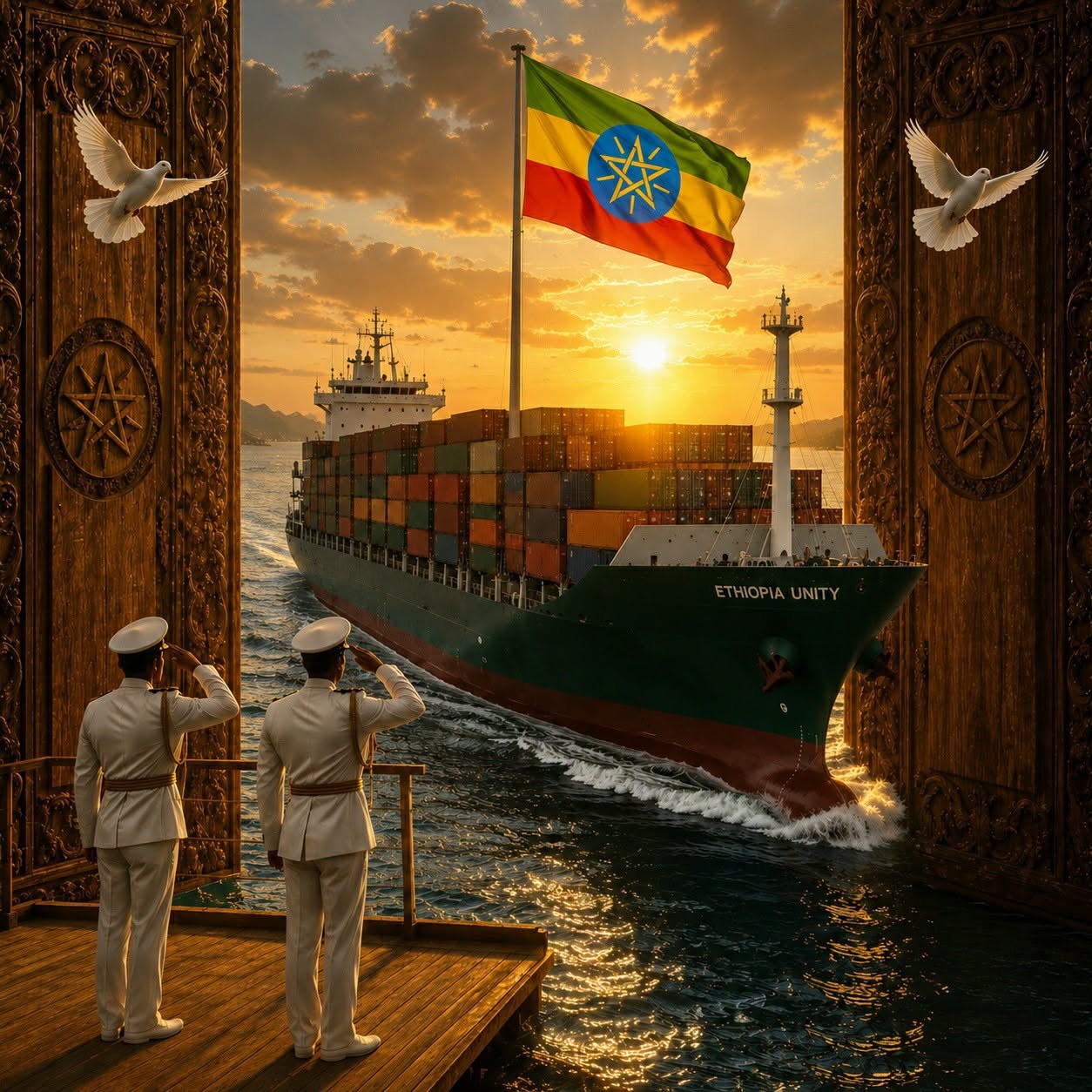
Opening the Horn to the Sea: Ethiopia’s Maritime Aspiration and Africa’s Unfinished Integration
Addis Ababa, August 27, 2026 (FMC) — The Horn of Africa’s relationship with the sea is older than the borders that now divide its shores. For centuries, Ethiopia’s history, commerce and political life were intertwined with the Red Sea and the wider maritime world.
Its historic ties to the coast were not merely geographical; they formed part of the country’s enduring place in the political and commercial history of the region.
The severing of that connection was shaped by successive geopolitical contests and the colonial-era remaking of the Horn, leaving Ethiopia—one of Africa’s largest nations and a country whose history is deeply intertwined with the region—without direct access to the sea.
What emerged from that history remains a defining structural reality: a country of more than 130 million people, with a rapidly expanding economy, conducting the overwhelming majority of its international trade through neighboring maritime gateways.
For Ethiopia, the consequences of landlockedness are not abstract. They reach into the price of trade, the competitiveness of exports, the cost of industrial inputs and the pace at which an expanding economy can connect to global markets.
More than 90 percent of Ethiopia’s foreign trade currently passes through Djibouti, making maritime connectivity one of the most consequential dimensions of the country’s economic future.
Yet the question before Ethiopia today is not one of historical grievance alone. It is how a country whose economic weight has grown dramatically can establish a more direct, reliable and diversified relationship with the sea—and do so without turning geography into confrontation.
That is why Ethiopia has placed diplomacy at the center of its maritime aspiration.
Its approach has consistently emphasized peaceful negotiation, mutual benefit and cooperation with neighboring countries.
The objective is not to redraw borders or dispossess another nation, but to find a mutually acceptable framework through which Ethiopia can regain direct maritime connectivity while coastal states also gain from the enormous economic activity that Ethiopia can generate.
This distinction is essential to understanding the issue internationally.
Ethiopia’s economic scale means that maritime access would not simply serve Ethiopian consumers and producers.
A more connected Ethiopia could expand regional cargo flows, strengthen logistics networks, attract investment into transport corridors and create larger markets for coastal economies.
The sea, in this context, becomes not a dividing line between states, but an economic bridge between them.
The Horn has long possessed extraordinary geographic advantages, yet its economic potential remains constrained by fragmentation.
A vast coastline faces one of the world’s most important maritime corridors, while one of the continent’s largest economies remains inland. Bridging that structural divide could unlock opportunities far beyond the immediate question of port access.
This is where Ethiopia’s maritime aspiration meets Africa’s continental project.
The African Union’s Agenda 2063 envisions a prosperous and integrated Africa in which people, goods, capital and services move more freely across borders.
The African Continental Free Trade Area seeks to translate that vision into a functioning continental market. Neither ambition can reach its full potential without the infrastructure and corridors that physically connect Africa’s economies to one another and to global commerce.
Ethiopia’s maritime connectivity therefore belongs within this larger story.
The country is already deeply embedded in the continent’s economic architecture. Through Ethiopian Airlines, Africa’s largest and most extensive aviation network, Ethiopia has helped turn geographical distance into commercial and human connectivity.
Its expanding road, rail, energy and digital infrastructure similarly contributes to the physical foundations of regional integration.
The maritime dimension would add another critical link.
If Ethiopia can secure direct sea access through peaceful diplomacy and mutually beneficial arrangements, the effect could extend from ports to production centers, from transport corridors to industrial parks, and from regional commerce to continental trade.
It could strengthen the Horn’s role as a gateway between African markets and the wider global economy.
The case for Ethiopia’s maritime connectivity, then, is not simply about what Ethiopia stands to gain. It is also about what a more connected Ethiopia can contribute.
For decades, Ethiopia has invested in the African project without treating its continental contributions as transactions requiring repayment.
Its aviation network has carried Africans across borders; its diplomatic institutions have supported continental cooperation; its economic and infrastructure ambitions increasingly intersect with regional development.
Its maritime aspiration can be viewed in the same broader spirit.
Ethiopia is seeking to restore a connection whose historical roots long predate the geopolitical arrangements that severed it, but it is pursuing that objective through the language of contemporary diplomacy: dialogue, negotiation, sovereignty, mutual interest and shared prosperity.
That makes the international question a constructive one: Can the Horn transform a historical geographic constraint into a new platform for regional economic integration?
The answer need not be a zero-sum choice.
A maritime arrangement that gives Ethiopia reliable access while creating greater trade, investment, logistics and employment opportunities for coastal states would enlarge the economic space of the entire region.
It would make the sea a shared avenue of prosperity rather than another fault line in the Horn.
For Africa, this matters because integration is ultimately built through connections. Roads must meet railways; railways must reach ports; electricity must cross borders; airlines must connect markets; and maritime gateways must serve the economies behind them.
Ethiopia’s aspiration sits precisely at that intersection.
Opening Ethiopia’s route to the sea through peaceful diplomacy would not merely reconnect a major African economy to the maritime world.
It could open another passage toward the Africa envisioned by Agenda 2063—more connected, more integrated and better positioned to turn its geography into shared prosperity.