
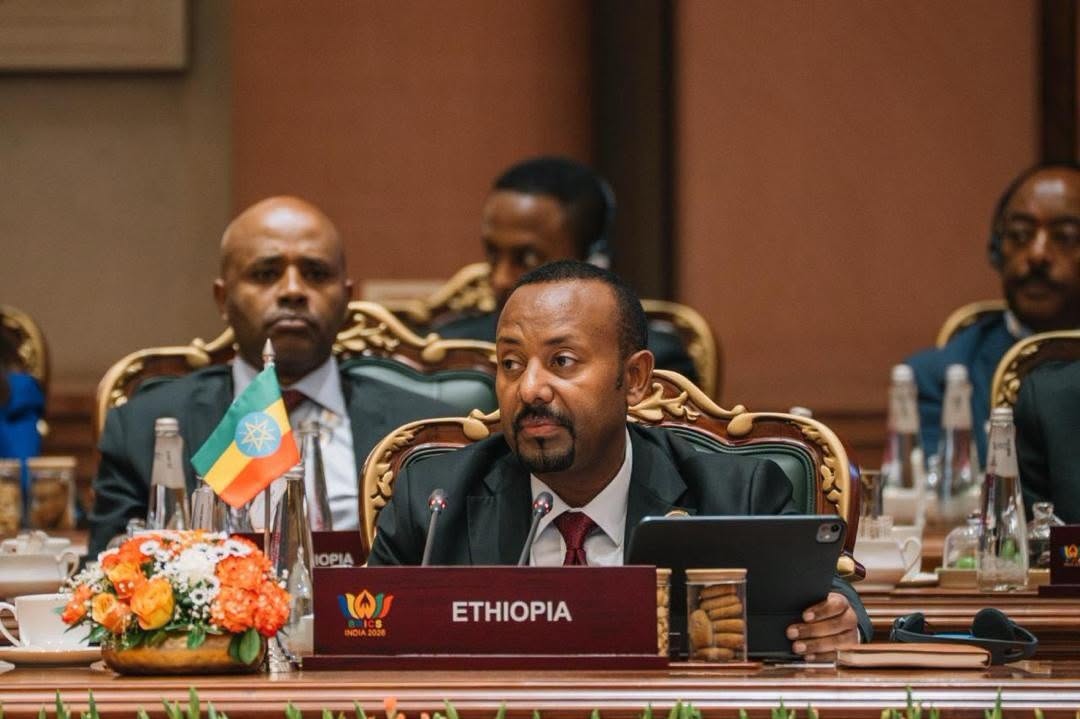
PM Abiy Calls for BRICS Coordinating Track Ahead of Ethiopia-hosted COP32
Addis Ababa, September 12, 2026 (FMC) — Ethiopian Prime Minister Abiy Ahmed has called for a practical BRICS coordinating track ahead of COP32, proposing a process to turn shared climate and development priorities into areas of agreement as Ethiopia prepares to host the global climate conference in Addis Ababa in 2027.
Addressing the 18th BRICS Leaders’ Summit in New Delhi, Prime Minister Abiy said resilience, innovation, cooperation and sustainability must be approached together as countries confront interconnected shocks and seek more resilient systems.
For Ethiopia, he said, building resilience means strengthening systems that can keep the country functioning under pressure, citing progress in food security, healthcare, technology and digital infrastructure.
He said Ethiopia has moved from dependence on imported wheat toward self-sufficiency and therefore approaches the proposed BRICS grain exchange both as a producer and supplier. In the health sector, he highlighted the expansion of pharmaceutical manufacturing, while noting that Ethiopia is also developing digital public infrastructure covering digital identity, payments and data exchange.
Prime Minister Abiy placed particular emphasis on artificial intelligence, saying the next generation of AI should serve more of humanity by understanding more languages, reaching more communities and drawing on a wider range of human knowledge.
He said Africa should play a role in building the next generation of AI and requires research, computing capacity, skills and institutions capable of leading that work. Ethiopia’s Maddamer University of Artificial Intelligence, he said, embodies that ambition.
“We wanted to work with institutions across BRICS to build AI that better understands and serves Africa,” Prime Minister Abiy said, reaffirming Ethiopia’s support for ethical and human-centered AI governance while stressing that good governance must be matched by technological capability.
Turning to economic cooperation, the Prime Minister said the strength of BRICS lies in the capabilities and resources that each member brings to the partnership, identifying critical minerals as an area with significant potential.
He noted that the energy transition, advanced manufacturing and digital economy all depend on minerals, while Africa holds many of these resources and BRICS countries bring capital, technology and markets.
“The opportunity is to bring them together and create more value where those resources are found,” he said, adding that Ethiopia is ready to build partnerships across minerals, renewable energy and its growing industrial base.
Prime Minister Abiy also highlighted Ethiopia’s connectivity assets, including Ethiopian Airlines and the country’s electricity links with neighboring economies, as well as Addis Ababa’s role as the headquarters of the African Union.
Against this backdrop, he said Ethiopia supports strong consultation between BRICS and the African Union to ensure engagement with Africa is better aligned with the continent’s Agenda 2063.
On the international financial system, Prime Minister Abiy said Ethiopia’s experience with economic reforms and external debt restructuring underlines the need for faster, more transparent and predictable debt resolution.
“For any economy, under pressure, time is a cost,” he said, calling for greater representation in global financial institutions and improved outcomes for countries facing financial pressures.
He also proposed making cross-border payments easier within BRICS and expanding the use of local currencies where this can lower costs and support trade.
Addressing climate action, Prime Minister Abiy said Ethiopia views climate action and economic transformation as closely connected. He noted that through the Green Legacy Initiative, Ethiopia has planted 56 billion seedlings over the past eight years, while expanding renewable energy and electric mobility and investing in more resilient agriculture, cities and infrastructure.
“In 2027, Ethiopia will have the honor of hosting COP32 in Addis Ababa,” he said, describing the responsibility as a trust and expressing Ethiopia’s ambition for a COP focused on “delivery and hope.”
He called for stronger action on adaptation, practical solutions for countries most in need and climate finance that can strengthen economies without adding to their debt burdens.
Prime Minister Abiy proposed establishing a BRICS coordinating track on the road to Addis, describing it as a practical process between now and COP32 to translate shared priorities into areas of agreement.
“BRICS is well-placed to contribute around this table our major economies, energy producers and countries facing the direct effect of climate change,” he said.
Concluding his remarks, Prime Minister Abiy stressed the importance of cooperation despite differences among countries, saying nations do not need to become more alike to pursue a common purpose.
“The value of BRICS lies in what we can achieve together,” he said, reaffirming Ethiopia’s readiness to contribute to the partnership and welcoming BRICS members to Addis Ababa for COP32 in 2027.