
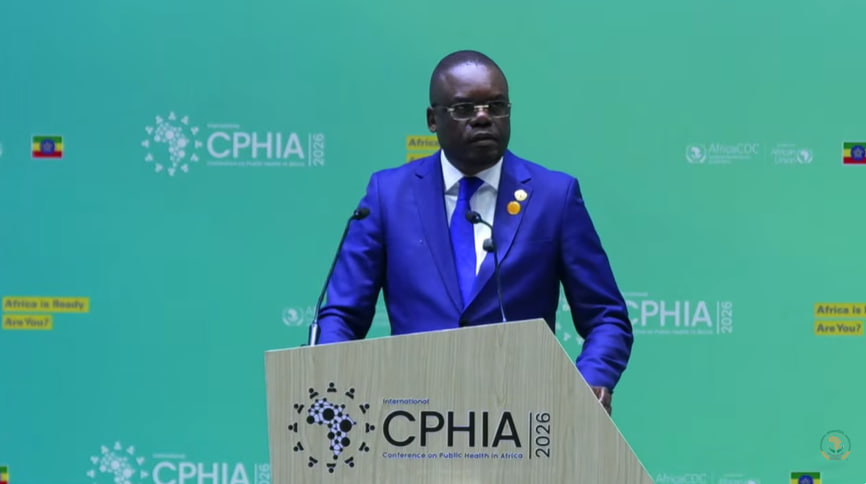
Africa’s Health Sovereignty Must Be Built on Strong Institutions, Accountable Leadership and Continental Ownership: Africa CDC Chief
Addis Ababa, November 23, 2026 (FMC) – Africa CDC Director-General Dr. Jean Kaseya has called for a decisive shift towards African ownership of the continent’s health future, emphasizing that health sovereignty must rest on strong institutions, accountable leadership, domestic capacity and the ability to respond to public health emergencies without dependence on external actors.
Addressing the opening of the Fifth International Conference on Public Health in Africa (CPHIA 2026) in Addis Ababa, Dr. Kaseya described the gathering as more than a conference, calling it a movement for Africa’s health security and sovereignty.
He stressed that African countries must take responsibility for protecting their populations by strengthening their own health systems, institutions and capacity to manage health emergencies.
He connected this ambition to Africa’s identity and place in human history, invoking Dinknesh, the ancient human ancestor discovered in Ethiopia more than two million years ago.
Objecting to the widespread use of the name Lucy, he called for recognition of her Ethiopian name, meaning “marvelous” or “fabulous,” and presented Dinknesh as a symbol of Africa’s origins, identity and confidence in shaping its future.
Dr. Kaseya reported significant institutional progress at Africa CDC, including an increase in the representation of women in leadership positions from 11 percent to 38 percent.
He also cited the expansion of National Public Health Institutes from seven countries to 42, and the growth of genomic sequencing capacity from seven countries to 52. He indicated that Africa CDC had achieved 96 percent of its strategic plan targets and was working towards full implementation.
He also highlighted the importance of African leadership in managing disease outbreaks, citing the agency’s involvement in responses in Uganda, Nigeria, Kenya and the Democratic Republic of the Congo.
He recalled how Africa CDC mobilized specialists and supported national authorities in containing outbreaks, while stressing that insecurity in affected areas, particularly in eastern DRC, remains a major obstacle to effective emergency response.
The Director-General outlined five central pillars for advancing Africa’s health sovereignty: local production of medical products, financing of the health sector, African leadership in outbreak response, digital transformation, and respect for African governance and sovereignty.
He emphasized that the continent must strengthen its ability to manufacture essential health products, finance its health priorities and lead responses to emergencies affecting its people.
He further argued that African sovereignty must be accompanied by good governance, trust and accountability.
Referring to the management and visibility of resources allocated to outbreak response, he stressed the need for transparency and effective oversight, insisting that African governments must be able to account for resources intended to protect their populations.
Dr. Kaseya also called for a change in the relationship between Africa and international partners, declaring that external actors should no longer assume leadership over the continent’s health response.
International cooperation, he maintained, must respect African institutions and support priorities defined by African countries rather than substitute for their leadership.
He attributed Africa CDC’s progress to the support and commitment of African leaders, acknowledging their role in strengthening the institution and its continental mandate.
He also recognized the contribution of young Africans, urging them to take responsibility for the continent’s future and become active participants in building its health systems.
Dr. Kaseya disclosed that CPHIA 2026 had registered 46,217 participants from 135 countries, exceeding the initial expectation of 30,000. He described the gathering as the largest public health conference in the world, underscoring the scale of participation in discussions on Africa’s health future.
His address also reflected on his personal journey, recalling his determination to make a difference from an early age despite imprisonment and obstacles to pursuing medical education. He used the experience to encourage young Africans to believe in their abilities and remain committed to transforming their societies.
Concluding his remarks, Dr. Kaseya reiterated that Africa’s health future must be shaped by Africans themselves, with capable institutions, effective leadership, accountable systems and the resources needed to protect the continent’s people. He invoked Dinknesh once again as a symbol of African identity and the continent’s determination to define its own future.