
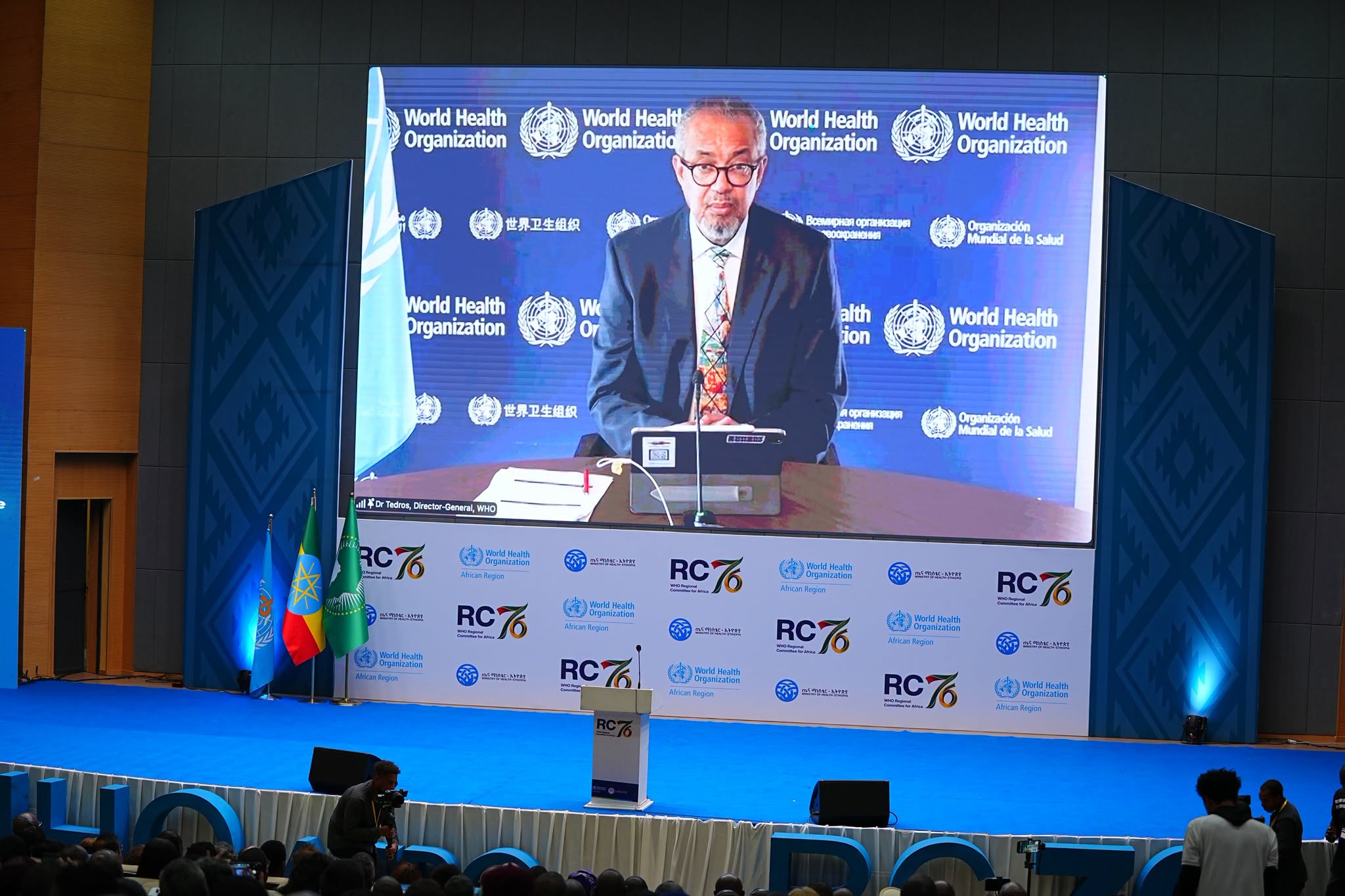
Africa Has Opportunity to Reduce Dependency Through Health Sovereignty, Self-Reliance & Solidarity: WHO Chief
Addis Ababa, August 25, 2026 (FMC) — Africa has an opportunity to reduce its dependence on external health financing by building greater health sovereignty, self-reliance and solidarity, World Health Organization (WHO) Director-General Dr. Tedros Adhanom Ghebreyesus said.
Speaking at a webinar during the 76th Session of the WHO Regional Committee for Africa in Addis Ababa, Dr. Tedros said the continent’s recent health gains demonstrate the potential to advance even amid severe disruptions to international health financing.
He said the sharp and sudden cuts to international financing had disrupted life-saving programs, resulting in clinic closures and job losses affecting HIV, tuberculosis, malaria, neglected tropical diseases, and maternal and newborn care.
At the same time, he highlighted continued progress across the continent. More than 21.7 million people living with HIV remain on uninterrupted treatment, while several countries have met the 95-95-95 targets. TB treatment coverage has risen to 74 percent from 52 percent in 2020, while malaria vaccine rollout has reached 25 countries.
Dr. Tedros also noted that more than 18 million children who had missed vaccinations have received catch-up immunization, while four million additional people have gained access to mental health services.
He said eight countries had reached major milestones in disease elimination, while Cabo Verde, Mauritius and Seychelles had become the first sub-Saharan African countries to achieve verified elimination of measles and rubella.
Despite these advances, Dr. Tedros warned that Africa continues to face major health-system vulnerabilities. Families still pay about one-third of health spending out of pocket, more than 245,000 cholera cases have been recorded across the region, and 44 of the 47 countries cannot reliably record causes of death.
He also pointed to the disproportionate burden of maternal and child mortality in Africa, noting that around 70 percent of maternal deaths and nearly half of under-five deaths worldwide occur on the continent.
Dr. Tedros said the financing crisis should also be viewed as an opportunity for African countries to strengthen domestic capacity and reduce long-standing dependence on external resources.
He highlighted efforts by countries to mobilize domestic revenue, including health-tax reforms. Fifteen countries reformed tobacco taxation last year, while South Africa now finances three-quarters of its HIV response domestically and Nigeria has increased domestic financing for tuberculosis, according to WHO.
He said Africa could mobilize significantly greater resources for health by curbing illicit financial flows, securing fairer debt terms and making fuller use of health taxes alongside other domestic reforms.
Dr. Tedros further linked health sovereignty to stronger local production, noting that the regional agenda includes measures to establish a foundation for the production of medicines and other health products within Africa. He also highlighted WHO’s support for local production through the mRNA Technology Transfer Hub in Cape Town and technical and financial support to the African Medicines Agency.
He said the Regional Committee’s agenda provides a framework for moving the continent toward domestically financed health systems, a stronger health workforce and improved regulation of medical products.
Dr. Tedros also stressed that stronger health systems remain essential to addressing major outbreaks, citing the ongoing Ebola response in the Democratic Republic of the Congo (DRC).
He said WHO is supporting the DRC government, the Africa Centres for Disease Control and Prevention (Africa CDC) and other partners in the response, including through clinical trials of three vaccines and three treatments.
He urged African countries to seize the current moment to build a health system architecture defined by greater ownership and solidarity.
“In this crisis lies an opportunity: to leave aid dependency behind and build health sovereignty, self-reliance and solidarity,” Dr. Tedros said.
He said the decisions under consideration at the Regional Committee should help establish a new era of health for Africa—one increasingly financed and shaped by African countries themselves.