
Africa Must Finance, Produce and Shape Its Own Health Future — President Taye
Addis Ababa, August 25, 2026 (FMC) — Africa must strengthen its capacity to finance, produce and shape its own health priorities as the continent confronts unpredictable health financing, geopolitical instability, disease outbreaks, climate pressures and conflicts that disrupt vital health services, President Taye Atske-Selassie said.
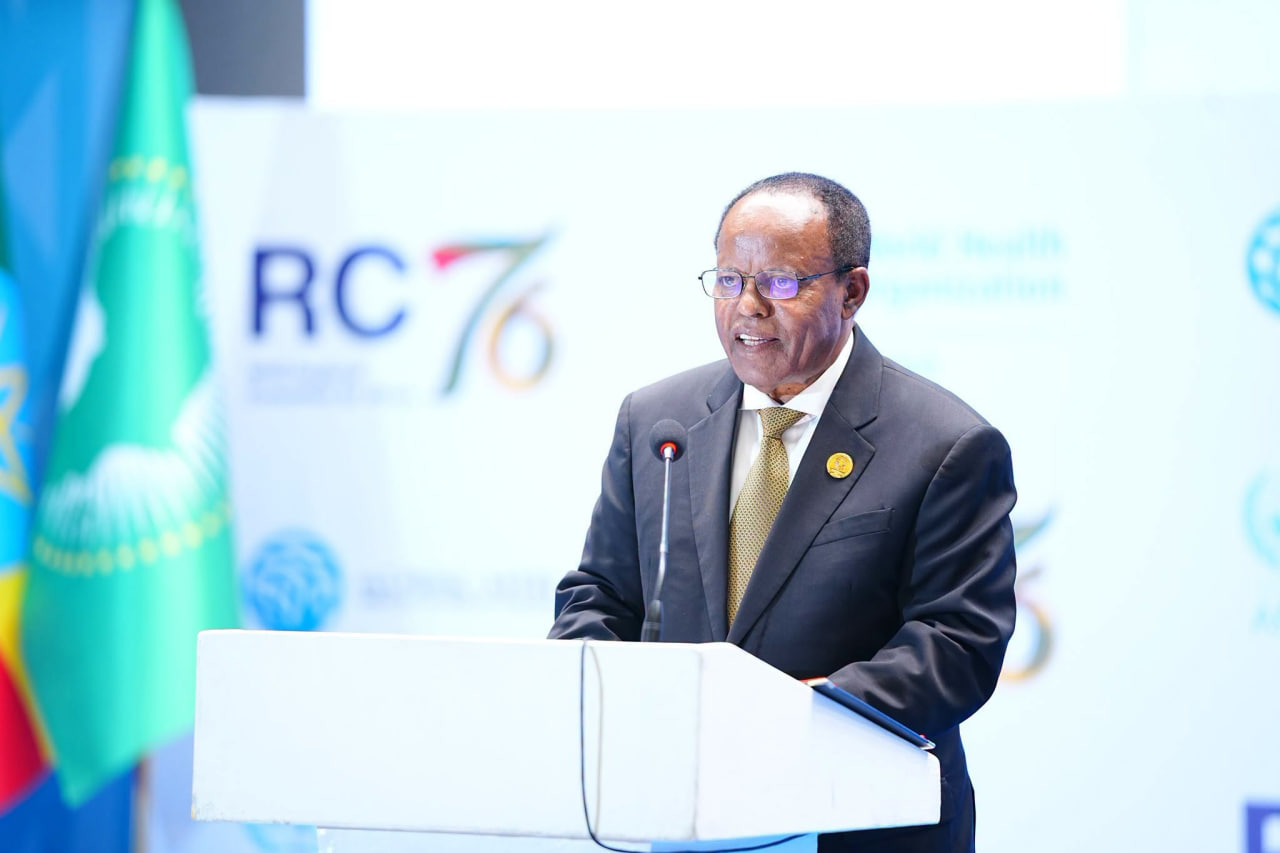
Addressing the 76th Session of the World Health Organization (WHO) Regional Committee for Africa in Addis Ababa, President Taye called for stronger regional cooperation and greater African ownership of the continent’s health architecture, stressing that decisions taken at the session should contribute directly to advancing the African Union’s Agenda 2063.
He said Africa was at a pivotal moment, facing a rapidly changing global environment in which health financing is becoming less predictable, geopolitical instability is testing multilateral institutions and disease outbreaks continue to threaten lives and economic stability.
Climate change, he added, is placing unprecedented pressure on communities, while conflicts disrupt essential health services, displace vulnerable populations and trigger cross-border humanitarian crises.
President Taye said these challenges also present a historic opportunity for Africa to strengthen its collective voice, deepen regional cooperation and assume greater ownership of its health architecture.
He highlighted Ethiopia’s experience in health-sector investment and structural reform, saying the country has treated health as a strategic national investment and steadily increased budget allocations despite competing economic demands.
Decades of investment in primary healthcare, he said, have brought essential services closer to communities and expanded access for millions of people, while expansion of the health workforce has contributed to progress in maternal, newborn and child survival.
President Taye also linked health resilience with environmental sustainability, citing Ethiopia’s Green Legacy Initiative as part of the country’s response to climate-driven health risks.
He noted that Ethiopia planted more than 800 million seedlings on August 3 as part of its target to plant 8 billion seedlings this year, bringing the total number of seedlings planted since the initiative began in 2019 to about 56 billion.
He further stressed that sustainable health systems cannot exist without peace, pointing to Ethiopia’s recently concluded National Dialogue, which brought together more than 4,000 delegates representing a broad range of political views.
He said dialogue and reconciliation are contributing to stability in Ethiopia and the wider region.
Turning to international cooperation, President Taye said global partnerships remain indispensable, but argued that effective partnerships should reinforce national leadership, strengthen domestic institutions and enable countries to sustain their own health priorities.
He cited the Accra Reset and its emphasis on stronger country ownership as an opportunity to rethink how global assistance supports national visions, while stressing that Africa’s ambitions must go further.
“Africa must be able to shape its own agendas by itself,” he said, arguing that the continent should not simply adapt to reforms designed elsewhere.
President Taye outlined five priorities for a unified and more self-reliant African health strategy.
The first is financial self-reliance, with African countries progressively increasing domestic public investment in health and shifting from external dependency toward predictable national financing models.
The second is accelerating local manufacturing of medicines, vaccines and diagnostics. Drawing on lessons from the COVID-19 pandemic, he underscored the need for stronger and more predictable investment in health security and vaccine capacity.
The third priority is harmonizing institutional roles, particularly by ensuring operational synergy between the WHO and the Africa Centres for Disease Control and Prevention (Africa CDC). He said the WHO’s global technical leadership and Africa CDC’s continental mandate should complement one another, while avoiding parallel systems and prioritizing country-led execution.
The fourth is institutionalizing strategic solidarity among African countries. President Taye called for practical mechanisms that would allow countries to rapidly share expertise, laboratory capacity and emergency supplies when neighboring countries face health crises.
He said African and other developing countries are particularly vulnerable when external support becomes uncertain, making stronger regional solidarity essential.
The fifth priority, he said, is for Africa to lead the climate-health agenda.
President Taye pointed to Ethiopia’s preparations to host COP32 in Addis Ababa in 2027, describing it as an opportunity for Africa to advance a unified position that places climate resilience, health systems and adaptation financing at the center of global policy discussions.
He posed fundamental questions over who sets Africa’s health priorities, who finances them and who delivers results for its people, arguing that the answers should begin with African leadership.
“National governments must lead, regional institutions must support, and global organizations must scale up their follow-up coordination and technical leadership,” he said.
President Taye concluded by calling for Africa’s next health chapter to be defined by “ownership over dependency, integration over fragmentation, and practical action over words,” urging participants to leave Addis Ababa with firm commitments and measurable actions.