
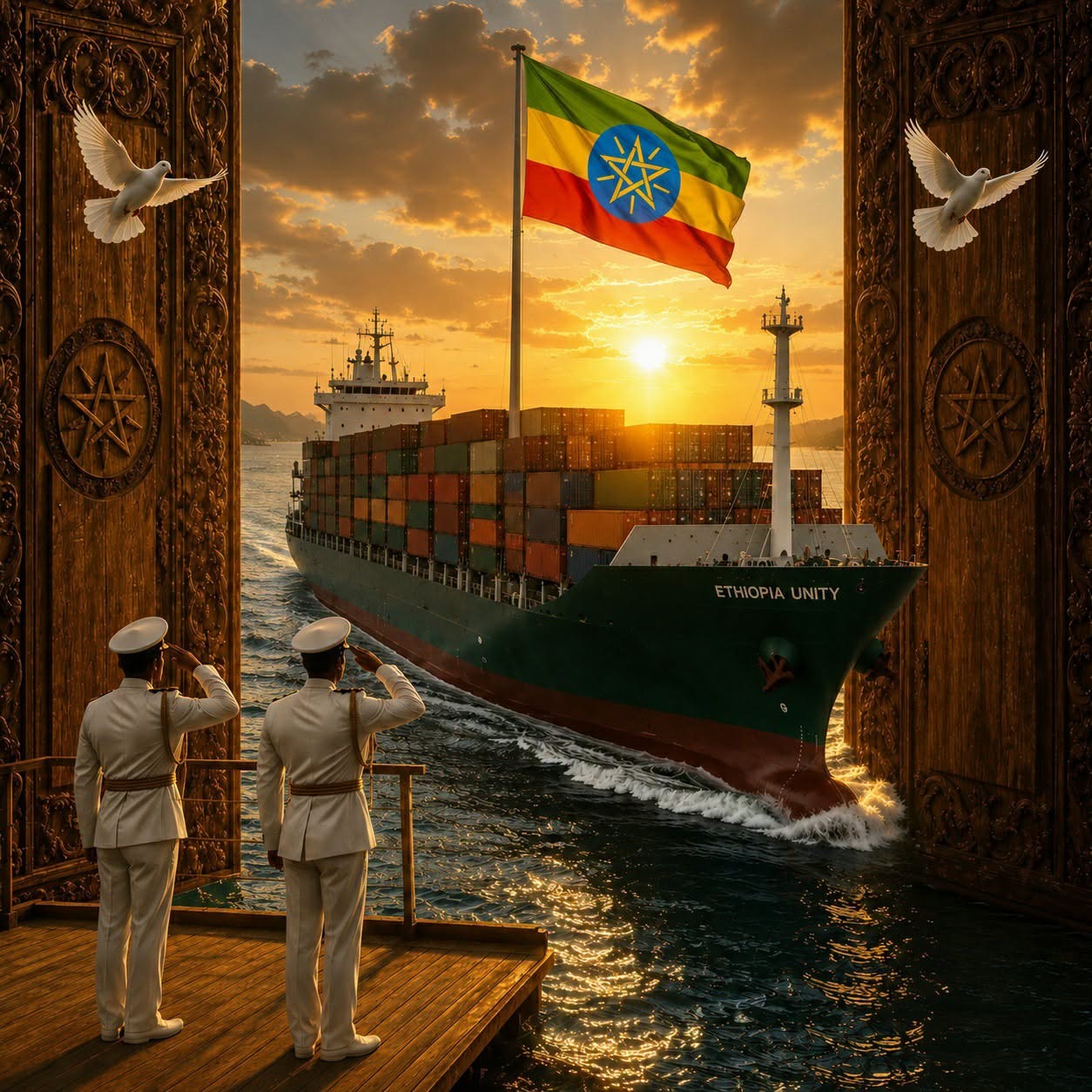
Beyond the Shoreline: Ethiopia and the New Economics of Red Sea Connectivity
Addis Ababa, September 25, 2026 (FMC) — Ethiopia’s relationship with the Red Sea was never meant to end at the shoreline. For centuries, the sea was part of the country’s economic geography, its civilizational reach and its strategic imagination.
Today, after more than three decades without direct sovereign access, the question is returning with the force of a transformed nation behind it.
Ethiopia’s maritime history reaches deep into antiquity. Adulis connected the Aksumite world to the Red Sea and the wider trading systems beyond it.
The sea was not a distant frontier to Ethiopia; it was a gateway through which goods, ideas, people and power moved between the African interior and the wider world. Historical research continues to document Ethiopia’s long engagement with Red Sea ports and maritime commerce.
That history makes Ethiopia’s present condition extraordinary.
A country with centuries of maritime history was stripped of direct sovereign access to the Red Sea in the upheavals surrounding the political transformation of the early 1990s.
In Ethiopia’s official account, this was not simply the inevitable consequence of Eritrea’s independence.
It was the product of a geopolitical conspiracy in which external interests and internal actors combined to sever Ethiopia from its historic maritime position without a sovereign national decision surrendering that inheritance.
The consequence was not merely the redrawing of a border. It was the removal of a historic coastline from Ethiopia’s sovereign geography.
Prime Minister Abiy Ahmed has stated that Ethiopia lost its sea access without a decision of the Ethiopian people, Cabinet or Parliament, describing the manner in which the loss occurred as illegal and unjust.
An Ethiopian geopolitical analysis published in 2026 likewise argued that transitional authorities lacked the constitutional legitimacy and parliamentary mandate to relinquish Ethiopia’s historical maritime position, particularly regarding Assab.
That is the historical question at the heart of Ethiopia’s maritime agenda: not simply why a country became landlocked, but how an ancient Red Sea nation came to have its direct maritime position removed without a sovereign national act that, in Ethiopia’s view, legitimately surrendered that inheritance.
Three decades have not erased that question.
They have magnified it.
The Ethiopia that entered the 1990s is not the Ethiopia of 2026. The country has grown in population, production, infrastructure, technological capability, diplomatic reach and continental ambition.
Its economy now stretches into manufacturing, aviation, digital services, renewable energy, modern agriculture and increasingly sophisticated regional and global trade networks.
Yet its maritime geography remains frozen in the political circumstances of another era.
That contradiction has an economic price.
A modern economy does not operate on maps alone. Machinery must arrive. Industrial inputs must move. Fuel must reach markets.
Agricultural commodities must find buyers abroad. Manufactured goods must compete across continents. Investment follows infrastructure, and infrastructure ultimately follows access.
For Ethiopia, the sea is therefore not a luxury added to development after everything else has been built. It is part of the infrastructure of development itself.
This is where the old maritime question becomes the new economics of connectivity.
Ethiopia’s enormous economic transformation has made its landlocked geography increasingly consequential. Every expansion of manufacturing deepens the need for international supply chains.
Every increase in exports intensifies the importance of efficient access to overseas markets. Every new industrial investment creates another connection between Ethiopia’s productive capacity and the maritime arteries of the global economy.
The larger Ethiopia becomes, the greater the economic significance of the sea.
That is why the maritime question can no longer be reduced to the search for a place where ships can load and unload Ethiopian cargo. A port is a physical facility. Sovereign maritime access is an economic option, a strategic choice and an extension of national geography.
It means having greater control over the routes through which an economy meets the world.
It means expanding the choices available to producers, exporters, investors and consumers.
It means reducing the distance—physical, economic and strategic—between Ethiopian production and global markets.
And it means confronting a fundamental contradiction: Ethiopia is building an economy whose ambitions are global while remaining separated from the maritime geography through which much of that global economy moves.
The contradiction is becoming even more pronounced as Ethiopia builds the foundations of a new economic order at home.
Its renewable-energy ambitions are creating a major power-producing economy. Its agricultural transformation is opening new export possibilities. Its manufacturing agenda is seeking deeper integration into global value chains.
Its aviation industry has made Addis Ababa one of Africa’s major international gateways. Its digital transformation is creating new economic networks beyond physical borders.
The country is building outward in almost every direction.
The sea is the missing dimension.
That is why Ethiopia’s maritime pursuit is increasingly inseparable from the country’s broader transformation.
The objective is not simply to recover a historical memory. It is to align Ethiopia’s physical and economic geography with the scale of the country it has become.
The issue has consequently moved from historical discourse into the highest levels of international diplomacy.
At the 81st United Nations General Assembly on September 24, President Taye Atske-Selassie stated that Ethiopia had come to recognize that its efforts to build a strong economy could not generate sustained development without reliable and dependable access to the sea.
He declared that Ethiopia was pursuing all possible diplomatic avenues to secure access to and from the sea and ensure its integration into the global trading system.
That statement carries the question beyond Ethiopia’s borders.
It tells the international community that the maritime issue is no longer a peripheral historical grievance. It is now being placed at the center of Ethiopia’s economic future.
And there is a reason for that timing.
The global economy has become a geography of corridors. Supply chains determine industrial competitiveness.
Maritime routes determine the movement of commodities and manufactured goods. Ports have become nodes in systems connecting producers, consumers, energy markets and investment across continents.
Countries do not merely trade through the sea. Their economic power is increasingly shaped by how effectively they connect to it.
For Ethiopia, this makes maritime access part of the unfinished architecture of national development.
The country has demonstrated that it can build dams of continental significance, expand renewable-energy production, transform agricultural production, construct major transport infrastructure and create new digital systems.
It has demonstrated that geographic constraints do not automatically dictate economic destiny.
The Red Sea question follows the same logic.
A country can inherit a difficult geography. It does not have to surrender its future to it.
This is why Ethiopia’s maritime ambition has acquired such weight. The country is not attempting to invent a relationship with the Red Sea.
It is seeking to restore a relationship that its history had already established and that the political upheavals of the twentieth century and early 1990s interrupted.
The distinction matters.
A new economic relationship with the sea would not merely change where Ethiopian cargo moves. It could change how Ethiopia conceives its economic geography.
The Ethiopian economy would no longer have to be understood solely through the boundaries of a landlocked state. Its productive interior could be connected more directly to the maritime world.
Its exporters could operate with a wider range of possibilities. Its industries could be positioned closer to global supply chains. Its strategic economic choices could expand.
The shoreline would become not an ending, but a beginning.
That is the deeper meaning of “connectivity.”
Connectivity is not simply roads meeting ports. It is the capacity of a nation to convert production into trade, geography into opportunity and infrastructure into economic power.
For Ethiopia, the absence of direct sovereign maritime access has meant that one of the world’s most consequential economic spaces has remained outside its sovereign geography even while remaining central to its commercial life.
That contradiction cannot be made invisible by time.
Nor can three decades of landlocked existence erase a maritime history measured in centuries.
The question now confronting Ethiopia is therefore larger than the recovery of a port.
It is whether the country’s next phase of economic transformation can be built on a geography inherited from the political settlements of the early 1990s—or whether Ethiopia will succeed in opening a new maritime chapter consistent with the scale, ambitions and economic weight of the country it has become.
The answer will not be found in nostalgia.
It will be found in diplomacy, international engagement, legal argument, economic statecraft and the determined pursuit of national interest.
Ethiopia has already taken that question to the world.
President Taye’s address at the United Nations has placed reliable maritime access alongside the country’s wider economic transformation, connectivity, manufacturing, renewable energy and continental integration agenda.
The message is unmistakable: Ethiopia cannot build a globally integrated economy while treating the sea as someone else’s geography.
For more than three decades, Ethiopia has lived with the consequences of losing direct maritime access. Now it is confronting the historical question with the weight of a country that has changed profoundly since that loss.
Its population has changed.
Its economy has changed.
Its ambitions have changed.
Its continental role has changed.
But the coastline was never forgotten.
Beyond the shoreline lies more than water and shipping lanes. It lies the economic geography of the world Ethiopia is trying to enter more fully: global markets, international supply chains, investment networks and the maritime arteries that bind continents together.
That is why Ethiopia’s return to the Red Sea is not merely about the past.
It is about the future.
It is about whether a nation that has spent more than three decades living with the consequences of maritime deprivation will accept those circumstances as the permanent geography of its destiny—or pursue the restoration of the maritime space it regards as an integral part of its history, sovereignty and national interest.
The shoreline is only the beginning.
What lies beyond it is Ethiopia’s place in the new economics of global connectivity.