
Breaking the Yield Ceiling, Recasting a Continent’s Food Future: Ethiopia’s Agricultural Ascent
Addis Ababa, September 21, 2026 (FMC) — For much of the modern era, Ethiopia entered the global food conversation from the wrong end of the equation.
Its name was repeatedly associated with famine, drought, food shortages and appeals for assistance. The country’s agricultural potential was immense, yet the distance between potential and production remained one of the defining constraints on its development.
That equation is now being challenged—not by rhetoric, but by a widening body of production, irrigation, mechanization, diversification and environmental restoration that is changing the scale and direction of Ethiopia’s agricultural story.
The most visible break with the past has come through wheat.
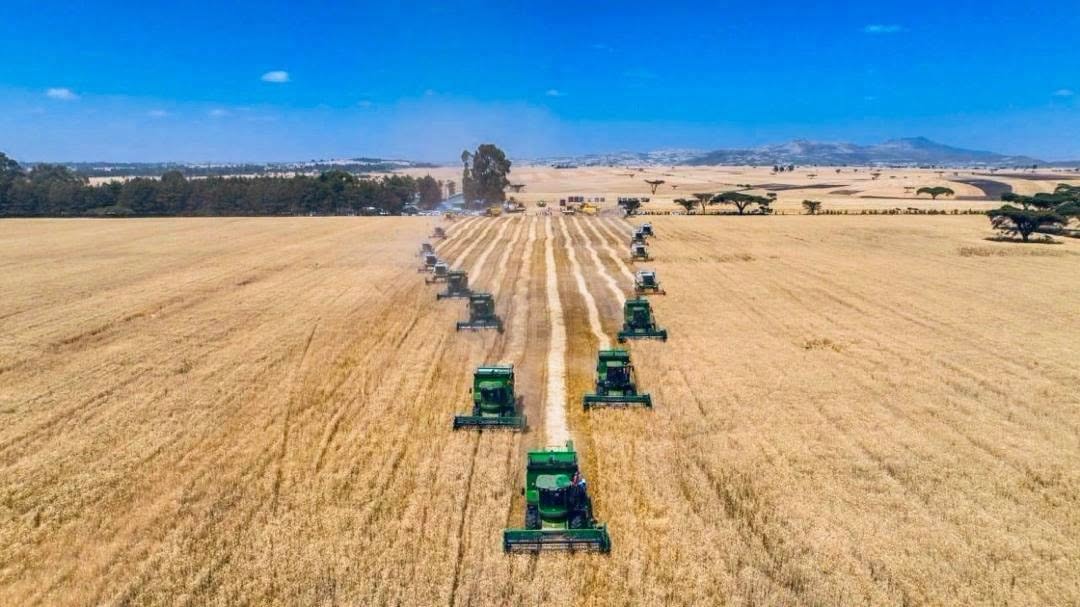
In a transformation that has unfolded with remarkable speed, irrigated wheat cultivation expanded from only 20,000 hectares in 2020 to 3.5 million hectares in 2025.
Wheat production from both rainy- and dry-season cultivation reached 280 million quintals in 2025, according to Ethiopia’s Ministry of Agriculture.
The country says it fully replaced an estimated 2.6 million quintals of wheat previously imported annually, saving about 1 billion US dollars a year in foreign exchange.
What makes the wheat story consequential is not simply the size of the harvest. It is the change in the production system behind it.
Irrigation has pushed cultivation beyond the traditional limits imposed by rainfall. Heat-tolerant varieties have opened new production possibilities in hotter lowland environments.
Mechanization, improved seed, soil management, agricultural research, extension services and organized production have increasingly been brought together around a single objective: turning agricultural potential into dependable productive capacity.
The transformation has already moved beyond import substitution.
In February 2023, Ethiopia made its first international wheat exports. FAO Director-General QU Dongyu subsequently described the country’s wheat self-sufficiency programme as a source of inspiration in Africa and globally, while urging Ethiopia to share its experience with other African countries.
That distinction matters.
A country that once had to look outward to fill part of its wheat requirement has increasingly been able to look inward for supply—and then outward again, this time as a potential supplier.
It is a movement from deficit to capacity.
And wheat is only one field in a much larger agricultural landscape.
According to a 2026 government review, overall agricultural output increased from 41.7 million tons to around 150 million tons over seven years.
Cluster farming has expanded to 9.5 million farmers across 12.8 million hectares, with reported gains of 29 percent in productivity and 18 percent in income. Crop diversification has accelerated, while coffee production has nearly doubled to around one million tons, generating about 2.65 billion US dollars in export earnings in 2024/25.
The transformation is also reaching beyond crops.
Under the Yelemat Tirufat, or Bounty of the Basket, initiative, Ethiopia has been expanding livestock, poultry, fisheries and beekeeping alongside crop production.
The Ministry of Agriculture reports annual milk production rising from 5.8 billion litres in 2022 to 11.7 billion litres in 2026, reflecting a broader effort to turn livestock assets into productive food systems, household income and commercial value chains.
In this emerging architecture, agriculture is no longer being treated simply as the sector that feeds the population.
It is increasingly being positioned as a foundation for industrialization, foreign-exchange generation, rural transformation, employment and economic resilience.
That is where the language of food security begins to meet the language of sovereignty.
Food security concerns whether people can access sufficient food.
Food sovereignty raises a deeper question: how much of that food can a country produce through its own land, knowledge, technology, infrastructure, farmers and institutions, and how resilient is that productive system when international markets are disrupted?
The experience of recent years has made that question impossible to ignore.
Pandemics, wars, disrupted supply chains, fertilizer shocks, food-price volatility and climate extremes have demonstrated that dependence on distant supply chains can quickly become an economic and strategic vulnerability.
For Ethiopia, expanding domestic production therefore carries significance well beyond the farm gate.
Every tonne of wheat produced domestically can reduce import exposure. Every irrigated hectare can extend the productive season.
Every improved seed variety can raise the return on land and water. Every new agro-processing connection can move value closer to the source. Every rural production cluster can create a stronger bridge between the farmer and the wider economy.
This is the logic behind the country’s growing emphasis on agricultural value chains rather than production alone.
It is also why the transformation is increasingly connected to Africa’s own search for food sovereignty.
The African Development Bank has described Ethiopia’s wheat experience as exemplary in the continent’s effort to raise agricultural productivity, while its climate-resilient wheat programme in Ethiopia brings together improved seed, irrigation, soil health, mechanization, post-harvest infrastructure and market access.
The continental wheat workshop now being held in Addis Ababa adds another dimension to that trajectory.
The gathering brings together agricultural policymakers, researchers, seed companies, regulators, farmer organizations and development partners to examine Ethiopia’s experience alongside the broader challenge of accelerating sustainable wheat transformation across Africa.
The emphasis on national seed systems and access to quality seed is especially revealing.
A transformation of this scale cannot depend indefinitely on one breakthrough crop or one production campaign. Its durability rests on science, breeding, seed multiplication, soil health, irrigation, mechanization, extension, finance, storage, markets and the capacity to continuously adapt agricultural systems to changing climates.
In other words, Ethiopia’s agricultural ascent is increasingly becoming a question of agricultural systems engineering.
The yield ceiling is not being challenged by a single intervention.
It is being challenged by changing the system beneath the yield.
And nowhere is that more visible than in landscapes where agriculture itself has changed its geographical boundaries.
In Ethiopia’s lowlands, including areas once regarded primarily through pastoral production systems, irrigation and heat-tolerant wheat varieties have created new possibilities for crop production.
The African Development Bank has documented the rapid expansion of irrigated wheat into Ethiopia’s hot, dry lowlands and linked the transformation to improved varieties, irrigation and technology.
This does not mean that pastoralism has ceased to matter, nor that every arid landscape can simply be converted into cropland.
The significance lies elsewhere: agricultural geography is no longer being treated as fixed.
Water, technology, science and infrastructure can alter the productive possibilities of a landscape.
That principle reaches beyond wheat.
It connects directly with another transformation that has become inseparable from Ethiopia’s development narrative: Green Legacy.
Since its launch in 2019, the initiative has turned environmental restoration into a nationwide undertaking. In 2026 alone, Ethiopia planted 805.3 million seedlings in a single 12-hour campaign with the participation of more than 26.2 million people.
By September, cumulative planting under the initiative had reached 56.8 billion seedlings over eight years, according to Ethiopia’s reported figures.
The significance of Green Legacy for agriculture lies beneath the visible canopy.
Soil, water, forests, watersheds, biodiversity and agricultural productivity are not separate systems. Degraded land erodes productive capacity; degraded watersheds undermine water security; soil loss weakens agricultural resilience.
Conversely, restoration can strengthen the ecological foundations on which farming depends.
Ethiopia’s 2026 National Regenerative Agriculture Strategy reflects this broader understanding, placing soil health, biodiversity and water management at the centre of efforts to build a more sustainable and climate-resilient agricultural system.
This is where the country’s agricultural and environmental narratives converge.
The field and the forest are no longer two unrelated stories.
One produces food.
The other helps protect the ecological conditions that make future production possible.
Together, they form part of a longer national attempt to turn land from a constraint into an asset—and vulnerability into productive resilience.
The international recognition that has accompanied the transformation is therefore significant, but perhaps more revealing as a marker than as an endpoint.
In January 2024, FAO awarded Prime Minister Abiy Ahmed the Agricola Medal, its highest award conferred by the Director-General.
FAO linked the recognition specifically to contributions to rural and economic development, the Wheat for Food Self-Sufficiency programme and Green Legacy. FAO’s Director-General said Ethiopia’s wheat self-sufficiency experience was an inspiration in Africa and globally and described the country’s experience as a model other countries could follow.
Recognition matters because it shows that the transformation is no longer being discussed only within Ethiopia.
But the more consequential measure is what happens when a national agricultural experiment becomes a reference point for continental problem-solving.
Africa has vast agricultural land, a young population and enormous potential, yet remains exposed to food imports and global supply shocks.
The African Union’s development ambitions, including the goals of Agenda 2063, ultimately depend not only on roads, markets and trade agreements, but on the productive capacity to feed African populations and generate value from African resources.
Agricultural surplus therefore carries a meaning larger than the surplus itself.
It can feed cities.
Supply industry.
Reduce import pressure.
Generate exports.
Strengthen rural incomes.
Support regional trade.
And alter the balance between what a country consumes and what it is capable of producing.
That is why Ethiopia’s wheat story has acquired a continental dimension.
The significance is not that one country has solved every food-security challenge. It has not. Ethiopia continues to face climate pressures, regional disparities, production constraints and food-security needs, while the agricultural system itself remains a work in progress.
The significance is that a country with one of Africa’s most powerful agricultural potentials is attempting to convert that potential into scale—and is doing so through a combination of irrigation, science, technology, production reform, environmental restoration and market development.
The old image of Ethiopia was often framed around the question of how much food the country needed from elsewhere.
The emerging question is increasingly different:
How much can Ethiopia produce?
How much more can it produce?
How far can its agricultural frontier extend?
How much value can be created from the harvest?
And how much of that experience can travel across Africa?
Those questions point toward a different national trajectory.
The harvest is becoming more than a harvest.
It is becoming infrastructure for food sovereignty.
The irrigation canal is becoming more than a waterway.
It is becoming an instrument for extending the productive calendar.
The improved seed is becoming more than an agricultural input.
It is becoming a piece of technological sovereignty.
The restored landscape is becoming more than environmental repair.
It is becoming part of the productive foundation of the future.
And the wheat field—once part of an import equation—is increasingly becoming a measure of what happens when science, water, land, policy and productive ambition converge.
Ethiopia’s agricultural ascent is therefore not simply a story of growing more.
It is a story of changing the ceiling.
And as that ceiling rises, so does the horizon of what Ethiopia can contribute to Africa’s search for a food-secure, productive and increasingly self-reliant future.
By Mesafint Brlie