
FROM INVASION TO PROXIES: Egypt’s Enduring Campaign Against Ethiopia
Addis Ababa, October 8, 2026 (FMC) — Egypt’s confrontation with Ethiopia did not begin with the Grand Ethiopian Renaissance Dam, nor did it begin with today’s geopolitical contest in the Horn of Africa. The roots run much deeper.
For generations, Cairo’s strategic calculations have been shaped by one overriding reality: Ethiopia sits upstream of the Abbay and commands enormous political, demographic and geographic weight in the Horn of Africa. That reality has repeatedly made Ethiopia central to Egypt’s calculations over water, regional influence and strategic access.
In the nineteenth century, the confrontation was not conducted through diplomatic communiqués or proxy networks.
Egyptian forces crossed into Ethiopian territory. Under Khedive Ismail, Egypt pursued an expansionist project in the Nile Basin and Red Sea region, culminating in military expeditions against Ethiopia. Egyptian forces suffered major defeats at Gundet in 1875 and Gura in 1876.
Historical scholarship records that securing the Nile sources was among the strategic motives behind Egypt’s regional expansion, while Egyptian forces attempted to establish control over territories connected to the Red Sea and upper Nile Basin.
The military expeditions failed, but the strategic question did not disappear.
It simply changed form.
The central Egyptian concern has remained the same: what happens if Ethiopia, the source of the Abbay, develops the economic and political capacity to use its own resources, assert greater control over its development choices and translate its geographic position into greater regional influence?
That question has followed Ethiopian-Egyptian relations into the modern era.
The Nile has consequently become much more than a river in the political imagination of Cairo. It has been treated as a strategic lifeline and a matter of national security.
Ethiopia, meanwhile, has increasingly rejected the notion that an upstream country should remain permanently constrained in developing its water resources.
The construction and completion of the GERD transformed that old strategic tension into a new era of confrontation. Even Egypt’s own official account of bilateral relations acknowledges that Nile waters and Horn of Africa security remain among the central issues binding the two countries.
This is where the old pattern meets the present.
The Egyptian army no longer needs to march toward the Ethiopian highlands for Cairo to exert pressure on Addis Ababa. The battlefield has become more sophisticated. Diplomatic alignments, regional partnerships, international lobbying and relationships with actors positioned around Ethiopia can serve purposes that once required armies.
And Eritrea occupies an especially consequential position in this new equation.
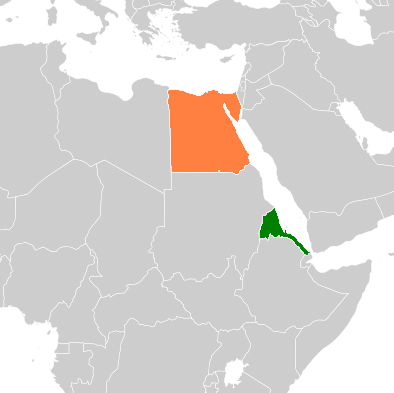
Cairo and Asmara have dramatically deepened their strategic relationship in recent years. President Abdel Fattah El-Sisi received President Isaias Afwerki in Cairo in June 2026, where the two sides discussed regional developments, Red Sea security and coordination between Egypt and Eritrea.
The Egyptian presidency explicitly described Red Sea governance and security as an area requiring coordination between the two countries.
The significance is difficult to miss.
Eritrea borders Ethiopia. It sits astride the Red Sea. Its political leadership has a long history inside Ethiopia’s political landscape. And Egypt has an unresolved strategic confrontation with Ethiopia over the Nile and a growing contest over influence in the Horn and Red Sea.
This is why the proxy dimension matters.
The old Egyptian approach sought to confront Ethiopia directly. The contemporary approach increasingly operates through a wider regional architecture in which pressure can be exerted from several directions simultaneously.
Eritrea can become one such pressure point. Regional diplomatic alignments can become another. Armed groups operating inside Ethiopia can become another.
And this is where the emergence of Tsimdo and the coming together of the rump TPLF group with other hostile armed elements becomes particularly significant to the broader strategic picture.
The question is no longer simply whether Cairo can defeat Ethiopia militarily. History already demonstrated the limits of that approach.
The more sophisticated question is whether Ethiopia can be kept sufficiently preoccupied, fragmented and strategically constrained that it cannot fully translate its demographic weight, economic expansion, water resources and geographic position into regional power.
That is the logic of proxy politics.
It is also why the words of Isaias Afwerki deserve attention. Afwerki has himself repeatedly spoken publicly about external powers seeking spheres of influence in the region and supporting proxies.
In his 2021 discussion of the Nile, he argued that the issue should not be viewed simply as a dispute among Ethiopia, Sudan and Egypt and warned that the Nile question could be used as a pretext for pursuing wider interests.
Afwerki has also spoken openly of the danger of outside actors attempting to shape Ethiopia through local partners and proxies.
Whatever one makes of his own political position, his public remarks provide an important window into how regional actors themselves understand the mechanics of influence in the Horn.
The broader historical record makes the argument even harder to dismiss.
Egyptian engagement with Eritrean political movements dates back decades. Historical accounts document Cairo’s involvement with Eritrean political actors during the formative period of the Eritrean liberation struggle, at a time when Egypt was pursuing influence across the Red Sea and Nile regions.
That history matters because today’s alignment is not emerging in an empty space.
It is emerging from decades of strategic competition over the same geography.
The Nile. The Red Sea. The Horn. Ethiopia.
The players have changed. The methods have changed. The language has changed.
But Ethiopia remains the strategic centre of gravity.
Today, Egypt can present its actions as regional diplomacy, Red Sea coordination or national-security policy. It can deepen relations with Eritrea, engage Sudan, build partnerships in Somalia and use international diplomatic platforms to advance its interests.
None of those activities, taken individually, proves a coordinated campaign to weaken Ethiopia. But taken together with the history of Nile competition and the rapidly deepening Egypt-Eritrea alignment, they form a strategic pattern that Ethiopia cannot afford to ignore.
The irony is that Cairo’s greatest fear may ultimately be the very Ethiopia that its previous strategies helped create.
A stronger Ethiopia cannot be treated as a peripheral Nile state.
A more prosperous Ethiopia cannot be permanently confined to a subordinate role in the regional order.
An Ethiopia that controls its development agenda, builds massive productive infrastructure, expands its diplomatic reach and seeks diversified access to the Red Sea inevitably alters the strategic balance of the Horn.
That is precisely why the struggle has moved beyond the river.
The GERD is only one theatre.
The Red Sea is another.
The political stability of Ethiopia is another.
And the cultivation of forces capable of keeping Ethiopia internally preoccupied is another.
This is the transition from invasion to proxies.
The old campaign required Egyptian soldiers crossing borders. The new contest requires something far cheaper: strategic partners, political leverage, diplomatic pressure and local actors willing to carry the confrontation from within Ethiopia’s neighbourhood—and, where possible, from within Ethiopia itself.
The Trojan horse, in this reading, is not necessarily a single organization. It is a method.
It is the use of another actor’s territory, grievances, armed networks or political ambitions to pursue a strategic objective without bearing the full cost of direct confrontation.
And this is why the current convergence involving Cairo, Asmara and hostile armed elements around Ethiopia deserves the closest scrutiny.
Egypt’s old problem with Ethiopia has never been simply Ethiopia’s existence.
It has been Ethiopia’s potential.
The potential to develop the Abbay.
The potential to become economically stronger.
The potential to exercise greater influence in the Horn.
The potential to reclaim a meaningful relationship with the Red Sea.
The potential to emerge as an increasingly consequential African power.
History shows that Cairo has confronted that potential through different instruments at different moments.
The nineteenth-century invasion failed.
The old attempts to control the Nile’s strategic environment evolved.
The political struggle over the Horn continued.
And today, the instruments are increasingly regional and indirect.
The proxies may change.
The partnerships may change.
The diplomatic vocabulary may change.
But the strategic contest over Ethiopia’s rise remains.
The decisive question for the present generation, therefore, is not whether Egypt still regards Ethiopia as strategically important. It plainly does.
The question is whether Ethiopia will allow its internal political challenges and the ambitions of external actors to become instruments for containing its national transformation.
That is the contest behind the contest.
From invasion to proxies, the battlefield has changed.
The strategic stakes have not.