
From the Red Sea to New Delhi: Ethiopia Takes Its Maritime Quest to the Heart of BRICS Diplomacy
Addis Ababa, September 17, 2026 (FMC) — From the shores of the Red Sea to the diplomatic table in New Delhi, Ethiopia’s quest for reliable access to the sea is increasingly becoming a defining strand of its international diplomacy.
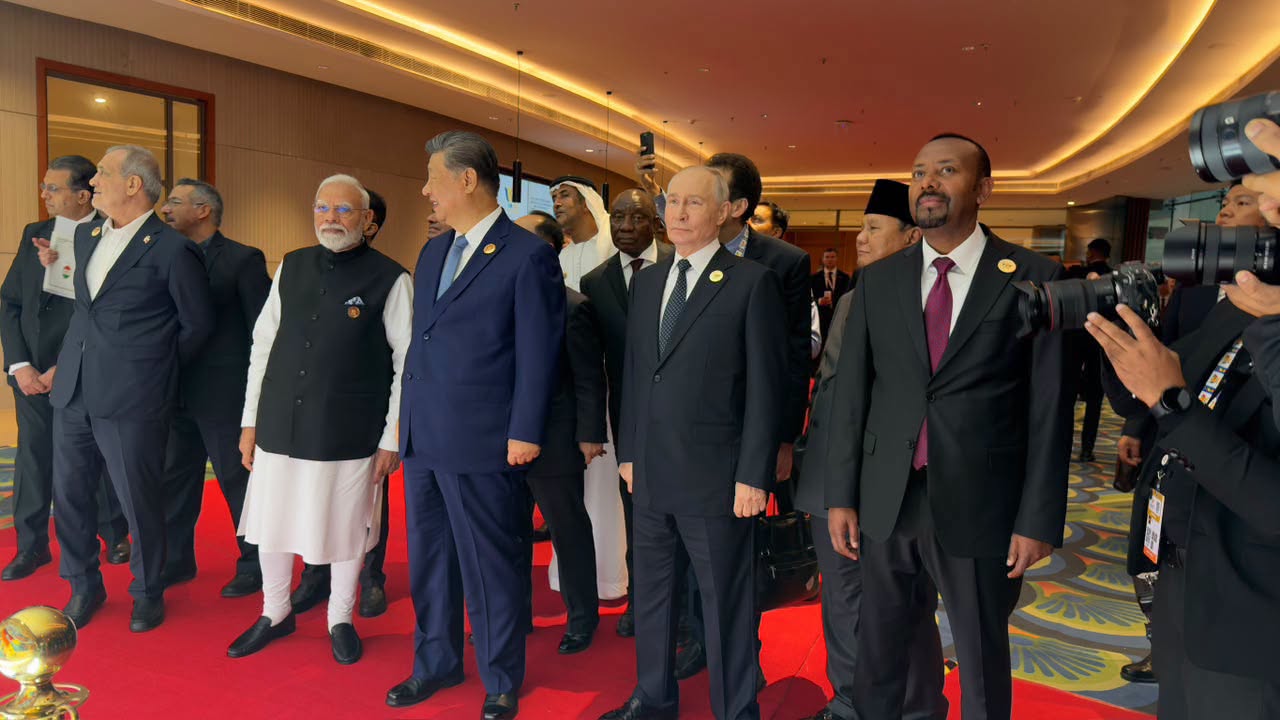
At the 18th BRICS Leaders’ Summit, Prime Minister Abiy Ahmed carried the question into the heart of a major gathering of emerging powers, placing Ethiopia’s maritime imperative within a broader argument over trade, markets, connectivity and the architecture of a more inclusive global economy.
His message was direct: for a large and growing economy, access to the sea is not a peripheral aspiration but an economic necessity. Ethiopia, he said, needs reliable and diversified access to international trade routes and will continue pursuing that objective through peaceful and negotiated arrangements.
The significance of New Delhi lies precisely there.
Ethiopia did not introduce its maritime question to the world at BRICS. It elevated it.
The intervention came after years in which Addis Ababa has increasingly brought the question of maritime access into bilateral diplomacy, regional engagement and international forums. What was once largely discussed within the confines of the Horn of Africa has steadily become part of Ethiopia’s wider foreign-policy conversation: a question touching economic sovereignty, continental connectivity, regional security and the country’s place in global commerce.
A history that reaches the sea
Ethiopia’s relationship with the Red Sea is considerably older than the modern political geography that now separates the country from the coast.
The civilisation of Aksum developed one of the ancient world’s significant commercial connections with the Red Sea through the port of Adulis, linking the Ethiopian highlands to markets across the Red Sea and Indian Ocean. Ethiopia’s more recent history likewise included direct maritime access through the territory that became Eritrea. Following the 1952 federation with Eritrea, Ethiopia again possessed direct access to the Red Sea; that access ended with Eritrea’s independence in 1993.
The loss transformed Ethiopia’s strategic geography.
Assab and Massawa had served as maritime outlets for Ethiopian commerce. Their separation from Ethiopia following Eritrea’s independence left Africa’s second-most populous country without a coastline and placed its international trade increasingly dependent on external maritime corridors. Ethiopian historical and strategic scholarship has consequently continued to treat maritime access not as a newly discovered ambition, but as a question rooted in the country’s history and its contemporary economic needs.
That history is central to understanding the diplomatic language Addis Ababa uses today.
Ethiopia is not presenting sea access simply as a matter of geographical convenience. Its argument combines historical connection with present-day economic necessity and a strategic assessment of what a major African economy requires to participate fully in international commerce.
Prime Minister Abiy has repeatedly emphasized that Ethiopia seeks to advance this objective peacefully and through negotiation rather than confrontation. That formulation was again carried into the BRICS setting.
New Delhi changes the scale of the conversation
The choice of BRICS as a diplomatic platform was significant.
The grouping brings together major economies spanning Africa, Asia, Latin America and the Middle East, creating a forum in which questions of trade, development, finance, connectivity and reform of international institutions intersect.
At New Delhi, Abiy connected Ethiopia’s maritime question to precisely that wider economic architecture.
“Access to finance must be matched by access to markets,” the Prime Minister told the summit. He then linked financial connectivity to physical connectivity, arguing that trade requires both payments and goods to move efficiently. For Ethiopia, he said, “access to the sea is first and foremost an economic imperative.”
That formulation gives the maritime agenda a larger meaning.
A port is not the destination of an economy. It is an entry point into one.
For Ethiopia, reliable access to international trade routes would affect the movement of exports, imports, industrial inputs, agricultural products, machinery and investment. It would influence the cost and resilience of supply chains and the country’s capacity to connect its expanding productive base with markets beyond its immediate neighbourhood.
The Prime Minister therefore placed sea access alongside the other elements of Ethiopia’s economic proposition to BRICS: capital, technology, markets, industrial partnerships, mineral development, renewable energy and value creation.
The message was broader than a request for a maritime outlet.
It was an argument about economic reach.
From geography to economic sovereignty
For Ethiopia, the maritime question is inseparable from the transformation of its economy.
A country seeking to expand manufacturing, agriculture, mining, energy, logistics and exports needs dependable channels into international markets. Geography can impose costs, but it does not have to determine economic destiny.
This is why Ethiopia has increasingly spoken of reliable and diversified access rather than dependence on a single corridor.
Diversification matters because international commerce is vulnerable to disruption. A major economy whose external trade depends heavily on one principal maritime route faces exposure to congestion, instability, price pressures and geopolitical shocks.
Sea access, in Ethiopia’s formulation, is therefore part of building resilience.
At BRICS, this logic was extended further. Ethiopia argued for stronger financial connectivity and more efficient cross-border payments alongside physical connectivity, reflecting an understanding that modern trade depends on both the movement of goods and the movement of value.
The sea route and the payment route ultimately serve the same purpose: making economic exchange faster, broader and more resilient.
The African dimension
There is also a continental dimension to Ethiopia’s maritime campaign.
Ethiopia sits at the centre of the Horn of Africa, close to one of the world’s most strategically important maritime corridors. The Red Sea and Gulf of Aden connect the Indian Ocean to the Suez Canal and carry a substantial share of global commerce.
For Ethiopia, therefore, maritime connectivity is not only about its own trade.
It intersects with the future of African integration.
The African Continental Free Trade Area is intended to deepen trade among African economies, but continental production ultimately requires efficient connections to global markets as well. For landlocked economies, maritime corridors are indispensable links in that chain.
Ethiopia’s argument is consequently becoming increasingly connected to a broader African development proposition: if African economies are to industrialize, add value to their resources and compete more effectively in global markets, physical connectivity cannot remain an afterthought.
This is one reason the maritime issue resonates beyond Ethiopia’s borders.
It is a question of how geography, infrastructure and global commerce intersect with Africa’s economic transformation.
BRICS as diplomatic leverage
New Delhi also demonstrated another dimension of Ethiopia’s approach: using multilateral platforms to widen the diplomatic space around issues of national importance.
Ethiopia joined BRICS in 2024 and has since participated in the grouping’s senior-official and ministerial processes. Before the New Delhi summit, Ethiopian Ambassador to India Nibu Tedla Nagas described BRICS as a platform through which developing countries could collectively advocate for greater representation in global decision-making and reform of international financial institutions.
The maritime question fits naturally within that larger diplomatic strategy.
Ethiopia is not placing its sea-access agenda in one diplomatic basket.
It is advancing the question through bilateral relations, regional diplomacy and multilateral institutions while connecting it to trade, development, security and international cooperation.
New Delhi added another major platform to that effort.
And the timing matters.
The BRICS summit was taking place against a backdrop of intense debate over global economic governance, connectivity and the changing distribution of influence among emerging economies. The bloc’s own declaration emphasized the greater participation of developing and emerging economies in international decision-making.
Ethiopia’s maritime question thus entered a forum whose broader political vocabulary includes precisely the issues Addis Ababa has been emphasizing: representation, access, connectivity and a greater voice for developing economies.
A diplomatic campaign, not a single demand
The evolution of Ethiopia’s maritime diplomacy is perhaps most visible in the way the issue is now framed.
It is no longer confined to the question of obtaining a port.
It encompasses trade corridors, economic resilience, regional integration, maritime security, international law, investment and the strategic geography of the Horn of Africa.
The objective is reliable access.
The method Ethiopia continues to emphasize is negotiation.
And the diplomatic arena is becoming increasingly international.
This distinction is critical in a region where maritime geography is deeply intertwined with national sovereignty and security. Ethiopia’s stated approach has been to pursue mutually beneficial arrangements through peaceful dialogue, while recognizing the sovereignty and interests of neighbouring states. Prime Minister Abiy reiterated that approach at BRICS.
The firmness of the objective and the peacefulness of the method are not contradictory.
They are the two pillars of the same diplomatic strategy.
From New Delhi to the next diplomatic horizon
New Delhi should therefore be understood as another milestone in a campaign that is still unfolding.
The summit gave Ethiopia an opportunity to put its maritime question before leaders representing some of the world’s largest emerging economies. It allowed the issue to be linked directly to international trade, market access and economic connectivity rather than treated solely as a regional geopolitical dispute.
It also demonstrated how Ethiopia is increasingly using its diplomatic platforms to connect national priorities to larger international conversations.
At BRICS, Ethiopia was advancing interests on finance, markets, trade, technology, climate, industrial development and institutional reform. Sea access was part of that wider picture—not an isolated demand detached from the country’s economic transformation.
That broader framing may ultimately be one of the most important developments in Ethiopia’s maritime diplomacy.
Because the question is not simply whether Ethiopia can reach the Red Sea.
It is whether Ethiopia can secure a reliable, sustainable and mutually beneficial maritime connection that matches the scale of its economy, its population, its regional responsibilities and its ambitions for deeper integration into world trade.
The historical relationship with the sea gives the question its memory.
The country’s economic transformation gives it urgency.
The Red Sea’s strategic importance gives it regional weight.
And diplomacy gives Ethiopia the avenue through which it is seeking to advance it.
From the shores of a sea to which Ethiopia has been historically connected, to the summit halls of New Delhi, the maritime question has travelled a long way.
It is now firmly on the international diplomatic map.
And Ethiopia is making clear that it intends to keep it there.