
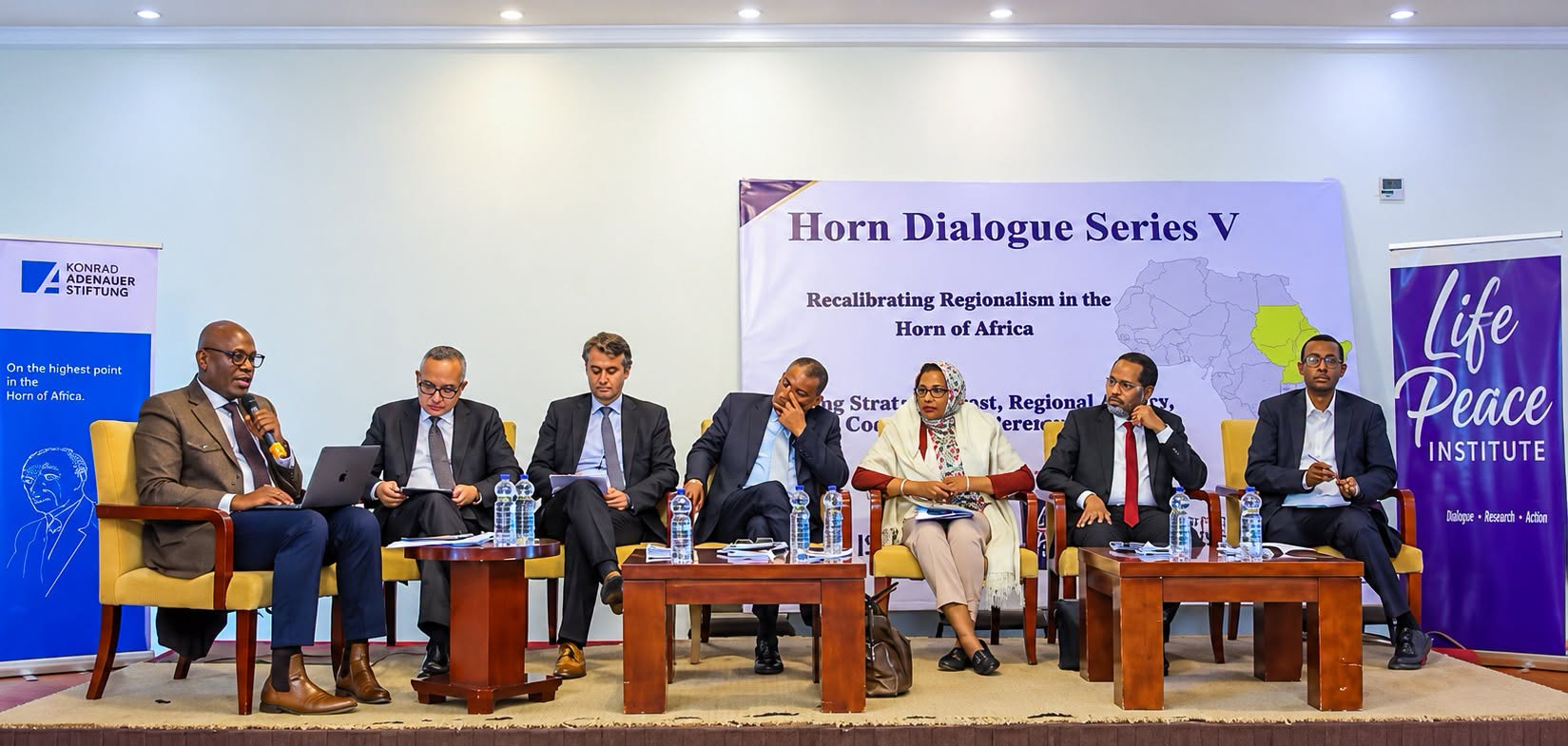
Horn Dialogue Champions Regional Ownership and Collective Action for Regional Security
Addis Ababa, November 25, 2026 (FMC) – Countries of the Horn of Africa must take greater ownership of regional security, reconcile national interests with shared priorities and move beyond fragmented approaches to address the conflicts and challenges confronting the region, participants at the fifth Horn Dialogue emphasized as the forum opened in Addis Ababa on Wednesday.
The two-day dialogue, convened by the Institute of Foreign Affairs (IFA) in partnership with the Institute for Security Studies (ISS), the Life & Peace Institute (LPI) and the Konrad-Adenauer-Stiftung (KAS), brings together policymakers, diplomats and experts to examine how strategic trust, regional agency and cooperative interdependence can lay the foundations for a more stable and integrated Horn of Africa.
Held under the theme “Recalibrating Regionalism in the Horn of Africa: Building Strategic Trust, Regional Agency, and Cooperative Interdependence,” the fifth edition focuses on strengthening regional cooperation and enabling countries to address shared security and development concerns through sustained dialogue and collective action.
Opening the forum, IFA Chief of Staff Dr. Gizachew Asrat, delivering welcoming remarks on behalf of Executive Director Dr. Abdiwasa Abdillahi, highlighted the Horn’s strategic importance, economic potential and opportunities for regional connectivity.
He underscored the need for constructive dialogue, strategic trust and mutually beneficial cooperation, emphasizing the role of research and policy institutions in translating policy discussions into practical recommendations.
Representatives of the partner institutions similarly stressed that the region’s future depends on stronger cooperation, locally driven solutions and tangible commitments. Dr. Paul-Simon Handy, ISS Regional Director for East Africa and Representative to the African Union, identified strategic trust and regional agency as essential to enabling countries of the Horn to shape their own security and economic priorities.
Peter Langat Cheruiyot, Finance and Administration Director at LPI, noted that the value of regional dialogue lies not only in the quality of discussions but also in the commitments, partnerships and practical action that follow.
Jan-Ole Voss, Director of KAS’s Regional Programme Security Dialogue for East Africa, likewise emphasized that the region’s future must be shaped by its countries and peoples, describing regional ownership as indispensable to sustainable security and development.
In the opening address, Ambassador Adam Tesfaye, Chief of Staff at Ethiopia’s Ministry of Foreign Affairs, reaffirmed Ethiopia’s commitment to pursuing secure and reliable access to the sea through peaceful dialogue, diplomacy and international law.
The relationship between regional fragmentation and shared security challenges featured prominently in a panel discussion titled “From Fragmented Security to Cooperative Regionalism: What Kind of Order for the Horn of Africa?”
Guang Cong, the UN Secretary-General’s Special Envoy for the Horn of Africa, stressed that the region’s multiple flashpoints cannot be addressed separately, emphasizing the need for a holistic regional approach.
“None of these flashpoints can be resolved in isolation. You must adopt a holistic regional approach to address those issues,” he stated.
Dr. Afyare Abdi Elmi, Research Professor at City University of Mogadishu and Senior Fellow at the Heritage Institute for Policy Studies, linked regional fragmentation to the fragility of state systems and the difficulties countries face in navigating a changing international order.
Ambassador Heiko Nitzschke, Germany’s Special Envoy for the Horn of Africa, highlighted the need to bring national interests into alignment with broader regional priorities, while recognizing that every country has legitimate national interests.
The discussion also addressed the place of trust in building regional cooperation. Hawa Ahmed Youssouf, Adviser to the Prime Minister’s Cabinet of Djibouti and Member of the UN Secretary-General’s Advisory Board on Disarmament Matters, emphasized the importance of trust among heads of state, pointing to the interdependence of Ethiopia, Djibouti, Somalia and other countries in the Horn.
Zerihun Teshome, Chairman of the Centre for Responsible and Peaceful Politics, offered a complementary but distinct perspective, arguing that trust should be an outcome of cooperation rather than a condition that must be fulfilled before it begins.
Waiting for trust to be fully established before taking joint action, he cautioned, would delay improvements in people’s lives.
Khalid Omer Yousif Mohamed Elamin, former Minister of Cabinet Affairs in Sudan’s Transitional Government, underscored the destructive consequences of conflict, stressing that war and violence cannot offer solutions for the continent.
The question-and-answer session extended the discussion to practical measures for strengthening regional security and cooperation.
Participants examined collective efforts to advance peace in Sudan, the importance of understanding neighbouring countries’ security concerns, and the need to reconcile national interests with shared regional priorities.
They also considered how countries in the Horn could exercise greater regional agency while developing mutually beneficial partnerships with external actors.
Beyond relations among governments, participants highlighted the contributions of civil society, women, young people, the media and educational institutions to building trust, strengthening people-to-people relations and advancing regional integration.
The discussions underscored that lasting regional cooperation requires more than dialogue. Effective diplomacy, respect for international law, sustained political commitment and stronger use of existing regional institutions were identified as essential to translating shared priorities into coordinated action and durable peace.