
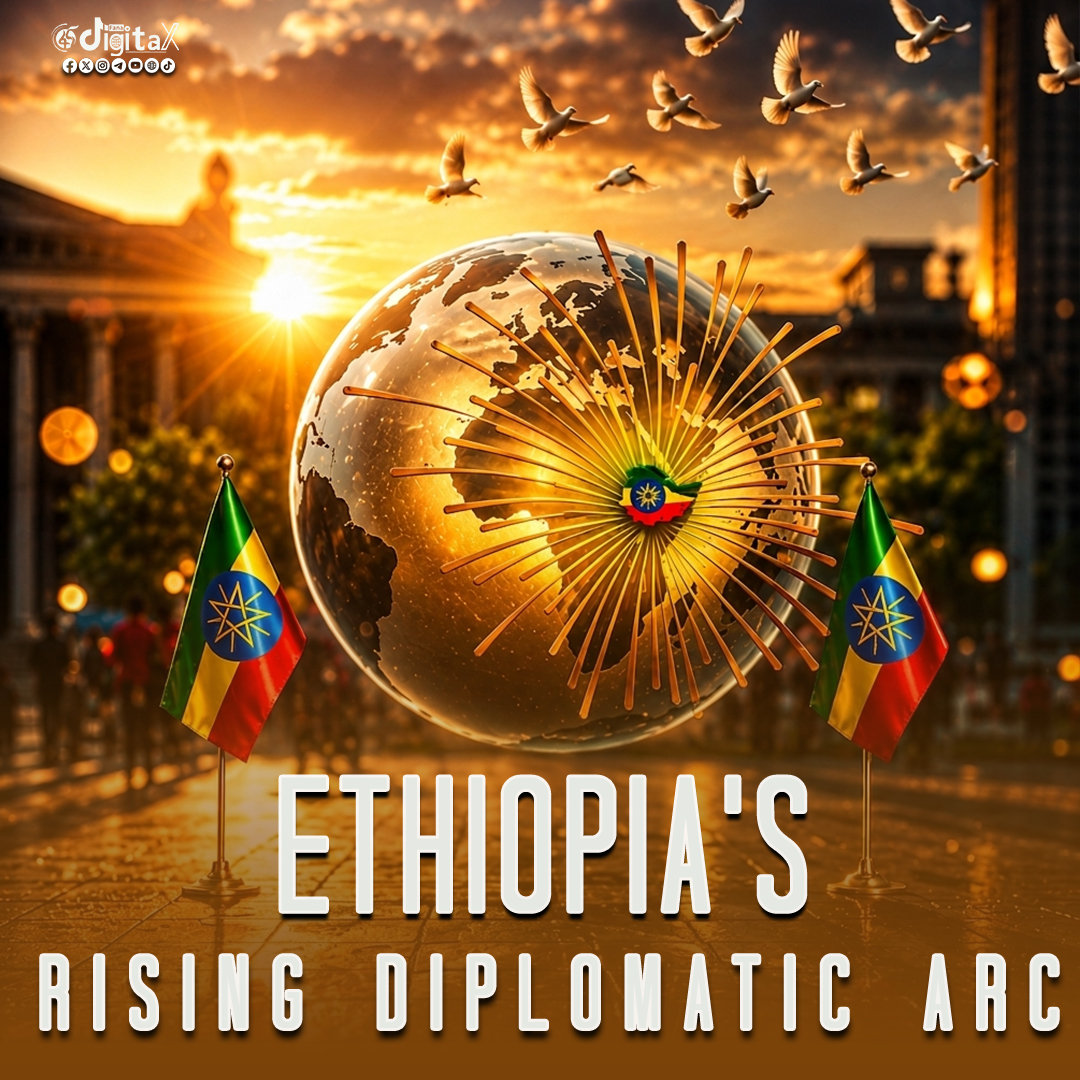
Medemer Diplomacy: Ethiopia’s Synergy-Driven Framework Linking Domestic Strength and Global Engagement
Addis Ababa, June 18, 2026 (FMC) – In contemporary Ethiopia’s national discourse, Medemer has emerged as a guiding philosophical outlook that emphasizes synergy, collective progress, and the coordination of national capacities across political, economic, and social spheres.
Rather than functioning as a narrow policy instrument, it is broadly understood as a framework that informs approaches to governance, development, and the country’s engagement with the wider world.
Introduced in modern political discourse by Prime Minister Abiy Ahmed, Medemer has swiftly evolved into a widely referenced idea for interpreting national transformation.
At its core, it underscores the principle that sustainable progress is achieved through alignment of efforts, strengthened cooperation among institutions and citizens, and the effective integration of national potential.
In this sense, it reflects a philosophy of cumulative strength, where national outcomes are shaped by coordination rather than fragmentation.
Within the domestic sphere, this philosophy is associated with efforts to enhance institutional coordination and reinforce the effectiveness of national systems. It emphasizes that governance outcomes improve when institutions operate in a complementary and interconnected manner, guided by shared national objectives.
Development, in this context, is not viewed as a series of isolated initiatives but as an integrated process in which economic reform, social progress, infrastructure expansion, and institutional strengthening are mutually reinforcing.
This approach also reflects a broader understanding of resilience in national development. Faced with complex structural challenges, the emphasis is placed on coordination, adaptability, and collective problem-solving as essential principles for sustaining progress and ensuring continuity of transformation across sectors.
In Ethiopia’s external engagement, Medemer is often referenced as a conceptual lens that highlights cooperation, flexibility, and diversified international relations. It does not function as a fixed diplomatic doctrine, but rather as an interpretive outlook that aligns external engagement with internal development priorities.
In this framing, international relations are understood as inherently interconnected and multidirectional, requiring adaptive engagement with a wide range of global partners.
This perspective places strong emphasis on partnership-building and mutual benefit in international cooperation.
Diplomatic engagement is increasingly framed around the principle that sustainable relationships are strengthened when cooperation produces shared outcomes in areas such as infrastructure development, investment, trade, energy cooperation, and knowledge exchange. In this way, external relations are closely linked with domestic transformation agendas.
At the regional level, Ethiopia’s engagement reflects an emphasis on interdependence and shared development within the Horn of Africa.
Relations with neighboring countries are increasingly shaped by connectivity, where infrastructure networks, energy cooperation, and trade corridors are viewed as instruments of mutual growth.
Rather than approaching regional relations in isolation, this outlook recognizes that long-term stability and prosperity are reinforced through structured cooperation and economic integration.
This regional orientation is grounded in a broader principle of dialogue and reciprocal engagement, where diplomacy is directed toward expanding shared opportunities rather than managing division. It reflects a practical understanding that regional development outcomes are interlinked and that cooperation serves as a foundation for stability and progress.
Beyond the regional dimension, Ethiopia’s external engagement reflects a broader diversification of global partnerships across Africa, Asia, Europe, the Middle East, and the Americas.
This multidirectional orientation enables engagement with a wide range of international actors in pursuit of development cooperation, investment, and institutional collaboration. Within this structure, diplomacy functions as an adaptive mechanism that responds to global shifts while maintaining consistent national priorities.
Ethiopia’s diplomatic posture is also closely tied to internal transformation processes. Economic modernization efforts, infrastructure expansion, agricultural productivity improvements, and institutional reforms collectively contribute to strengthening the country’s external positioning.
Urban development and infrastructure growth, particularly in major cities, have enhanced Ethiopia’s capacity to host international summits, diplomatic engagements, and multilateral forums, reinforcing its role as a regional diplomatic hub.
Environmental initiatives, including large-scale reforestation and sustainability programs, have further contributed to Ethiopia’s visibility in global climate discussions, expanding its participation in environmental governance platforms and strengthening its profile in international cooperation on climate-related issues.
Across these dimensions, Medemer-oriented thinking reflects an effort to align internal transformation with external engagement in a mutually reinforcing system. It emphasizes continuity with historical foundations while adapting to contemporary global dynamics, where interconnectedness defines the structure of international relations.
In this sense, Ethiopia’s evolving diplomatic approach can be understood as a system of synergy-driven statecraft in which internal cohesion, development priorities, and external relations are integrated components of a broader national trajectory. It reflects a vision in which diplomacy is not separate from development, but part of a unified process of national advancement.
Ultimately, Ethiopia’s Medemer-oriented diplomacy presents a framework of collective momentum—one in which national progress is shaped through coordination, shared purpose, and adaptive engagement with an evolving international system.
Within this outlook, the country’s engagement with the world is defined by both continuity and transformation, anchored in internal synergy while expanding outward through diversified and cooperative global relations.