
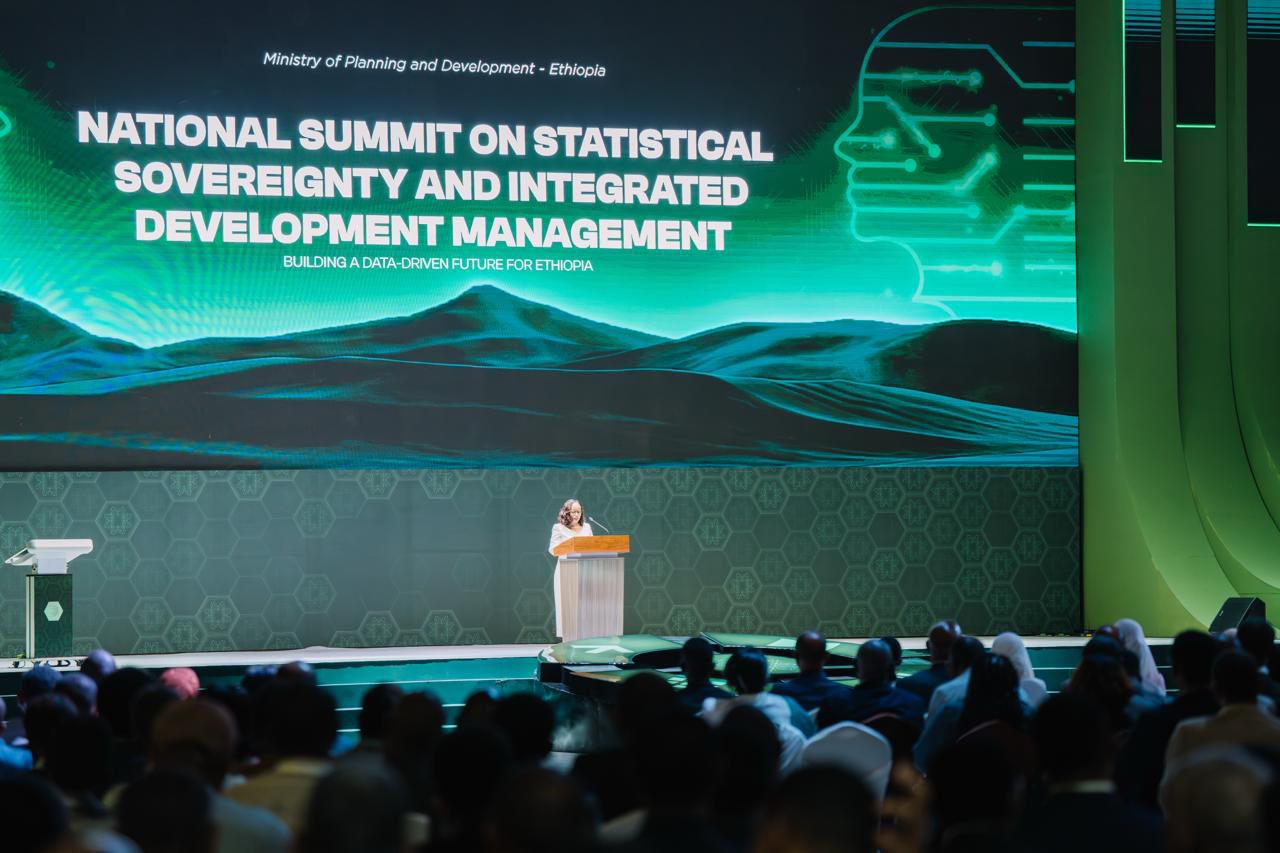
Officials Outline Major Push for Integrated, Real-Time and Sovereign National Data System
Addis Ababa, May 18, 2026 (FMC) — Ethiopia is advancing wide-ranging reforms aimed at building a unified, real-time and sovereign national data system designed to strengthen evidence-based governance, planning, and development management, officials said during the National Summit on Statistical Sovereignty in Addis Ababa.
Speaking on the occasion, Minister of Planning and Development Fitsum Assefa said Ethiopia is transitioning from externally dependent data systems toward a self-reliant framework rooted in domestic capacity.
She noted that expanded household, tourism, and business surveys are supporting ongoing reforms and strengthening the Ten-Year Development Plan while enhancing predictive policymaking.
Director-General of the Ethiopian Statistical Service (ESS), Abdulaziz Shefa, said Ethiopia is shifting national statistics to the center of development planning, emphasizing progress from paper-based systems to digital data collection.
He highlighted improvements in agricultural and economic censuses as well as the Ethiopian Demographic and Health Survey (EDHS), implemented within the frameworks of the Ten-Year Development Plan, Agenda 2063, and the Sustainable Development Goals.
Deputy Director General of the Ethiopian Statistical Service (ESS), highlighted that Ethiopia is transitioning from paper-based systems to a fully digitized and real-time statistical infrastructure using CAPI, GIS, remote sensing, cloud computing, and an enumerator tracking platform developed with the National Intelligence and Security Service (INSA).
She noted that Ethiopia is building sovereign digital intelligence supported by 26 connected branches, AI-powered survey dashboards, and a roadmap focused on modern systems and skilled Ethiopian professionals.
State Minister at the Ministry of Planning and Development Bereket Fesehatsion said Ethiopia is addressing fragmented planning and accountability systems through an integrated digital framework linking more than 113 public institutions under the “One Plan, One Report” system.
He added that the shift is enabling real-time performance monitoring, results-based management, and stronger fiscal accountability through standardized accounts and harmonized GDP measurement.
Director at the Ministry of Planning and Development, Abas Mohammed, said official statistics, when legal, sound, and accessible, turn data into evidence for governance.
He noted that Ethiopia’s Homegrown Economic Reform and Ten-Year Development Plan rely on trusted local data, highlighting progress including expanded household surveys, full dissemination of the Demographic and Health Survey (DHS), and advances in agricultural and economic censuses led by Ethiopian civil servants.
Director at the Ministry of Planning and Development, Zerihun Kebede, said Ethiopia’s digital sovereignty is now operational, not aspirational, noting that a national digital monitoring and evaluation platform integrates indicators, programs, and KPIs into a single validated system with real-time, AI-supported insights from approved data sources.
He said the system eliminates fragmented statistics and ensures a single trusted national source of data for decision-making across institutions.
Director at the Ethiopian Artificial Intelligence Institute, Worku Gachena, said Ethiopia is building sovereign digital infrastructure where national data is stored, governed, and processed locally to power artificial intelligence systems.
He highlighted the development of a unified data ecosystem, Ethiopian cloud services, and multilingual AI tools, adding that under Digital Ethiopia 2030, plans include a sovereign cloud, national data lakehouse, and indigenous AI models aimed at converting data into productivity and economic value.