
One Visa, Countless Wonders: Walk Through Ethiopia’s Living Heritage and Extraordinary Landscapes
Addis Ababa, September 1, 2026 (FMC) — There are journeys that take travelers to places they have seen before, and then there are journeys that seem to open a door into another age.
Ethiopia belongs to the latter.
In this ancient land of origins, the traces of humanity’s earliest story meet the grandeur of forgotten kingdoms, sacred traditions still alive in the present, and landscapes that can change from misty mountain heights to volcanic wilderness within a single journey.
As September approaches and the Ethiopian New Year draws near, the country is entering one of its most evocative seasons.
The rains have washed the highlands into deep green, the delicate yellow blooms of Adey Abeba begin to appear, and communities prepare to welcome Enkutatash.
It is a moment when Ethiopia’s landscape, history and living culture seem to converge—and Prime Minister Abiy Ahmed is inviting the world to experience it.

In his latest invitation message to the world, the Prime Minister described Ethiopia as a land of immense beauty, living heritage and extraordinary diversity, inviting travelers from around the world to discover its many wonders with a single Ethiopian visa.
For a country known as the Land of Origins, the invitation reaches deeper than tourism.
Ethiopia offers a rare encounter with the beginnings of humanity itself.
The archaeological landscapes of the Lower Valley of the Awash and the Lower Valley of the Omo preserve some of the most important evidence of human evolution, connecting the modern traveler with a story that began long before borders, cities or written histories existed.
But Ethiopia’s story did not end with its earliest inhabitants.
It continued through civilizations that rose, flourished and left their imprint across the highlands and valleys.
At Axum, towering stelae and ancient ruins recall one of Africa’s great civilizations and a kingdom whose influence once stretched far beyond the northern Ethiopian highlands.
At Lalibela, churches carved into living rock remain extraordinary expressions of faith, architecture and craftsmanship.
Gondar preserves castles and palaces from the imperial era, while the walled city of Harar carries centuries of Islamic scholarship, commerce and cultural exchange within its historic streets.
At Tiya, enigmatic carved stelae stand as silent reminders of cultures whose stories continue to intrigue generations of visitors and researchers.
Together, these places offer something increasingly rare in the modern world: the possibility of moving through different ages of human history without leaving one country.
Yet Ethiopia’s heritage is not confined to stones, ruins and archaeological sites.
Its most compelling stories are still being lived.
They survive in music and dance, in craftsmanship and cuisine, in religious ceremonies, oral traditions and community life. Timket turns streets and public spaces into vibrant expressions of faith and celebration.
Meskel brings communities together around the Demera and the commemoration of the discovery of the True Cross.
And Enkutatash, arriving with September, offers visitors a particularly intimate glimpse of Ethiopia as the country welcomes a new year according to its own ancient calendar.
The season itself becomes part of the experience.
After months of rain, the highlands emerge refreshed. Hillsides glow green, fields come alive and Adey Abeba—the flower closely associated with the Ethiopian New Year—begins to punctuate the landscape with yellow.
Across communities, families prepare traditional foods, children gather flowers and people exchange New Year greetings.
For a visitor, September is therefore not simply another month on the calendar. It is an invitation to encounter Ethiopia when nature and culture are both in transition.
Beyond the heritage sites, another Ethiopia unfolds across its extraordinary geography.
The country rises from deep lowlands into rugged highlands, crosses escarpments and volcanic landscapes, opens into vast lakes and forests, and reaches some of the most extreme environments on the African continent.
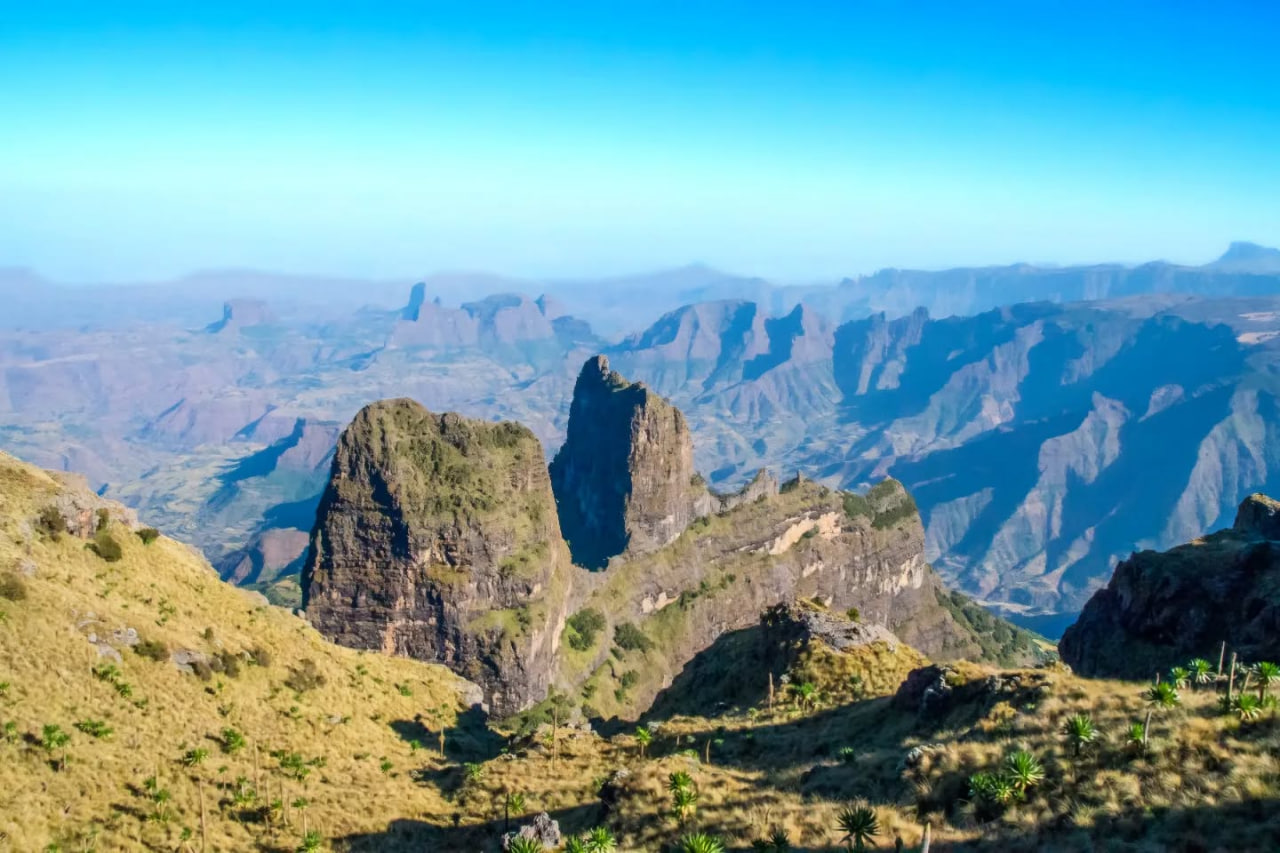
The Simien Mountains rise in dramatic cliffs and valleys, creating a landscape of extraordinary scale and a refuge for wildlife found nowhere else. The Bale Mountains offer alpine scenery, forests and rare species, including the Ethiopian wolf and mountain nyala.
The Rift Valley brings a different rhythm: chains of lakes, volcanic formations, escarpments and open landscapes stretching across the heart of the country.
Lake Tana combines expansive waters with islands, monasteries and centuries of history, while its surrounding landscapes offer waterfalls, forests and highland scenery.
Farther south and southwest, forests, rivers and wildlife merge with the cultural diversity of communities whose traditions have evolved over generations. The landscapes around the Omo Valley offer another window into Ethiopia’s extraordinary human diversity.
Then, in the far north-east, the landscape seems to belong to another planet.
The Danakil Depression unfolds through salt flats, volcanic formations, mineral-rich terrain and immense heat, offering one of the most surreal geological environments on Earth.
From alpine heights to desert depressions, Ethiopia’s geography alone can make a journey feel like several journeys stitched together.
And its wildlife adds another layer.
The Ethiopian wolf, gelada and mountain nyala are among the country’s most distinctive species, while its varied ecosystems support an exceptional range of birds and other wildlife. For travelers drawn to nature, Ethiopia offers not simply scenery but the chance to encounter ecosystems and species found nowhere else on the planet.
This is why the country’s appeal cannot be reduced to a handful of famous landmarks.
A traveler may come for Lalibela and discover the mountains. Come for the history of Axum and encounter the culture of the north. Follow the Rift Valley and find lakes, volcanic landscapes and wildlife. Travel south and encounter communities whose traditions remain deeply rooted in their surroundings. Go east and discover the historic character of Harar and the vast landscapes beyond it.
Every road opens another chapter.
And between those chapters lies another of Ethiopia’s enduring attractions: hospitality.
Coffee, deeply woven into Ethiopian social life, is more than a beverage.
The traditional coffee ceremony can turn an ordinary moment into an expression of welcome, conversation and community. Injera and the diverse dishes served with it provide another way into the country’s history and regional cultures, bringing people together around the same table.
Increasingly, Ethiopia is also developing the places that allow visitors to remain within these experiences rather than simply pass through them.
The country’s tourism transformation has begun to move beyond identifying attractions toward developing destinations around them—places where travelers can stay, dine, explore, relax and experience the character of the surrounding landscape.
The Dine for Nation and Dine for Generations initiatives have contributed to this shift, with destination infrastructure and hospitality facilities emerging around locations endowed with natural and cultural assets.
At Gorgora, on the shores of Lake Tana, lakeside scenery, history and hospitality are being brought together in an emerging destination within one of Ethiopia’s richest cultural regions.
At Wenchi, a dramatic volcanic landscape is becoming the setting for an eco-tourism experience, while Koysha in the southwest offers another gateway into Ethiopia’s spectacular natural environment.
Further east, Shabeely Resort adds a new dimension to the country’s tourism landscape, bringing accommodation, restaurants, cultural facilities, recreation and other hospitality services together within the distinctive setting of the Somali Region.
Its completed facilities include 51 accommodation keys designed to enable visitors to spend more time experiencing the surrounding environment.
The transformation is spreading beyond these flagship destinations.
Hospitality investment is expanding along major tourism corridors and in cities including Addis Ababa, Hawassa, Bahir Dar, Jimma and Langano. One agreement announced in 2026 envisages approximately 1,140 new hotel keys across 10 properties, with openings planned in phases.
That growing accommodation network is changing the possibilities for travelers.
Ethiopia can increasingly be experienced not as a hurried passage between isolated attractions, but as a journey in which destinations themselves become part of the experience.
A visitor might begin in Addis Ababa, exploring its museums, cultural institutions, restaurants and rapidly changing urban landscape, before heading toward the northern highlands and Lake Tana. From there, the journey can descend into the Rift Valley, turn toward the southern cultural landscapes or continue east toward Harar and the wider lowlands.
The choices are as varied as the country itself: city hotels, destination resorts, lodges and eco-tourism facilities, increasingly positioned to allow visitors to stay longer and explore more deeply.
That development matters because Ethiopia’s greatest tourism asset is its variety.
Few journeys offer such a striking succession of contrasts: ancient churches and modern city life; archaeological landscapes and living traditions; alpine mountains and volcanic deserts; expansive lakes and dense forests; centuries-old cuisine and an evolving hospitality industry.
Its UNESCO-recognized heritage provides an international window into this extraordinary inheritance, but the country’s cultural wealth extends far beyond formal inscriptions.
Much of Ethiopia’s heritage lives in communities, ceremonies, landscapes and traditions that continue to evolve rather than sit frozen in the past.
That living quality is what gives the country a distinctive character.
Visitors do not simply walk among monuments. They encounter people who continue to celebrate, worship, create, cook, sing, trade and pass knowledge from one generation to the next.
And for those arriving in September, the experience carries an added resonance.
The landscape is renewed by the rains. Adey Abeba begins to bloom. Enkutatash approaches. Ancient traditions and contemporary life meet in streets, homes, churches, markets and public spaces across the country.
It is a particularly fitting time to discover a nation whose identity has always been shaped by continuity and renewal.
For the world, the opportunity is not merely to see another destination.
It is to encounter a place where humanity’s deep past remains visible, where civilizations have left extraordinary architectural and cultural legacies, where nature changes dramatically from region to region, and where traditions remain part of everyday life.
That is why Ethiopia can be difficult to experience through a single image.
One photograph cannot capture Lalibela. One landscape cannot explain the Simien Mountains. One monument cannot tell the story of Axum. One festival cannot encompass the country’s living cultures. And one visit may only reveal the beginning of what lies beyond the next horizon.
The Prime Minister’s invitation to “walk through Ethiopia” therefore carries a powerful tourism proposition: come not simply to look, but to move through the layers of a country whose past and present remain remarkably intertwined.
Come for the origins, and stay for the living heritage.
Come for the mountains, and discover the cultures beneath them.
Come for the ancient cities, and follow the roads into landscapes that feel entirely new.
Come in September, when the rains have refreshed the land, the New Year is approaching and Ethiopia is dressed in the green and gold of a season of renewal.
With a single Ethiopian visa, an extraordinary range of worlds opens before the traveler.
One visa. Countless wonders. The Land of Origins is not simply a place to visit—it is a country to walk through, discover and remember.