
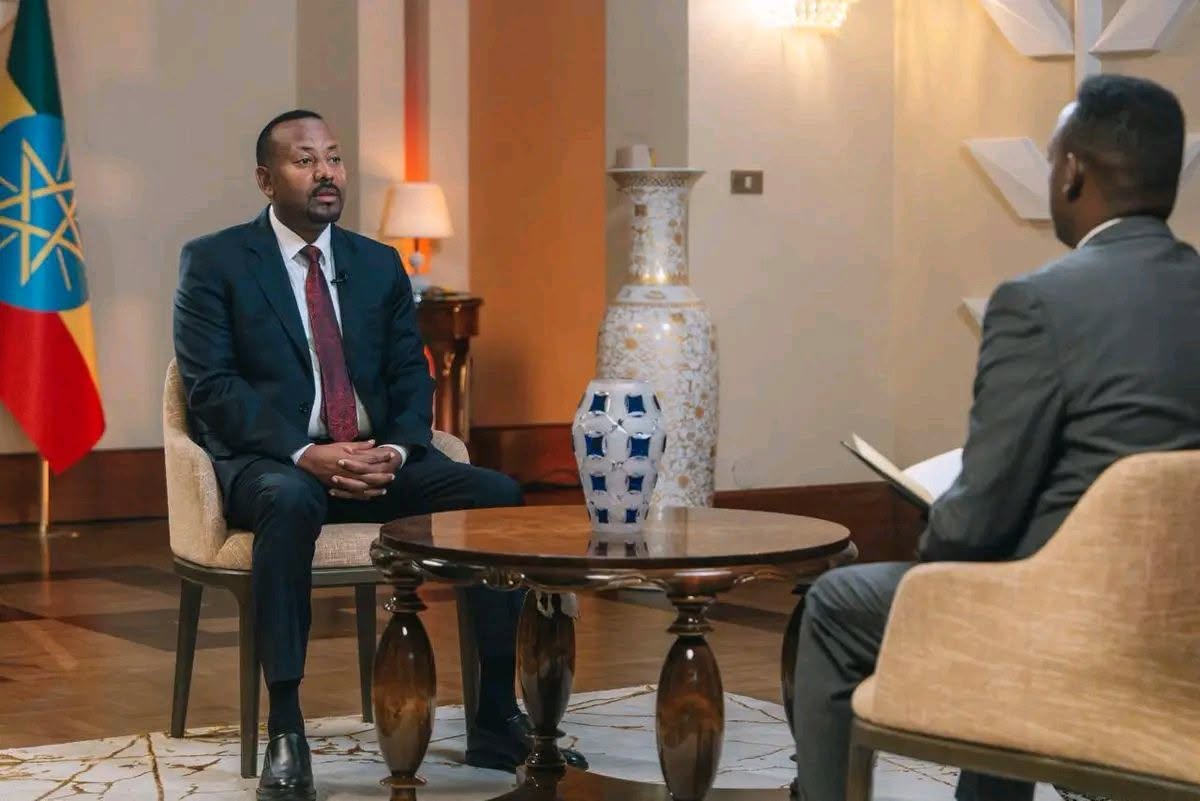
PM Abiy Tells Eritrea to Embrace Peaceful Relations and Shared Development with Ethiopia
Addis Ababa, October 19, 2026 (FMC) — Prime Minister Abiy Ahmed has called on Eritrea to embrace peaceful relations and shared development with Ethiopia, contrasting Eritrea’s former industrial strength with what he described as the country’s prolonged economic decline and warning that continued rejection of cooperation would have extremely severe consequences.
In his Tigrigna-language interview broadcast on October 19, the Prime Minister examined Eritrea’s trajectory since independence, arguing that the country’s ruling establishment had squandered the economic potential inherited from an industrial and commercial base that once placed Eritrea among Africa’s relatively developed economies.
The Prime Minister recalled that Eritrea once had more than 300 industries, describing it as a country with substantial productive capacity and a strong industrial foundation. He contrasted that past with the situation today, arguing that the country had failed to sustain its economic achievements or translate its former advantages into continued progress for its people.
He cited the condition of Eritrea’s principal cities to illustrate the scale of the decline. Asmara, once a prominent urban and commercial centre, had lost much of the standing it previously enjoyed, he said, comparing it with Ethiopian cities such as Arba Minch and Jigjiga. He also described Massawa as largely empty and Assab as uninhabited, presenting these examples as evidence of the erosion of economic activity and the failure to capitalize on the country’s potential.
For the Prime Minister, the consequences extend beyond deteriorating cities and lost industrial capacity. He argued that Eritrea’s political leadership had neglected the welfare of its own people, leaving a population he described as hardworking and hospitable to face hardship and displacement. The country’s development, he maintained, has suffered because its ruling establishment has not given sufficient priority to building institutions, expanding productive activity and improving people’s lives.
He also challenged the Eritrean regime’s political orientation towards Ethiopia, accusing it of becoming an instrument of forces hostile to its neighbour instead of concentrating on its own national development. In his assessment, a government that has failed to address its own country’s challenges cannot meaningfully help others resolve theirs.
The Prime Minister questioned what Eritrea gains from external actors that encourage confrontation with Ethiopia. Such forces may provide ammunition and other military support, he said, but they cannot deliver the economic transformation Eritrea needs or solve the problems confronting its population. Weapons cannot replace functioning institutions, productive industries or policies that create livelihoods and improve living standards.
His criticism placed the question of Ethiopia–Eritrea relations within a broader argument about national priorities. Rather than directing resources and political energy towards hostility, the Prime Minister said Eritrea should concentrate on rebuilding its economy and improving the welfare of its people. Peaceful relations with neighbouring countries, in this view, are an essential condition for pursuing those objectives.
Ethiopia, he stressed, favours good-neighbourly relations and shared development. The two countries have the potential to pursue a relationship in which cooperation serves their respective populations and supports regional stability. The Prime Minister’s appeal was for Eritrea to become a partner in development rather than align itself with forces seeking confrontation with Ethiopia.
The call for cooperation, however, came with a clear warning. The Prime Minister said the consequences would be extremely severe if Eritrea’s ruling establishment continued to reject Ethiopia’s appeals for peaceful relations and persisted on what he described as a destructive course. His remarks underscored the seriousness with which Ethiopia views the direction of its neighbour’s policies while reiterating that a peaceful, development-oriented relationship remains the alternative being offered.
The Prime Minister’s assessment of Eritrea’s post-independence trajectory thus served as the backdrop to his appeal for a change in direction. He argued that the country’s past industrial standing demonstrates the development potential that has been lost, while its present difficulties underline the costs of political choices that place confrontation above the welfare of the population.
Ultimately, his message was that Eritrea’s future should be built around the needs of its people and the pursuit of economic progress. By embracing peaceful relations and cooperation with Ethiopia, Eritrea could redirect its attention towards development rather than continue a course that, in the Prime Minister’s assessment, has deprived its people of opportunities and placed the country on a destructive path.
#Ethiopia #GreatNation #ProudPeople #GrandVision #Eritrea #RegionalCooperation #PeaceAndDevelopment