
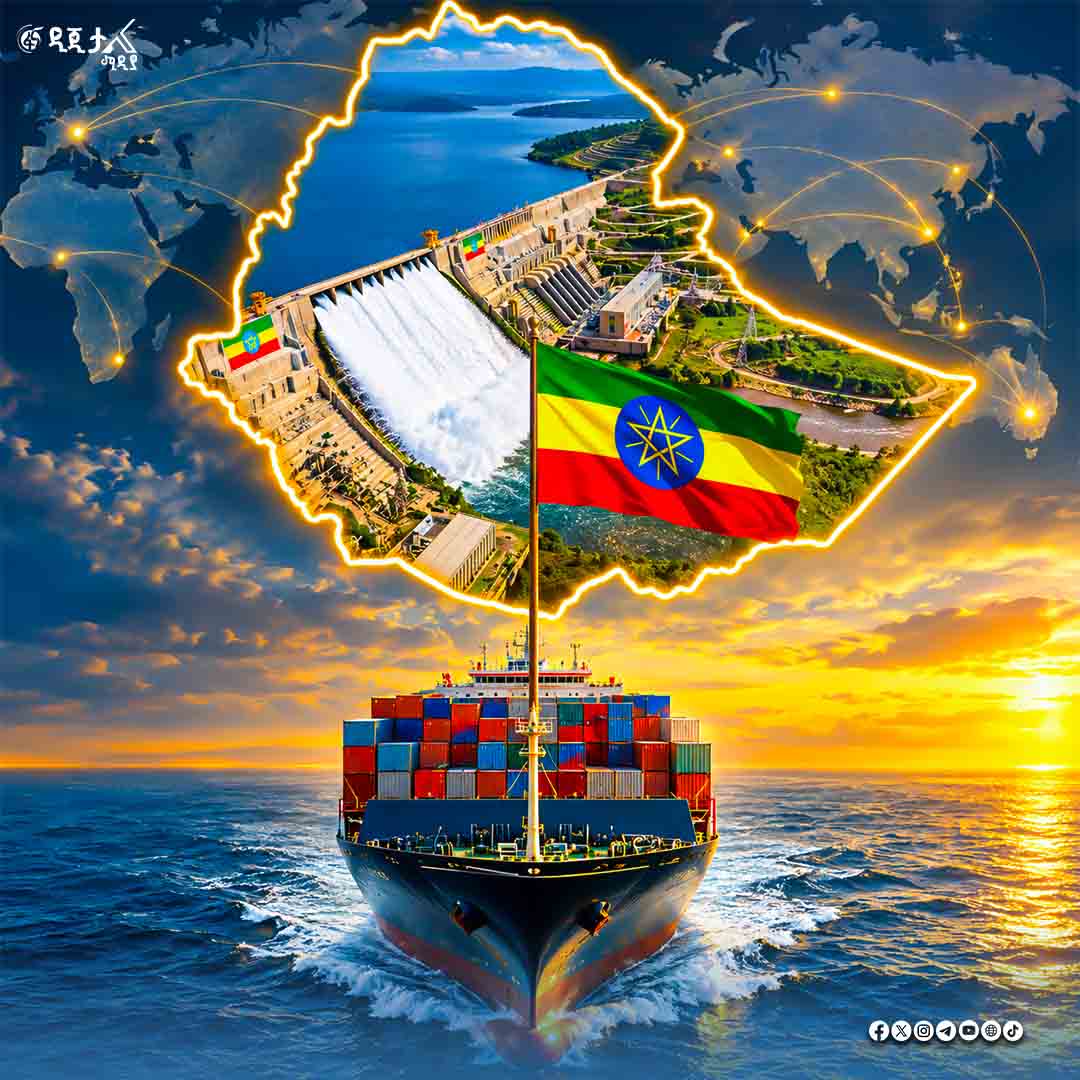
The Geography That Cannot Be Negotiated Away
Addis Ababa, October 5, 2026 (FMC) — Some realities are political. Others are geographical. Governments can redraw policies, alliances can shift, borders can change and diplomatic language can become sharper or softer. But geography does not negotiate.
That is the significance of Ethiopia’s latest message on the Abay and the Red Sea.
The Ministry of Foreign Affairs has placed two questions that are often treated separately within a single strategic frame: Ethiopia’s right to develop the waters originating in its highlands and its enduring geographic and historical connection to the Red Sea.
The message is unmistakable: neither reality can be erased by political rhetoric, coercion or destabilization.
The Abay begins in Ethiopia. Virtually all of the Blue Nile originates in the Ethiopian highlands, and the river contributes about 85 percent of the Nile’s total flow.
The Grand Ethiopian Renaissance Dam has already transformed the debate from one about whether Ethiopia can develop its water resources into one about how a major upstream country can responsibly and equitably manage a transboundary resource while pursuing its own development.
Ethiopia has consistently presented the GERD as a hydropower and water-management project rather than a mechanism to consume the Nile’s waters.
The transformation is profound. For decades, Ethiopia’s development ambitions along the Nile were constrained by a regional order in which downstream interests were frequently treated as though they possessed an overriding political authority over an upstream country’s development choices. The GERD shattered that assumption.
Built with Ethiopian resources and determination, it became a physical expression of a much larger change: Ethiopia would no longer define its development possibilities through the anxieties of others.
The same principle now extends toward the Red Sea.
Ethiopia is landlocked today, but landlocked is not synonymous with strategically disconnected. Its nearest border lies only a short distance from the Red Sea coast. Its history, economy, security environment and regional relationships have for generations been intertwined with the Red Sea corridor. The loss of direct coastline altered Ethiopia’s political geography; it did not erase its geography.
This distinction matters.
The Red Sea is no longer merely a maritime space on a map. It is one of the world’s most consequential strategic corridors, connecting the Mediterranean, the Gulf, Africa and the wider Indian Ocean system.
Trade, energy, logistics, security and geopolitical competition converge there. To imagine that Ethiopia—a major country at the heart of the Horn of Africa—can be permanently detached from that architecture is to mistake a political arrangement for a permanent geographical fact.
And this is where an older regional logic begins to encounter a new Ethiopia.
For much of modern history, Ethiopia’s vulnerabilities were treated as opportunities for external pressure. Internal divisions could be exploited. Development ambitions could be contained. Access to strategic corridors could be denied. Proxy relationships could be cultivated. Regional politics could be organized around preventing Ethiopia from becoming too economically, politically or strategically independent.
That logic has not disappeared simply because history has moved on.
But Ethiopia has changed.
The GERD is one expression of that transformation. So are expanding energy generation, agricultural modernization, industrialization, digital transformation, infrastructure development and the broader economic reforms aimed at building a more productive and resilient economy. Ethiopia’s economic transformation is not simply a domestic project; it is gradually changing the strategic weight the country carries across the Horn and East Africa.
This is why the MFA’s reference to proxies and destabilization carries significance beyond diplomatic vocabulary. Ethiopia is making clear that attempts to alter its legitimate interests indirectly will not change the underlying realities.
There is an important distinction here. Ethiopia is not presenting confrontation as its preferred instrument. Quite the opposite: the Ministry has reaffirmed peaceful engagement, mutual respect, regional cooperation and good-neighbourliness. But peaceful diplomacy does not mean strategic passivity. Dialogue and national sovereignty are not opposites.
A mature regional order should be able to accommodate both.
The real question, therefore, is not whether Ethiopia has interests in the Abay or the Red Sea. It is how those interests can be accommodated within a regional architecture built on cooperation rather than zero-sum calculations.
The Abay offers perhaps the clearest lesson. Water that crosses borders can become either a source of perpetual confrontation or a foundation for shared prosperity. Ethiopia has repeatedly argued for the latter. The GERD itself was presented by the Ethiopian government as capable of producing electricity while regulating highly variable flows, with potential benefits for downstream water management.
The same logic can apply to maritime access.
Ethiopia’s pursuit of meaningful access to the sea need not be understood as a threat to its neighbours. Properly structured, it can become an economic opportunity for the wider region: greater trade, expanded logistics, infrastructure investment, industrial connectivity and deeper integration between the landlocked interior and the maritime economy.
The Horn does not need another zero-sum contest over geography.
It needs to turn geography into an economic asset.
That requires a departure from an older mindset in which one country’s development is interpreted as another country’s loss. It requires recognizing that a more connected Ethiopia can contribute to a more connected region; that Ethiopian energy can support regional markets; that Ethiopian agricultural and industrial production can feed regional trade; and that maritime connectivity can expand rather than diminish the economic space available to neighbouring states.
This is ultimately what makes the latest Ethiopian position larger than a diplomatic statement.
It is a declaration that Ethiopia’s strategic future will not be defined by inherited constraints.
The Abay cannot be wished away from Ethiopia. Ethiopia cannot be wished away from the Horn. And its geographic and historical relationship with the Red Sea cannot be made irrelevant by political preference.
The choice before the region is therefore not between Ethiopia and its neighbours.
It is between an old politics of containment, pressure and zero-sum rivalry—and a new regional order capable of accommodating Ethiopia’s development, sovereignty and legitimate interests within a framework of cooperation.
Geography has already spoken.
The question now is whether regional politics is prepared to listen.