
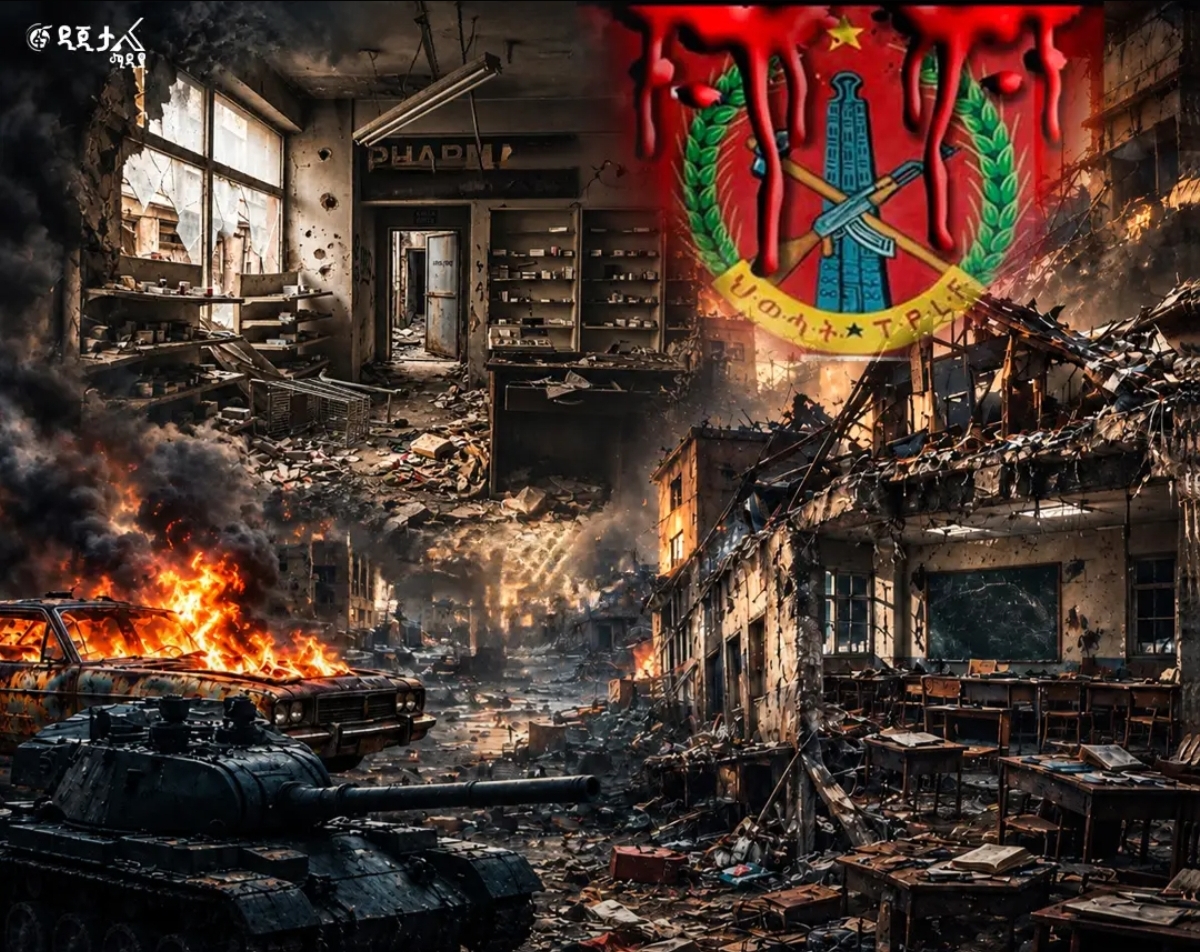
The Illegal TPLF Is Wrecking Civilian Foundations Across Northern Ethiopia: From Destroyed Infrastructure to Militarized Schools and Forced Recruitment
Addis Ababa, September 30, 2026 (FMC) — The illegal TPLF group is once again dragging the people of northern Ethiopia into the destructive abyss from which they had barely begun to emerge, ravaging civilian foundations, wrecking public infrastructure, militarizing schools, plundering public resources and forcing young people, including children, toward another senseless war.
What is unfolding now across the Tigray region and the neighboring Amhara and Afar regions is not an accidental eruption and certainly not a new chapter in the history of the banned TPLF group.
It is the latest manifestation of a destructive political and military culture that has followed the group for decades — a five-decade trail of bloodshed, coercion, destruction and political treachery that has repeatedly placed its own interests above the peace, dignity and future of the Ethiopian people.
The illegal TPLF group is again turning civilian communities into military terrain.
Schools — institutions meant to educate children and prepare them for a better future — are being dragged into the machinery of war. Public facilities are being exposed to destruction. Civilian spaces are being converted into military positions and logistical sites. Communities that should be rebuilding homes, schools, businesses and livelihoods are instead being forced to live under the shadow of renewed mobilization.
This is the true face of the group’s so-called political struggle: destroy what civilians need, militarize what children need for their future, and sacrifice the young to preserve an exhausted political project.
The most unconscionable dimension is the forced recruitment of young people and children.
The illegal TPLF group has once again been associated with coercive mobilization in the Tigray region, dragging young people away from their families and pushing them toward military camps and the battlefield. Children who should be holding books are being exposed to guns. Young people who should be building their lives are being turned into instruments of another war.
This is not a mission for the protection of the people of Tigray.
It is the exploitation of the people of Tigray.
For decades, the illegal TPLF group has attempted to present itself as the political representative and defender of the people of Tigray. Yet its conduct repeatedly exposes the opposite reality. When the group returns to war, it is the people of Tigray who pay the price. When schools are militarized, it is their children whose education is sacrificed. When public infrastructure is destroyed, it is their communities that are deprived. When young people are forcibly mobilized, it is their families who lose sons and daughters to a war they did not choose.
The people of Tigray must therefore be separated from the illegal TPLF group that has repeatedly claimed to speak in their name.
The group is not synonymous with the people.
Indeed, the history of the past decades demonstrates how profoundly the interests of ordinary people have been subordinated to the group’s political and military ambitions.
The current destruction also exposes the hollowness of the group’s claims to have changed.
The Pretoria Peace Agreement of November 2022 opened a historic door away from war. It offered an opportunity to silence the guns, disarm combatants, restore normal life and return political competition to peaceful and constitutional channels.
The federal government chose that path.
It accepted the peace process. It supported reconciliation. It opened a political route for the TPLF to regain legal political standing under the country’s revised legal framework, despite the group’s previous loss of legal status because of its violent conduct.
The National Election Board of Ethiopia subsequently gave the group a fresh opportunity to operate legally, issued repeated notices and allowed a period for corrective measures before ultimately revoking its registration after the group failed to meet the required legal obligations.
The opportunity was there.
The political road was there.
The constitutional institutions were there.
The choice to return to confrontation was not forced upon the illegal TPLF group.
And that is precisely why the group’s present conduct cannot be disguised as an unavoidable political reaction. After years of destruction, the country was offered another chance to choose peace over war. Ethiopia pursued dialogue, reconciliation and institutional politics. The illegal TPLF group instead allowed the machinery of militarization to return.
Its conduct has once again placed the people of Tigray and neighboring regions in the path of destruction.
This is also where the group’s historical record cannot be separated from its current behavior.
For nearly five decades, the illegal TPLF group has built its political existence around armed struggle, coercive power and an exclusionary political order. During its 27 years of dominance over Ethiopia’s political system, it accumulated enormous state power while opposition was suppressed, dissent was constrained and the country’s political and economic direction was placed under a narrow ruling structure.
When that order began to change in 2018, the group did not embrace the new national political trajectory.
Instead of reconciling itself with a changing Ethiopia, it retreated into confrontation.
Instead of helping build a new political compact, it resisted the transition.
Instead of competing through the country’s emerging political institutions, it ultimately returned to war.
The same destructive instinct is visible again today.
The illegal TPLF group is not merely fighting over political positions. It is once again placing civilian life, public institutions and an entire generation in the line of fire.
Its destruction does not stop at military targets.
It reaches schools.
It reaches public infrastructure.
It reaches religious institutions and places of heritage when they are dragged into military purposes.
It reaches the economic foundations of communities.
And most tragically, it reaches children.
A movement that claims to fight for a people cannot credibly justify destroying the foundations upon which that people’s future depends.
A group that claims to defend a region cannot defend it by turning its schools into military spaces, its youth into forced recruits and its communities into battlefields.
A political project that requires children to carry the burden of war has already revealed the depth of its moral bankruptcy.
The consequences are not confined to the Tigray region. The renewed violence is spilling toward Amhara and Afar, threatening communities that have already endured years of conflict and devastation. The illegal TPLF group’s military adventurism therefore once again risks widening the circle of suffering and pulling more Ethiopian communities into a confrontation from which nobody gains except those who thrive on instability.
This is why the present campaign must be understood for what it is: another assault on the civilian foundations of Ethiopia.
While the illegal TPLF group is mobilizing young people for war, Ethiopia has been pursuing a fundamentally different national direction.
The government has invested political capital in dialogue and reconciliation rather than allowing every political disagreement to become a battlefield. The National Dialogue process brought thousands of Ethiopians together to confront longstanding political grievances and seek a peaceful national consensus. It has sought to replace the country’s recurring cycle of confrontation with dialogue, accommodation and constitutional politics.
That is not the language of a government preparing society for permanent war.
It is the language of a state attempting to move a deeply divided country toward political coexistence.
The government has also continued to pursue development as the foundation of national resilience — expanding infrastructure, strengthening institutions, investing in technology, widening economic opportunity and building the productive capacity required to give Ethiopia’s young population a future beyond conflict.
The contrast could not be more direct.
One side is attempting to pull Ethiopia’s young generation toward classrooms, skills, technology, production and development.
The illegal TPLF group is again pulling young people toward military camps.
One side is investing in the future.
The other is consuming it.
One side is opening political space for dialogue and reconciliation.
The other is returning to the language and machinery of armed confrontation.
One side is trying to rebuild civilian foundations.
The other is wrecking them.
The people of Tigray, Amhara and Afar deserve neither another generation of war nor another cycle in which children become the currency of political ambition. They deserve functioning schools, secure communities, roads, hospitals, livelihoods, investment and a future in which their children can grow without being conscripted into somebody else’s political struggle.
The illegal TPLF group has had decades to demonstrate what its armed political project delivers.
Its latest actions are only another chapter in that record.
The choice before Ethiopia is therefore not between war and surrender, nor between militarization and political exclusion. It is between allowing destructive forces to repeatedly consume the country’s civilian foundations and continuing to build a political order in which disagreements are settled through dialogue, constitutional institutions, reconciliation and peaceful political competition.
The Ethiopian people have already paid an enormous price for political violence.
They should not be forced to pay again.
And Ethiopia’s children should never again be made to carry the weapons of those who have failed to build a peaceful political future.