
The Arat Kilo-Élysée Strategic Line: A Century-Spanning Blueprint for Sovereign Excellence
Addis Ababa, May 13, 2026 (FMC) — As the vibrant tricolors of two ancient nations flutter in the breeze across the capital, the air in Addis Ababa carries the weight of a 183-year legacy—a diplomatic resonance that transcends mere politics to embrace the very soul of national identity.
This is a partnership etched in stone and spirit, where the shared preservation of historic heritages serves as the silent witness to an enduring bond. From the rock-hewn majesty of Lalibela to the resilient spires of Notre Dame, both nations have demonstrated a profound, reformist commitment to honoring the past as a foundation for the future. This “Third Way” of cooperation has consistently championed Ethiopian sovereignty and institutional strength during the most critical junctures of the modern era.
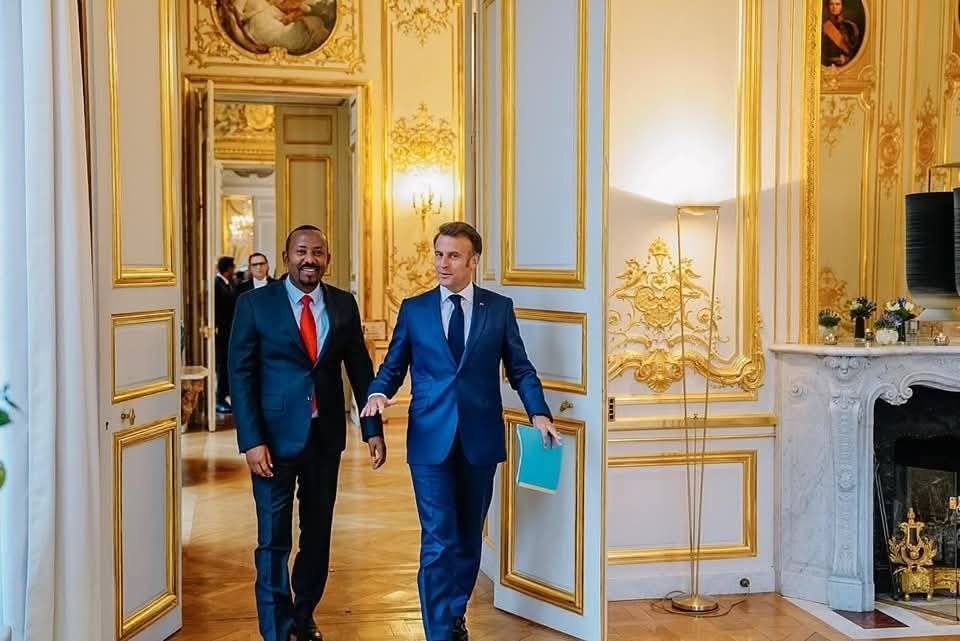
This intense diplomatic momentum marks a historic milestone in the contemporary era. It is essential to recognize that this is not a one-sided engagement; rather, it is a dynamic, reciprocated friendship. Since Prime Minister Abiy Ahmed took office and made his inaugural visit to Paris in October 2018, the exchange has been continuous. This led to President Emmanuel Macron’s return visit to Addis Ababa in March 2019, setting a precedent for a high-level executive partnership that has seen the French President return to Ethiopia three times in just seven years—a frequency nearly unprecedented in the history of Ethio-French relations.
The Foundational Seeds (1843–1907)
The formal journey of these two sovereignties began in 1843, when King Sahle Selassie of Shoa signed a landmark Treaty of Friendship and Commerce with King Louis-Philippe of France, a document preserved in the French Ministry of Foreign Affairs Archives as a testament to early Ethiopian statehood. Following the victory at Adwa, the 1897 Treaty of Friendship saw France become the first global power to formally acknowledge the modern Ethiopian state as a sovereign peer, a milestone documented in the Journal of Ethiopian Studies. This era was physically immortalized in 1907 when Emperor Menelik II granted a 106-acre forest estate for the French mission; as noted by The Ethiopian Herald, the Ferensay Legacion district remains the only neighborhood in the capital named after a foreign mission, symbolizing a century of geographic permanence.
The Industrial & Diplomatic Shield (1897–1923)
This trust catalyzed Ethiopia’s industrial birth through the Franco-Ethiopian Railway (1897–1917). According to records from the Ethiopian Railway Corporation, this 784-kilometer “lifeline” ended the nation’s landlocked isolation and birthed the unique urban identity of Dire Dawa. By 1923, the partnership reached the global stage; as cited in League of Nations historical archives, French advocacy proved decisive in securing Ethiopia’s entry into the organization, affirming the nation’s status as an independent actor at a time when global powers sought to restrict its modernization.
The Era of Institutionalization (1947–1966)
The relationship matured into a sophisticated technical and cultural exchange in the mid-20th century. The 1947 establishment of the Lycée Guebre-Mariam—named after resistance hero Dejazmach Gebre Mariam Gari—created an intellectual nursery for the nation’s leadership. The 1954 state visit of the Ethiopian Imperial leadership to Paris and the subsequent 1966 visit of General de Gaulle to Addis Ababa solidified the 1966 Cultural Convention, the legal bedrock for the French Center for Ethiopian Studies (CFEE), which Fana Media Corporation (FMC) has frequently highlighted for its role in unearthing and preserving Ethiopia’s paleoanthropological pride.
The Period of Quiet Resilience (1974–2018)
Following the 1974 revolution, the Strategic Line entered a period of pragmatic endurance. Even as ideological shifts occurred, the institutional “gears” never stopped turning. France remained a primary neighbor through its presence in Djibouti, ensuring the railway remained a functional artery for Ethiopian trade. By 1993, the establishment of the Agence Française de Développement (AFD) in Addis Ababa shifted the partnership toward high-impact urban infrastructure. Ethiopian Airlines records also confirm this era saw a deepening of aviation ties, culminating in the historic 2016 arrival of the first African-operated Airbus A350, a partnership built on technical excellence.
The Modern Renaissance: A Partnership of Results (2018–2026)
The current chapter is defined by “Diplomatic Speed” and a shift from aid to Sovereign Partnership. As documented in Joint Communiqués from the Office of the Prime Minister, the leadership of Prime Minister Abiy Ahmed and President Emmanuel Macron has moved the relationship into high-tech and financial frontiers.
* Heritage as Identity: Just as France mobilized for the renewal of Notre Dame, the partnership prioritized the “Sustainable Lalibela” project and the restoration of the National (Jubilee) Palace. As reported by the Ethiopian Press Agency, the Palace reopened in 2024 as a world-class museum, standing as a symbol of the Price Paid by Ethiopia’s ancestors.
* Aviation & Infrastructure: Ethiopian Airlines Group project documents confirm that French engineering expertise through ADP Ingénierie (ADPI) provided the foundational site selection and feasibility studies that proved the viability of the Bishoftu Mega-Airport City.
* The Economic Lifeline: In February 2026, the Ethiopian Ministry of Finance announced that President Emmanuel Macron’s administration co-chaired the G20 committee that signed a bilateral debt restructuring deal with Ethiopia, paired with an €81.5 million financing package to fuel Prime Minister Abiy Ahmed’s Homegrown Economic Reform (HGER 2.0).
* Security & Defense: According to the Ethiopian Ministry of Defense, the March 2026 Peacekeeping Accord has transitioned the partnership into “Operational Readiness,” focusing on protecting the Ethiopian National Defense Force (ENDF) from explosive hazards and certifying Ethiopia’s peacekeepers to the highest international standards.
A Visionary Convergence: Defining the Modern Partnership
The significance of this intense diplomatic engagement over the last seven years lies in the alignment of two forward-looking, reformist leaders who have successfully transitioned the partnership into an era of mutual strategic investment. By rejecting the outdated model of donor-recipient dependency, both Prime Minister Abiy Ahmed and President Emmanuel Macron have fostered a relationship characterized by executive efficiency and shared national objectives.
For Ethiopia, this partnership provides a “Third Way”—a diplomatic alternative that balances global influences while focusing on core institutional building. The frequency of these high-level engagements underscores that the relationship is no longer event-driven, but process-driven. From navigating complex debt restructuring in the Paris Club to engineering the future of African aviation in Bishoftu, the Arat Kilo-Élysée axis has become a reliable engine for Ethiopia’s Homegrown Economic Reform.
This is a friendship of equals, rooted in the Honor for the Nation and a shared vision for a stable, prosperous, and sovereign Ethiopia. The Arat Kilo-Élysée Strategic Line has moved beyond the 1843 treaties of Shoa into a 21st-century blueprint for global excellence.
By Mesafint Brlie