
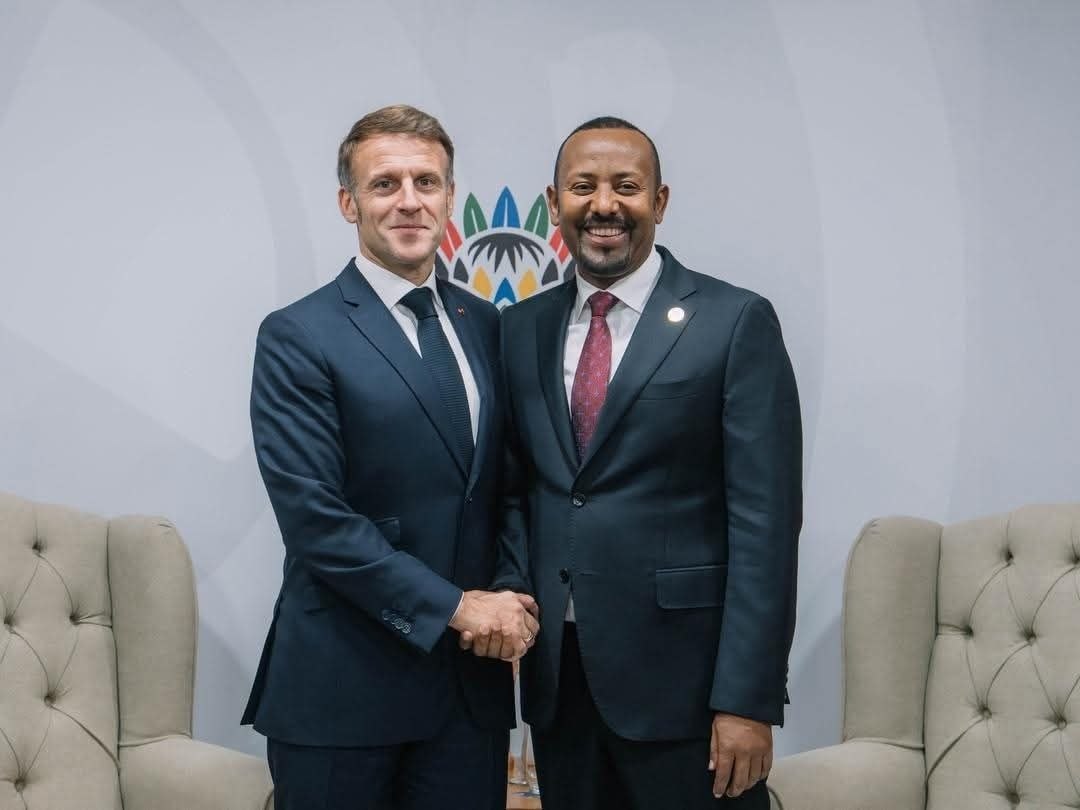
The New Geometry of Ethiopia–France Relations
Addis Ababa, May 13, 2026 (FMC) — As the global diplomatic landscape continues to shift toward multipolar engagement, the partnership between Ethiopia and France has increasingly taken on the characteristics of a structured, multi-dimensional strategic alliance.
Anchored in the 2018 framework that set the foundations for a special partnership, the relationship has steadily evolved into a broad platform of cooperation centered on sovereignty, economic transformation, technological advancement, climate action, and cultural heritage preservation.
The anticipated arrival of French President Emmanuel Macron for his 3rd visit in 7 years in Addis Ababa today—following high-level multilateral discussions at the Africa Forward Summit—comes at a moment of renewed diplomatic momentum, as both countries consolidate a transition from traditional diplomacy to implementation-driven partnership.
From Political Renewal to Institutionalized Partnership
The modern phase of Ethiopia–France relations was significantly redefined in 2018, when both countries elevated their engagement into a structured partnership framework encompassing political dialogue, economic cooperation, development support, education, cultural exchange, and broader institutional collaboration.
Since then, relations have been shaped by sustained high-level exchanges. Prime Minister Abiy Ahmed’s official visit to Paris in 2018, followed by President Emmanuel Macron’s reciprocal visit to Addis Ababa in 2019, marked the beginning of a more structured and regularized pattern of political engagement and strategic coordination.
This reciprocity has since become a defining feature of the relationship, supported by continued consultations across government institutions in both capitals.
Converging Reform and Development Agendas
At the core of the partnership is a growing convergence between Ethiopia’s national reform agenda and France’s renewed approach to engagement with Africa.
Under the leadership of Prime Minister Abiy Ahmed, a 2019 Nobel Peace Prize Laureate and recipient of multiple international recognitions including the FAO Agricola Medal (2024) and African Union Champion designation for Artificial Intelligence and Digital Health (2026), Ethiopia has pursued an ambitious transformation agenda focused on economic liberalization, agricultural modernization, infrastructure expansion, climate resilience, and digital transformation.
On the French side, President Emmanuel Macron’s administration, widely recognized for its forward-looking and reform-oriented foreign policy approach, has emphasized innovation-driven growth, ecological transition, and a recalibrated Africa policy grounded in investment, partnership, and multilateral cooperation. France’s engagement has also extended into global financial coordination mechanisms supporting economic stabilization efforts across developing economies, including Ethiopia.
These two forward-looking, energetic, and reform-driven leadership approaches have become increasingly integral to the deepening trajectory of Ethiopia–France relations.
This convergence has strengthened the foundation for expanded cooperation across energy, infrastructure, governance systems, and institutional capacity-building.
Economic Cooperation and Strategic Investment Momentum
Economic relations between Ethiopia and France have progressively shifted toward structured, investment-oriented cooperation aligned with Ethiopia’s broader reform trajectory.
France has played an active role in international coordination frameworks, including G20-led mechanisms supporting Ethiopia’s debt restructuring process under the Common Framework, reinforcing macroeconomic stability and reform implementation.
More broadly, President Macron’s recent continental engagement has included the announcement of a €23 billion investment and financing initiative aimed at strengthening Africa–Europe cooperation across infrastructure, energy transition, innovation, and development priorities. This broader framework is expected to further shape the environment within which Ethiopia–France cooperation continues to deepen.
These developments reflect a broader shift toward long-term investment diplomacy, where economic engagement is increasingly tied to implementation, structural reform, and development outcomes.
Climate, Energy, and Agricultural Transformation
Environmental cooperation remains a central pillar of Ethiopia–France relations.
Ethiopia’s large-scale reforestation and climate resilience initiatives align closely with France’s leadership role in global climate governance under the Paris Agreement. This shared orientation has strengthened collaboration in renewable energy development, particularly in hydropower, wind, and geothermal resources.
Agricultural transformation also remains a key area of convergence, with Ethiopia’s productivity gains driven by irrigation expansion, mechanization, and modernization efforts contributing to broader regional food security objectives.
Digital Transformation and Emerging Technologies
Digital innovation has emerged as a new frontier of cooperation between the two countries.
Ethiopia’s national digital transformation agenda—covering artificial intelligence development, ICT infrastructure expansion, and digital governance reform—aligns with France’s emphasis on technological sovereignty and innovation ecosystems.
This alignment is creating new opportunities for cooperation in cybersecurity, digital finance systems, and technology-driven public sector modernization.
Heritage, Culture, and Institutional Cooperation
Cultural and historical cooperation continues to provide depth to the bilateral relationship.
Joint engagement in heritage preservation and restoration projects reflects a shared commitment to safeguarding historical identity while promoting cultural tourism, research collaboration, and knowledge exchange.
Institutional cooperation in education, archaeology, and scientific research further reinforces long-standing people-to-people connections between Ethiopia and France.
Security and Regional Stability
Security cooperation remains an evolving dimension of the partnership within broader regional stability frameworks.
Engagement in peacekeeping support, technical training, and institutional capacity-building reflects shared interests in strengthening operational readiness and contributing to stability in the Horn of Africa and beyond.
A Relationship Defined by Structured Engagement
The evolution of Ethiopia–France relations since 2018 reflects a transition from episodic diplomacy toward a more structured and institutionalized strategic partnership.
Regular high-level exchanges between Prime Minister Abiy Ahmed and President Emmanuel Macron have contributed to sustained policy dialogue across multiple sectors, reinforcing continuity in cooperation and implementation frameworks.
As both countries navigate complex regional and global dynamics, their partnership increasingly reflects pragmatic alignment in economic modernization, innovation, climate action, and institutional strengthening.
The Road Ahead
The anticipated visit of President Emmanuel Macron to Addis Ababa marks another step in the continued consolidation of Ethiopia–France relations.
Rather than a symbolic engagement, the visit reflects a maturing relationship shaped by shared priorities and expanding cooperation frameworks. Under the leadership of Prime Minister Abiy Ahmed and President Emmanuel Macron, both forward-looking, energetic, and reform-driven leaders, the partnership continues to evolve into a forward-looking model of engagement grounded in reform, investment, and institutional collaboration.
Rooted in decades of historical interaction and strengthened by the 2018 strategic framework, Ethiopia–France relations are entering a phase defined by sustained dialogue, growing investment cooperation, and a shared commitment to stability in a rapidly evolving multipolar world.
By Mesafint Brlie