
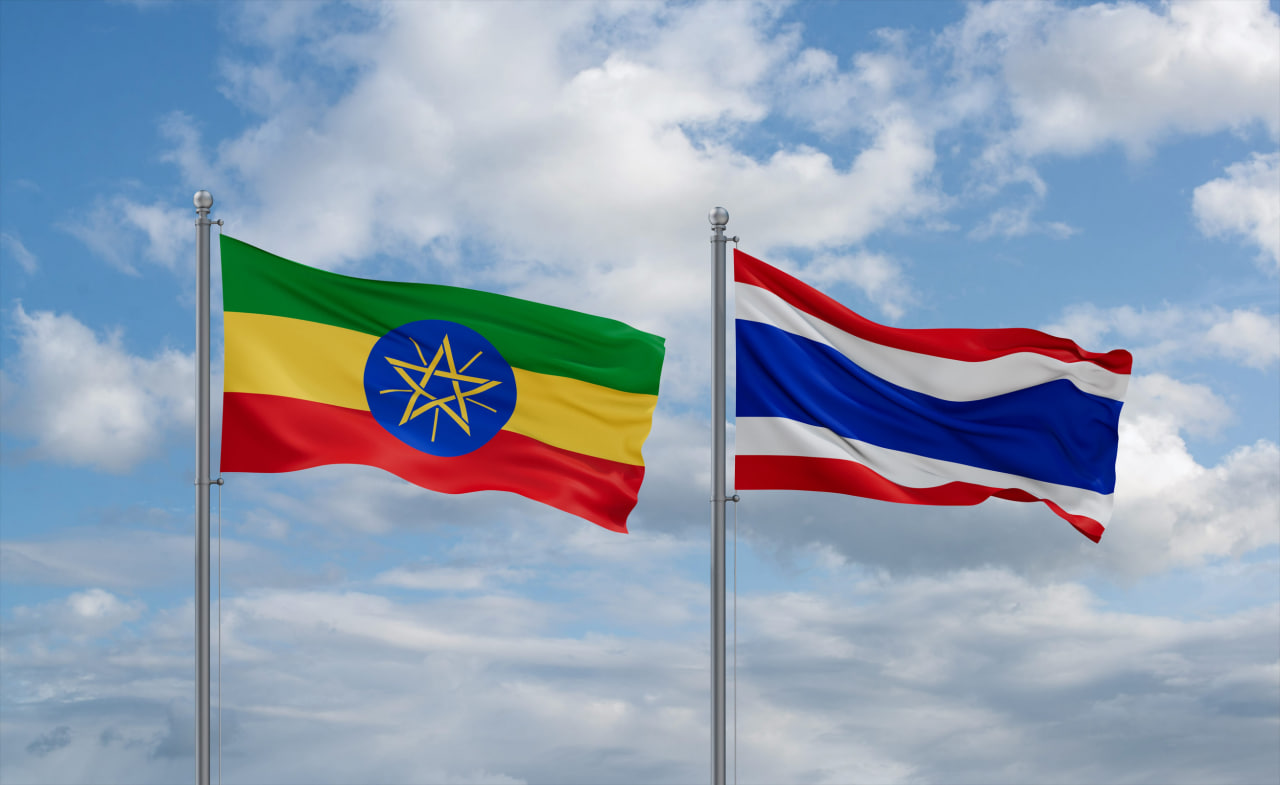
Two Sovereign Civilizations, One Emerging Horizon: How Ethiopia and Thailand Are Rewriting an Old Friendship
Addis Ababa, August 29, 2026 (FMC) — History sometimes places distant nations on parallel roads without ever bringing them together. Ethiopia and Thailand travelled such roads for centuries.
One rose in the highlands of the Horn of Africa, where ancient kingdoms built their own political traditions, commercial networks and cultural institutions.
The other developed across the river valleys and plains of Southeast Asia, where successive kingdoms forged their own systems of statecraft, commerce and diplomacy.
Their landscapes were different. Their religions and cultural traditions evolved differently. Their historical experiences were far from identical.
Yet beneath those differences lies an intriguing common thread: both developed powerful traditions of sovereignty, national identity and diplomatic statecraft, and both entered the modern international order with a determination to preserve their own political agency.
That history gives today’s Ethiopia-Thailand relationship a depth that cannot be measured merely by the number of diplomatic agreements signed between Addis Ababa and Bangkok.
It is a relationship between two countries that understand, from very different historical experiences, what sovereignty means.
And now, as their diplomatic engagement gathers new momentum, that shared historical consciousness is meeting a new geopolitical reality—one in which Africa and Asia are drawing closer, the Global South is asserting greater agency, and Ethiopia is expanding its diplomatic horizons far beyond traditional partnerships.
For Ethiopia, sovereignty is not an abstract concept preserved in diplomatic documents. It is woven into the country’s historical memory.
From the Aksumite civilization and its far-reaching connections across the Red Sea world to the emergence of successive Ethiopian states, the country developed a long tradition of statehood that existed on its own terms.
That tradition acquired an extraordinary symbolic force at the Battle of Adwa in 1896, when Ethiopian forces defeated invading Italian troops.
Adwa became much more than a military victory. Across Africa and the wider world, it came to represent the capacity of an African state to resist European imperial expansion and defend its sovereignty.
Ethiopia’s history was subsequently scarred by the Italian occupation of 1936–1941. Yet the restoration of Ethiopian sovereignty after the occupation reinforced rather than erased the country’s powerful historical consciousness of independence.
Thailand’s story followed a different path but produced a strikingly comparable historical instinct.
Known as Siam until 1939, Thailand navigated an increasingly imperial world in which European powers were transforming the political map of Asia. It preserved its formal independence while negotiating under enormous pressure with Britain and France and making significant territorial concessions.
Its survival was not accidental. Thai diplomacy evolved as an instrument of state preservation—balancing competing powers, negotiating treaties, modernizing institutions and adapting to an international system increasingly dominated by European empires.
Thailand’s own diplomatic history describes its restoration of complete independence in legal jurisdiction and taxation through a series of treaty negotiations that culminated in the 1930s.
Thus, although the two countries experienced radically different historical circumstances, both emerged from the age of imperialism with a profound attachment to sovereignty. That is one of the most compelling bridges between their histories.
It would be too simplistic to say that Ethiopia and Thailand experienced colonialism in exactly the same way. They did not. Ethiopia fought a major anti-colonial war and later endured occupation.
Thailand avoided formal colonization but faced intense imperial pressure, unequal treaties, territorial losses and restrictions on its sovereign authority before progressively restoring full legal independence.
Their paths were therefore different. But perhaps the more meaningful comparison lies not in the absence or presence of colonial rule, but in the determination of both societies to retain a national political identity and preserve room for independent decision-making.
That experience helped shape two diplomatic cultures that valued flexibility without surrendering national interests.
Thai diplomacy, in particular, became renowned for pragmatic balancing. Its historical record shows repeated efforts to negotiate with powerful neighbours and distant powers rather than allowing the country’s fate to be decided entirely by them.
Ethiopia likewise developed a diplomatic tradition in which external engagement was closely linked to the preservation of sovereignty and the country’s independent voice.
For both, diplomacy was not merely the art of making friends.
It was the art of preserving choices.
The depth of the two countries’ histories is another point of convergence. Ethiopia’s historical narrative reaches back through Aksum and other ancient centres of civilization, leaving behind monumental architecture, written traditions, religious heritage and a cultural identity that remains central to the country’s modern national consciousness.
Thailand’s historical landscape is equally rich, shaped by Sukhothai, Ayutthaya and later Bangkok, with traditions of Buddhism, monarchy, architecture, literature, craftsmanship and commerce that have continued to influence contemporary Thai identity.
Both countries therefore carry their past visibly into their present. In Addis Ababa, history lives alongside a rapidly modernizing capital that has become a diplomatic hub for Africa. In Bangkok, centuries of Thai cultural heritage coexist with one of Asia’s most dynamic metropolitan economies.
In both cases, tradition has not simply been preserved. It has been adapted. And that capacity to combine continuity with change may be another reason the two countries increasingly see possibilities in one another.
Formal diplomatic relations between Ethiopia and Thailand were established on April 10, 1964. Half a century later, the two countries marked the 50th anniversary of those relations with cultural and diplomatic events in Addis Ababa, reflecting a relationship that had endured across generations.
For much of that period, however, the relationship remained quieter than the potential of the two countries suggested. Today, that is changing.
The relationship is acquiring greater institutional depth. Political consultations are being established as a regular mechanism for policy dialogue.
Cooperation between the two countries’ Chambers of Commerce is being strengthened. Business communities are being brought together. Development cooperation is being linked more closely with investment and technology.
The latest high-level engagement in Addis Ababa has added fresh momentum to this trajectory.
Thailand’s Deputy Prime Minister and Foreign Minister Sihasak Phuangketkeow’s meetings with President Taye Atske-Selassie and Foreign Minister Gedion Timothewos, followed by broader business engagement between the two countries, have underscored the increasingly active character of the partnership.
The significance lies not simply in the meetings themselves, but in the breadth of the relationship they represent—from political dialogue and diplomatic cooperation to commerce, investment and people-to-people ties.
Thailand has also announced plans to reopen its Royal Thai Embassy in Addis Ababa with a resident ambassador—a move that could give the relationship a stronger and more permanent diplomatic presence.
The symbolism is significant. A relationship that once operated through more distant diplomatic arrangements is moving closer to the centre of both countries’ foreign-policy calculations.
The renewed Ethiopia-Thailand relationship also tells a larger story about Ethiopia itself.
Addis Ababa has long been a diplomatic capital because it hosts the African Union and numerous international organizations. But Ethiopia’s contemporary diplomacy is increasingly seeking to transform that geographic and institutional advantage into broader partnerships across the Global South.
Asia occupies an increasingly important place in that horizon.
Ethiopia is engaging Asian countries not merely as sources of development assistance or markets, but as partners in trade, investment, technology, industrialization, infrastructure, education, healthcare and diplomatic coordination.
Thailand fits naturally into this expanding architecture. It is not simply a Southeast Asian state seeking an African partner.
It is a country with extensive experience in agro-processing, manufacturing, tourism, healthcare, technology and development cooperation, sectors that intersect with Ethiopia’s own economic ambitions.
Thailand, for its part, sees Ethiopia not simply as another market. Ethiopia is home to the African Union, occupies a strategically important position in the Horn of Africa and serves as a diplomatic and economic gateway into the continent.
The relationship therefore has value in both directions.
There is a broader geopolitical story unfolding behind the bilateral relationship. For decades, relations between Africa and Asia were often discussed in terms of development assistance, trade or diplomatic solidarity.
The emerging relationship is more ambitious.
African and Asian countries increasingly see one another as partners in shaping a more balanced international economic and political order. That is the larger space in which Ethiopia and Thailand are positioning their relationship.
Thailand’s renewed emphasis on its Thailand–Africa Initiative explicitly recognizes Africa’s growing role in the international system and regards the continent as an important partner in the Global South. Its renewed engagement with Ethiopia, including the latest high-level visit, reflects that wider orientation.
For Ethiopia, such engagement opens another avenue for strengthening its connections with Asia while broadening the country’s diplomatic and economic partnerships.
For Thailand, deeper engagement with Ethiopia provides an important channel into Africa’s diplomatic centre.
The result is a relationship that can potentially serve two purposes at once: strengthening bilateral ties and helping connect two regions whose strategic importance is steadily rising.
The next chapter will not be written only in foreign ministries.
It will increasingly be written in factories, farms, laboratories, hospitals, universities, airports, hotels and boardrooms.
Thai expertise in technology, innovation and agro-processing can contribute to Ethiopia’s efforts to add value to agricultural products and expand industrial capacity. Ethiopia’s agricultural resources, growing market, strategic location and expanding economic opportunities can offer Thai companies new avenues for investment.
The same logic extends to tourism, healthcare, manufacturing, digital technology, services and education.
The recent Ethiopia-Thailand Business Bridge in Addis Ababa is therefore more than a business forum. It represents an attempt to give economic substance to a diplomatic relationship that is gaining new political momentum.
And this is where the old story of the two countries begins to acquire a new vocabulary.
Sovereignty becomes partnership.
Diplomacy becomes connectivity.
Historical friendship becomes investment.
And geographical distance becomes opportunity.
There is something compelling about two countries with such distinct histories finding new relevance in one another at this particular moment.
Ethiopia and Thailand do not share the same civilization. They do not share the same geography. They do not share the same political history.
But they share something perhaps more durable: a deep attachment to national identity, a long memory of statecraft and a historical understanding that independence requires both resilience and diplomatic intelligence.
That shared instinct once helped both countries navigate an age dominated by imperial powers.
Today, the international landscape is changing again. The centre of economic gravity is shifting. Africa is asserting greater strategic importance. Asia is deepening its global influence. The Global South is demanding greater voice, representation and agency.
Ethiopia and Thailand are responding to that transformation from opposite ends of the same emerging bridge.
Their relationship, formalized more than six decades ago, is now being given new institutional, economic and diplomatic energy. The planned return of a resident Thai embassy to Addis Ababa, the establishment of political consultations, stronger business-to-business engagement and expanding cooperation in development and technology all point in the same direction.
The story is no longer simply about two countries maintaining a longstanding friendship.
It is about two historically resilient nations asking what that friendship can accomplish in a changing world.
And perhaps that is the most interesting chapter of all.
**The old civilizations remain. The history remains. The sovereignty remains.
But the horizon is getting wider.**