
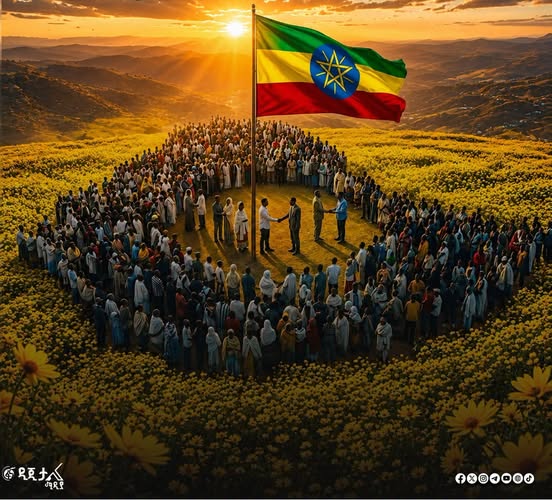
The Social Capital of a Civilization: Ethiopia’s Indigenous Values and the Architecture of National Unity
Addis Ababa, September 25, 2026 (FMC) — A nation is held together by more than institutions. Beneath constitutions, elections and infrastructure lies a deeper architecture of trust, shared values, civic responsibility and reconciliation—the social capital through which people resolve differences and sustain a common national purpose.
For Ethiopia, much of that capital is indigenous.
Across generations, communities have developed traditions of consultation, mediation, collective responsibility and coexistence. Elders, customary institutions, religious traditions and indigenous systems of social organization have provided mechanisms for settling disputes and restoring relationships. What is often regarded as heritage is therefore also a reservoir of social knowledge relevant to modern state-building.
That inheritance is increasingly meeting contemporary democratic institutions.
The National Dialogue, built through years of nationwide consultations, culminated in the National Dialogue Conference, which opened in Addis Ababa on July 15, 2026, bringing nearly 4,000 participants together for 40 days of deliberation across eight major agendas.
Political representatives joined elders, Abba Gadas, religious leaders, women, youth, farmers, pastoralists, scholars and other sections of society in discussions spanning nation-building, governance, political and electoral systems, institutional development, rule of law and human rights, socio-economic questions, reconciliation and peacebuilding.
The significance lies in the method: differences were brought into a sustained national conversation, with dialogue and negotiated understanding placed alongside formal political institutions.
The recent election adds another dimension. Held on June 1, 2026, it brought more than 54 million registered voters into the country’s seventh general election.
Together, the election and National Dialogue illustrate complementary forms of democratic participation: citizens exercising political choice through elections while engaging collectively on the deeper questions shaping the national order.
Neither requires uniformity. A resilient democracy depends on the capacity to accommodate disagreement without turning political difference into permanent division.
That principle has deep roots in Ethiopia’s indigenous traditions.
Customary mediation has historically sought not only to settle disputes but to restore relationships. In the contemporary context, such traditions provide a social foundation for peaceful engagement and reconciliation alongside formal institutions.
Ethiopia’s cultural life reinforces the same architecture. Meskel, Irreecha and Timket are living spaces of collective memory and belonging, renewing relationships and transmitting values across generations.
They demonstrate how culture can function as social infrastructure—strengthening bonds that laws and institutions alone cannot manufacture.
Medemer adds a contemporary national vocabulary to this inheritance: coming together, complementarity, mutual responsibility and collective contribution. It connects indigenous social wisdom with the broader task of building a cohesive modern state.
The trajectory is therefore larger than any single political process. Peaceful engagement is becoming a means of addressing differences; reconciliation a resource for rebuilding social cohesion; democratic participation a practice extending beyond the ballot box; and shared national narratives a basis for national consensus.
A modern state needs strong institutions. A democracy needs participation. Peace requires reconciliation. National unity requires a shared sense of purpose.
Ethiopia’s indigenous social capital connects them.
The task is not to preserve the past unchanged, but to translate its most enduring principles—dialogue, responsibility, mediation, coexistence and reconciliation—into the foundations of a modern national order.
That is the social capital of a civilization: an inherited capacity to live with difference, find common ground and build the future together.