
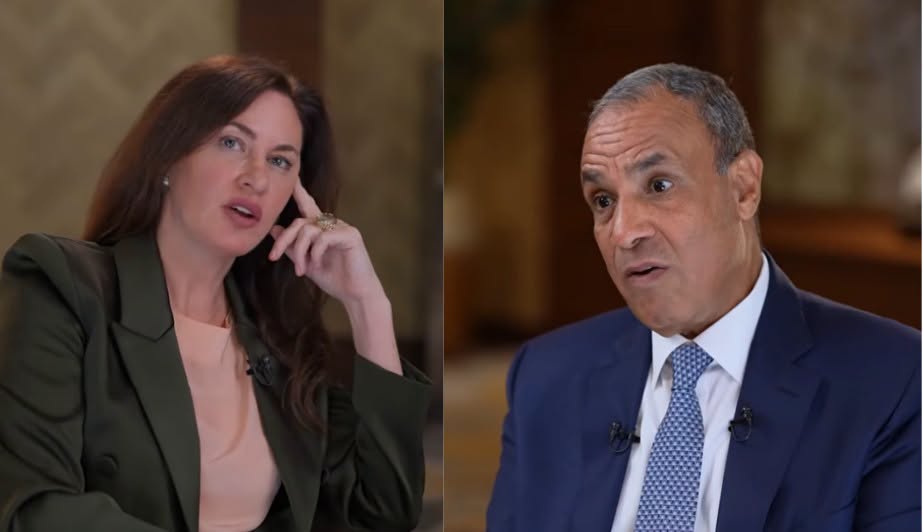
Abbay River Is Not a Casino: Hadley Gamble’s Reckless Bet on Egyptian Confrontation with Ethiopia
Addis Ababa, August 29, 2026 (FMC) — The Abbay River is not a casino, Ethiopia’s sovereign development is not a wager, and the future of an entire region cannot responsibly be placed on the table of inflammatory television questioning.
Yet that is precisely the disturbing direction of American journalist Hadley Gamble’s interview with Egypt’s Foreign Minister, in which a dispute over Ethiopia’s legitimate development of its water resources was repeatedly pushed toward the language of threats, military power and confrontation.
The problem is not that a journalist asked difficult questions. Tough questioning is an essential part of journalism.
The problem is the direction in which the questioning was driven. On an issue as sensitive as the Nile, where responsible journalism should test claims, challenge assumptions and keep diplomatic space open, Gamble repeatedly framed Ethiopia’s development through Egypt’s security fears and then pressed the Egyptian minister beyond diplomacy toward the prospect of force.
The pattern is unmistakable. After introducing Ethiopia’s plans for potentially three additional dams, Gamble framed the Nile as a “lifeline” for Egypt and immediately asked for Cairo’s response.
She then supplied another escalatory premise herself: “It’s a threat to your national security.” The framing moved the discussion away from the legitimate question of how an upstream country may develop its own resources and toward the presumption that Ethiopia’s development constitutes an Egyptian security threat.
That was followed by an even more consequential line of questioning. After the minister referred to 13 years of negotiations, Gamble asked: “At what point now that you have witnessed this and lived through those 13 years at what point is the solution… not diplomacy?”
That is not merely a request for an assessment of negotiations. It places the abandonment of diplomacy directly on the table.
Then came the most troubling turn. Gamble asked: “So what’s the point of having the biggest Arab military and not using it?”
There is no ambiguity in the premise. The question takes the conversation from water diplomacy to military capability and asks why that capability should remain unused. On an already combustible regional dispute, this is precisely the kind of framing that responsible journalism should approach with exceptional caution, not amplify.
The sequence continued with another loaded formulation: “So diplomacy doesn’t work, they’re starving you, this issue is coming to a head and quickly. What is the solution?”
Here, Ethiopia is no longer presented simply as an upstream country pursuing water-resource development.
It is rhetorically transformed into an actor that is “starving” Egypt, while the interview is simultaneously framed as a crisis rapidly approaching a decisive point. The question then demands a “solution” after diplomacy has already been declared ineffective.
This is where the interview warrants serious scrutiny—not merely as a matter of style, but as a matter of journalistic responsibility.
A journalist interviewing a senior foreign-policy official on a dispute involving two countries has every right to challenge the official, question his government’s assumptions and ask what options remain.
But there is a profound difference between interrogating power and constructing a narrative in which military confrontation becomes the implied next step. The former serves journalism. The latter risks becoming an instrument of escalation.
Even more revealing is Gamble’s characterization at another point in the discussion: “I mean, it must be incredibly frustrating.” In isolation, such a remark might appear innocuous.
In the broader sequence, however, it reinforces the emotional and confrontational frame surrounding the dispute.
The interview repeatedly returns to crisis, threat, military strength and the prospect of confrontation rather than keeping equal emphasis on cooperation, equitable utilization and the enormous stakes of peace in the Nile Basin.
Ethiopia has never presented the Grand Ethiopian Renaissance Dam as an instrument for depriving Egypt of water.
The GERD is a hydropower project built to harness Ethiopia’s own natural resources for electricity generation and national development.
Producing electricity does not consume the Nile waters in the manner of irrigation or other consumptive uses. Ethiopia has consistently maintained that its development of water resources can proceed alongside reasonable and equitable utilization and without significant harm to downstream countries.
That distinction matters.
Ethiopia is not attempting to appropriate Egypt’s sovereign resources. It is not demanding access to Egypt’s territory, water or national wealth. It is seeking to develop resources within its own territory for the benefit of its own population.
The country’s rivers, highlands and water resources are not bargaining chips to be surrendered whenever Cairo declares a security concern.
Nor can Ethiopia’s developmental aspirations be reduced to a threat merely because Egypt has historically structured its national water security around overwhelming dependence on the Nile.
That dependence is a reality for Egypt. It does not, however, transform Ethiopia’s resources into Egyptian property.
The Nile is a transboundary river, not a private possession. Its future cannot be governed by a colonial-era mentality in which downstream dependence is converted into upstream restraint and where the developmental rights of the source countries are treated as subordinate to the preferences of downstream powers.
Ethiopia has repeatedly chosen cooperation over confrontation. It has participated in years of negotiations over the GERD.
It has maintained that the dam can produce benefits beyond its borders through electricity generation and regional power integration. It has continued to advocate equitable and reasonable utilization of transboundary waters.
That is the fundamental reality that gets obscured when Ethiopia’s dams are repeatedly presented as an existential Egyptian threat.
The irony is profound. Ethiopia is harnessing the Abbay primarily to generate power and expand development, while Egypt’s political narrative continues to frame virtually every significant upstream development through the prism of existential danger.
Ethiopia builds infrastructure; the narrative turns it into aggression. Ethiopia generates electricity; the narrative turns it into deprivation. Ethiopia invokes cooperation; the narrative keeps returning to confrontation.
And Gamble’s questioning did little to break that cycle.
Instead, it repeatedly intensified it.
The most revealing moment may therefore not be any single question but the cumulative architecture of the interview. First came Ethiopia’s prospective dams. Then the “threat” to Egypt’s national security.
Then the failure of diplomacy. Then Egypt’s military capacity. Then the assertion that Egypt was being “starved.” Finally came the demand to identify the solution.
Such sequencing matters. Questions are not politically weightless simply because they end with a question mark. The premises embedded within them can shape the narrative, narrow the range of acceptable answers and push an interviewee toward particular interpretations of events.
On an issue as consequential as the Nile, that responsibility should be taken seriously.
The international community should therefore look beyond the surface of the interview and examine what kind of regional narrative is being constructed.
Ethiopia does not need to be portrayed as an adversary merely to make Egypt’s security concerns intelligible. Egypt’s water concerns can be examined seriously without converting Ethiopia’s development into an act of hostility.
There is also a larger historical issue that cannot be ignored. For decades, Egypt’s approach to the Nile has been heavily influenced by arrangements made without the meaningful participation of all basin countries.
Ethiopia was not a party to the 1959 Nile Waters Agreement between Egypt and Sudan, yet Cairo has repeatedly treated historical arrangements as though they could permanently determine the rights of an upstream country that was never a signatory.
That logic cannot provide a sustainable foundation for the future.
The age in which the developmental rights of upstream African countries could be indefinitely subordinated to inherited arrangements is passing.
Africa’s source countries are asserting their legitimate right to develop, industrialize, generate electricity and improve the lives of their people. That is not aggression. It is development.
Ethiopia has no interest in depriving Egypt of water. But neither will Ethiopia accept the proposition that its own development requires Cairo’s approval.
This is precisely why journalism matters.
A serious journalist should expose the assumptions behind competing narratives rather than reinforce one side’s most inflammatory premises.
The proper question is not how to make Ethiopia’s development appear threatening enough to justify confrontation. It is how two sovereign countries can move beyond inherited distrust and construct a durable framework for cooperation.
The Nile Basin needs more diplomacy, not less; more evidence, not emotional escalation; more cooperation, not militarized rhetoric.
Most importantly, Ethiopia’s legitimate right to develop its resources must not be converted into a security threat simply because another country has chosen to define its water security in existential terms.
The Abbay is not a battlefield. It is not Egypt’s private reservoir. And it certainly is not a casino where journalists can gamble with the consequences of regional peace.
Ethiopia will continue to develop its water resources responsibly, generate power, pursue economic transformation and engage its neighbors on the basis of sovereign equality and mutual benefit.
That is not a threat.
It is a right.