
Africa’s Integration Runs on Infrastructure
Addis Ababa, September 25, 2026 (FMC) — A pipeline can be measured in kilometres. Its significance can be measured in something far greater: the markets it connects, the industries it enables and the economic space it helps create.
The Ethiopia-Djibouti petroleum products pipeline is one more piece in an emerging infrastructure architecture that is quietly reshaping the economic geography of the Horn of Africa. Its 120 kilometres are not simply another route for moving fuel; they form part of a growing network in which ports, railways, highways, logistics centres, storage facilities and energy systems increasingly operate as one connected economic corridor.
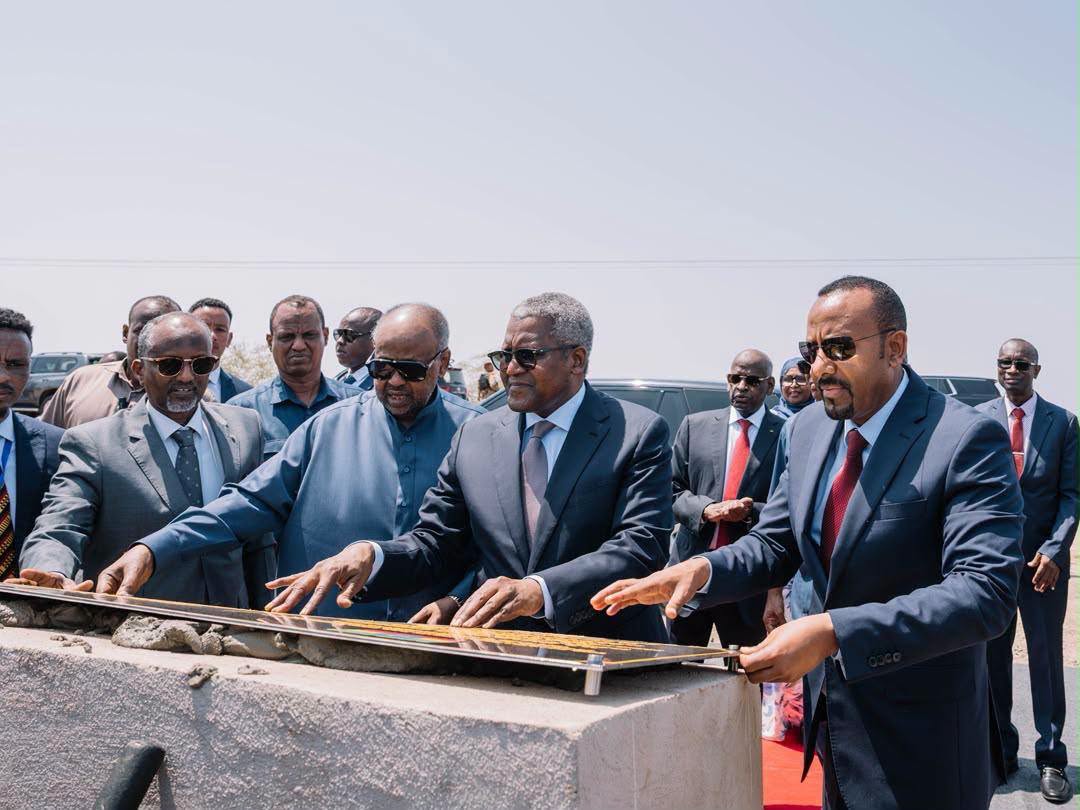
The project was launched with a groundbreaking ceremony in Damerjog, Djibouti, on September 24, attended by Ethiopian Prime Minister Abiy Ahmed, Djibouti President Ismail Omar Guelleh and Dangote Group President and CEO Aliko Dangote. Developed through a partnership between Ethiopian Investment Holdings and the Dangote Group, the project represents an investment of about $660 million.
But its significance extends well beyond the pipeline itself.
Africa’s integration cannot live on agreements alone. The African Continental Free Trade Area provides the framework for a single continental market; Agenda 2063 provides the long-term vision. But markets need physical systems capable of carrying energy, goods, capital and people across borders efficiently.
Infrastructure is where that ambition acquires physical form.
The Ethiopia-Djibouti corridor offers a compelling illustration. Djibouti’s maritime gateway and logistics capacity meet Ethiopia’s large and expanding market and productive base. The railway, highways, logistics facilities, storage infrastructure and now the pipeline add successive layers of connectivity to that relationship.
The objective is not simply to move more goods. It is to reduce friction across the value chain.
Modern competitiveness increasingly depends on how efficiently the entire logistics chain performs—from port to storage, railway to road, energy terminal to factory, and production centre to market. The question is no longer simply whether infrastructure exists, but whether infrastructure works together.
That is regional integration in its most practical form.
The pipeline adds another artery to that system, designed to reduce reliance on long-distance road haulage, improve fuel logistics, expand storage and strengthen supply to sectors ranging from aviation and transport to agriculture, construction and industry.
But the deeper proposition is connectivity itself.
It is also where African investment enters the equation.
With Ethiopian Investment Holdings and the Dangote Group at the centre of the project, alongside African financial institutions, continental capital is being mobilized around infrastructure serving African markets. The model reflects a broader ambition to strengthen Africa’s capacity to finance, build and operate strategic assets from within the continent.
Industrialization follows the same logic.
Africa’s next economic chapter requires more than exporting resources and importing finished products. It requires deeper processing, stronger manufacturing ecosystems, regional value chains and logistics systems capable of retaining more value within African economies.
The pipeline is therefore part of a larger chain: port, storage, transport, industry, market.
And that chain requires African expertise to operate it.
Engineers, technicians, logistics specialists, regulators and entrepreneurs are not peripheral to infrastructure; they are its long-term operating system. Skills transfer, technology absorption and local technical capacity determine whether infrastructure becomes a lasting productive capability.
There is also a resilience imperative.
For economies tied to the Red Sea, disruptions in maritime routes and energy markets can rapidly travel through domestic supply chains. Storage capacity, diversified transport and interconnected infrastructure provide not only efficiency, but room to absorb shocks and keep economic activity moving.
This is where the Ethiopia-Djibouti corridor acquires continental resonance.
A port connects to a railway. A railway connects to logistics. Logistics connects to energy. Energy supports industry. Industry connects to markets. Markets, linked across borders, begin to form the physical foundation of the continental market envisioned by AfCFTA and Agenda 2063.
The measure of integration, ultimately, is not how many agreements Africa signs, but how easily its economies can work with one another.
That is why infrastructure matters.
Not simply because it moves fuel, but because it moves economies closer together.