
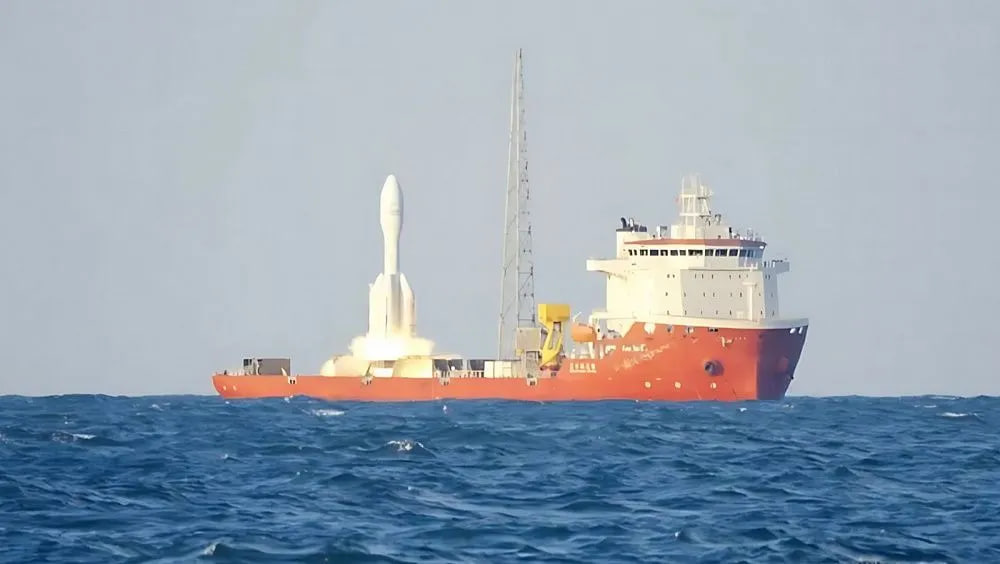
China Makes First Sea-Based Launch of Low-Earth-Orbit Internet Satellite Constellation
Addis Ababa, September 17, 2026 (FMC) — China has successfully placed nine satellites into their designated orbits from waters off the coast of Shanghai, marking the world’s first mobile sea-based launch of a low-Earth-orbit satellite constellation intended to provide broadband internet services, as reported by TV BRICS, citing its Chinese partner Science and Technology Daily
The Gravity-1 Y3 launch vehicle carried eight satellites belonging to the Qianfan constellation, also known as the “Constellation of a Thousand Sails,” which is being developed as a global low-Earth-orbit satellite system for high-speed internet access, along with an Enhanced Ultra High Throughput (EUHT) technology test satellite.
The mission established two new Chinese records for a single sea-based launch, with the payload exceeding three tonnes and the injection altitude reaching 800 kilometers.
The results demonstrated the suitability of sea-based launches for medium- and large-sized satellite payloads.
Gravity-1 is a solid-fuel rocket with a maximum payload capacity of 6.5 tonnes to low-Earth orbit. The mission marked its second mobile launch from the Far East, coming only 56 days after the previous mission.
The launch also demonstrated the rocket’s capacity to operate under maritime conditions involving high temperatures, humidity and salt fog.
It was the first launch dedicated entirely to a low-Earth-orbit internet satellite mega-constellation.
Meanwhile, development of the Gravity-2, a large reusable liquid-fuel rocket, is progressing. The rocket is expected to carry up to 21.5 tonnes to low-Earth orbit and is scheduled to make its debut in the near future.