
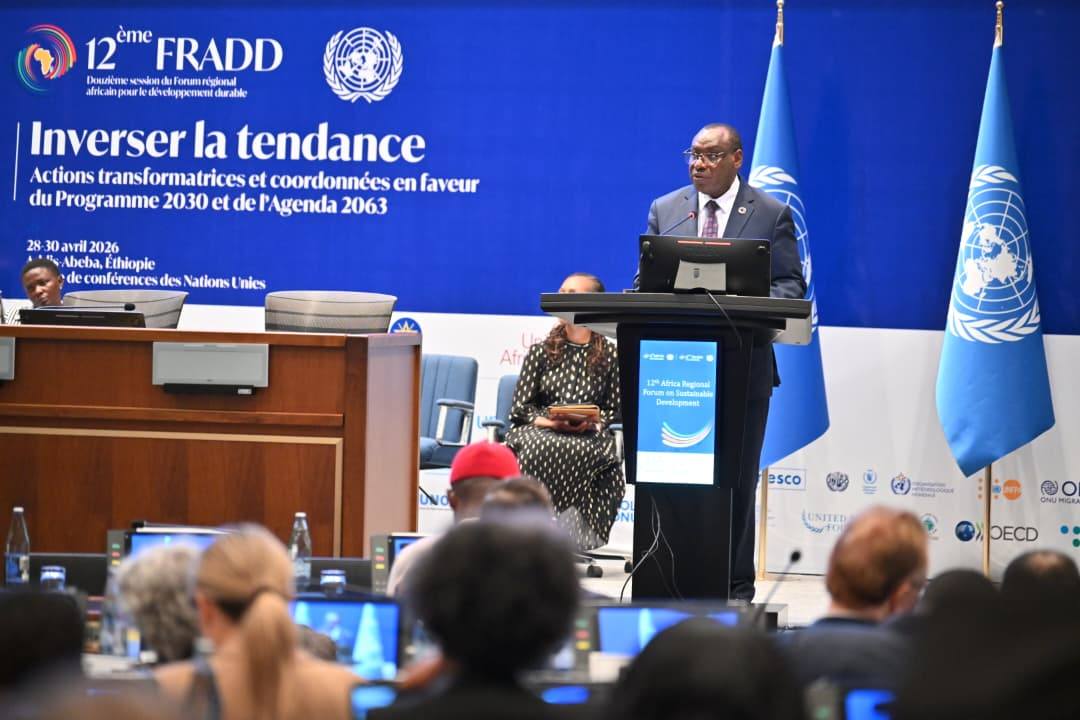
ECA chief proposes five priority reforms to accelerate Africa’s development transformation
Addis Ababa, April 28, 2026 (FMC) – The Executive Secretary of the United Nations Economic Commission for Africa, Claver Gatete, has proposed five priority reforms aimed at accelerating Africa’s sustainable development transformation, urging a decisive shift from fragmented interventions to system-wide implementation.
Speaking at the Twelfth Session of the Africa Regional Forum on Sustainable Development in Addis Ababa, the ECA Chief stressed that Africa’s main challenge is not the absence of policy frameworks, but the persistent gap between planning and large-scale execution.
He said structural constraints, combined with rapid demographic, urban, and climate transitions, require a fundamental rethinking of development strategies across the continent.
The ECA Chief outlined five priority reforms he said are critical to unlocking Africa’s development potential.
First, he proposed repositioning foundational services such as water, energy, and infrastructure as core economic assets. He said these sectors must be fully integrated into industrial strategies, urban planning, and regional value chains, rather than being treated as standalone social services.
Second, he called for urgent efforts to close Africa’s infrastructure financing gap through innovative and blended financing models. He emphasized the need for stronger domestic resource mobilisation, improved investment environments, and the development of bankable projects capable of attracting private capital.
Third, he proposed leveraging Africa’s rapid urbanisation as a driver of jobs and productivity, stressing that cities must be aligned with industrialisation strategies and supported through investments in transport systems, housing, and urban upgrading.
Fourth, he called for aligning digital and green transitions, noting that energy systems, digital infrastructure, and industrial development must be planned in an integrated manner, with climate resilience, skills development, and innovation at the core.
Fifth, he proposed strengthening data systems, institutions, and regional cooperation, highlighting the importance of cross-border infrastructure, transboundary resource management, regional power pools, and value chains under the African Continental Free Trade Area.
The ECA Chief stressed that Africa’s central challenge remains implementation at scale, noting that existing frameworks such as the Sustainable Development Goals and Agenda 2063 are already well aligned but require stronger execution.
“The tide will not turn on its own. What is required now is a decisive shift from plans to implementation at scale,” he said.
He added that Africa’s development trajectory must move beyond fragmented interventions toward integrated systems capable of delivering structural transformation.
The Africa Regional Forum on Sustainable Development continues in Addis Ababa, bringing together governments, regional institutions, development partners, civil society, youth, and the private sector to review progress and accelerate implementation of Africa’s development agenda.