
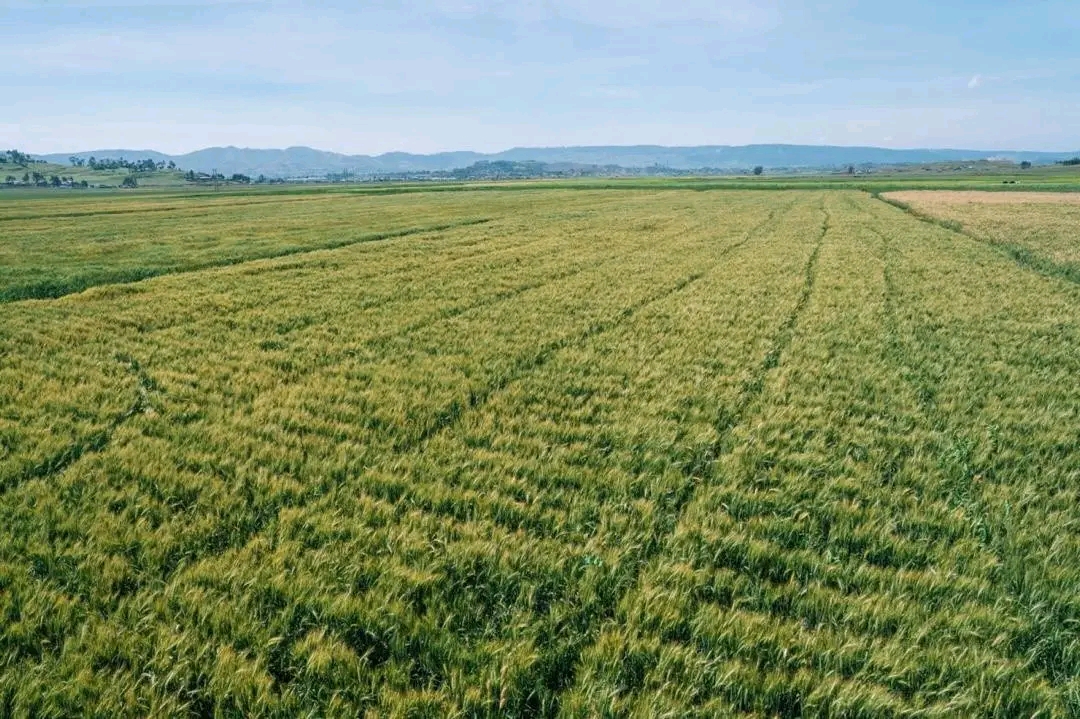
Ethiopia Becomes Africa’s Leading Wheat Producer with Record Harvest of Over 330 Million Quintals — PM Abiy
Addis Ababa, May 6, 2026 (FMC) – Ethiopian Prime Minister Abiy Ahmed stated that his country has become Africa’s leading wheat producer, with output surpassing 330 million quintals this fiscal year.
The Prime Minister made the remarks following his visit this morning to a wheat field cultivated on 2,150 hectares of land in Sululta Woreda, North Shewa Zone of the Oromia Regional State.
He said the results achieved in the agricultural sector are highly impressive and are providing renewed strength and motivation to further intensify efforts, generate new ideas, and implement them.
Prime Minister Abiy noted that summer farming and summer wheat production were not common in Ethiopia prior to the outbreak of COVID-19.
He said the initiative was launched based on the conviction that no arable land should remain idle, that reliance on aid must be reduced, and that the country’s vast agricultural potential should be fully utilized.
He stated that the results of summer (dry season) wheat cultivation have now reached an impressive level and gained wide acceptance.
Recalling that Ethiopia had been importing wheat and was among countries with low production levels five to six years ago, the Prime Minister said the sector has since registered significant transformation.
According to him, 4.4 million hectares of land were cultivated during the main rainy season this year, while about 3.8 million hectares were covered during the summer season, bringing the total cultivated area to over 8 million hectares. He said this resulted in more than 330 million quintals of wheat production, placing Ethiopia first in Africa.
He added that cultivated land increased by about 950,000 hectares compared to last year, while production rose from 280 million quintals to 331 million quintals—an increase of 50 million quintals within a year.
Prime Minister Abiy said the expansion of wheat production is bringing historic change in improving the livelihoods of citizens who had long been supported by the safety net program.
He noted that many woredas and kebeles in North Shewa Zone that previously relied on such support are now no longer beneficiaries.
He also indicated that, alongside wheat production, farmers are engaged in dairy and poultry farming, supplying about 500,000 liters of milk to cities every day.
The Prime Minister further stated that the summer wheat initiative is contributing significantly to Ethiopia’s economic growth, noting that past limitations were linked to weak management, while improvements are now being recorded year after year.
He stressed that producing over 330 million quintals of wheat is a major achievement, adding that no other country in Africa is producing at this level. He expressed confidence that with sustained effort and proper use of technology, Ethiopia could reach 500 million quintals of wheat production in a short period.
Prime Minister Abiy also noted that agriculture, alongside industry, technology, mining, and tourism, is delivering strong results.
Emphasizing the importance of sustained effort, Abiy said global challenges can only be overcome through work, stressing that progress depends on continuing what has been started.
He further called for the proper use of all agricultural seasons and urged farmers and agricultural experts to make necessary preparations for the upcoming winter season, which he described as a period of intensive work.