
Ethiopia’s GDP Rebasing Establishes New Benchmark for Long-Term Development Planning – Minister
Addis Ababa, November 4, 2026 (FMC) – Ethiopia has unveiled updated Gross Domestic Product (GDP) figures following a comprehensive rebasing exercise, establishing a more accurate economic benchmark to guide national planning, strengthen policy decisions and advance the country’s long-term development ambitions, Minister of National Strategy Bereket Fesehatsion said.
Under the revised national accounts, with the 2017 Ethiopian fiscal year (2024/25) adopted as the new base year, Ethiopia’s GDP stood at 24.03 trillion Birr, equivalent to 201.42 billion US dollars. The figure increased to 31.86 trillion Birr, or 210.7 billion US dollars, in the 2018 Ethiopian fiscal year (2025/26).
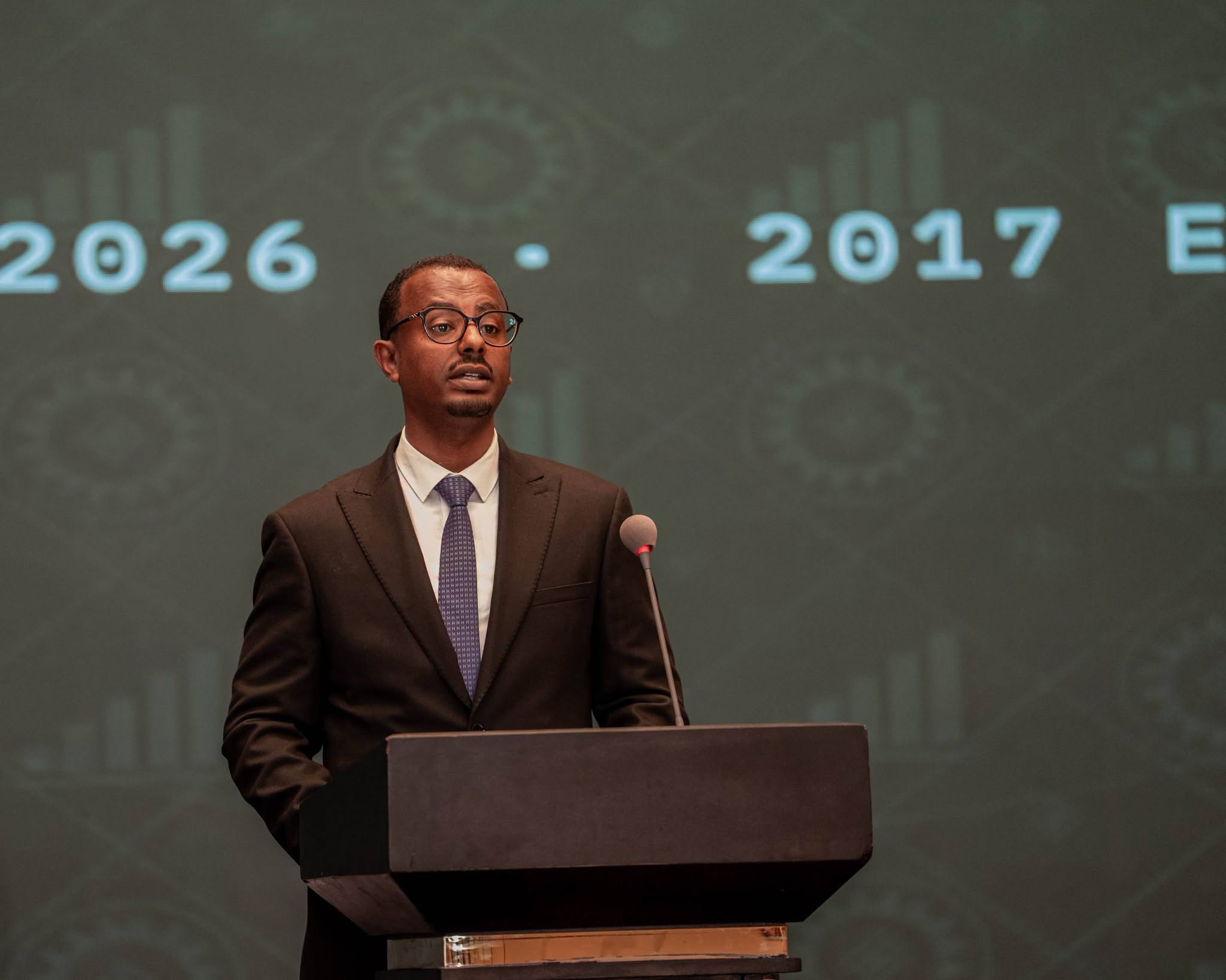
Speaking at the launch of the updated figures today, Bereket said the rebasing provides a more comprehensive picture of the economy by incorporating emerging economic activities and sectors that were previously underrepresented in national statistics.
He emphasized that the updated measurement framework would help the government move beyond assessing economic expansion in quantitative terms and give greater attention to the productive capacity of the economy.
Strengthening domestic production, generating employment and reducing excessive dependence on primary commodities remain important priorities in this regard, he noted.
The minister said reliable economic statistics are essential to sound economic management, providing a stronger basis for policy formulation, budget allocation, investment decisions and development planning.
The revised figures will also offer a more accurate benchmark for assessing national objectives in foreign trade, revenue generation, investment and employment creation, while strengthening confidence among domestic and international investors.
The 2017 Ethiopian fiscal year was selected as the new base year in consideration of its relative macroeconomic stability, declining inflation and the availability of comprehensive statistical data.
The exercise drew on findings from the agricultural census, the economic establishments census and household surveys, among other sources, to reflect structural changes in the national economy.
Conducted under the leadership of Ethiopian professionals with technical assistance from the International Monetary Fund, the process also sought to bring the country’s national accounts in line with the 2008 System of National Accounts and other international standards.
Bereket highlighted efforts to strengthen national statistical capacity through the recruitment and training of young graduates, enabling them to work alongside experienced professionals and acquire the technical expertise needed to sustain the system.
The government plans to institutionalize GDP rebasing every five years to keep national economic statistics relevant and reflective of changing economic realities.
The minister described the updated framework as an important foundation for Ethiopia’s long-term ambition of building a prosperous country by 2050, supported by stronger domestic capabilities and improved living standards for citizens.