
From Neighbours to Economic Partners: What Lamu Signals for Ethiopia, Kenya and Africa’s Integration Agenda
Addis Ababa, October 1, 2026 (FMC) — On the shores of Lamu, the groundbreaking of a major refinery has placed a much larger idea in physical form: Africa’s economic future will increasingly depend on how effectively its countries connect infrastructure, markets, capital and productive capacity.
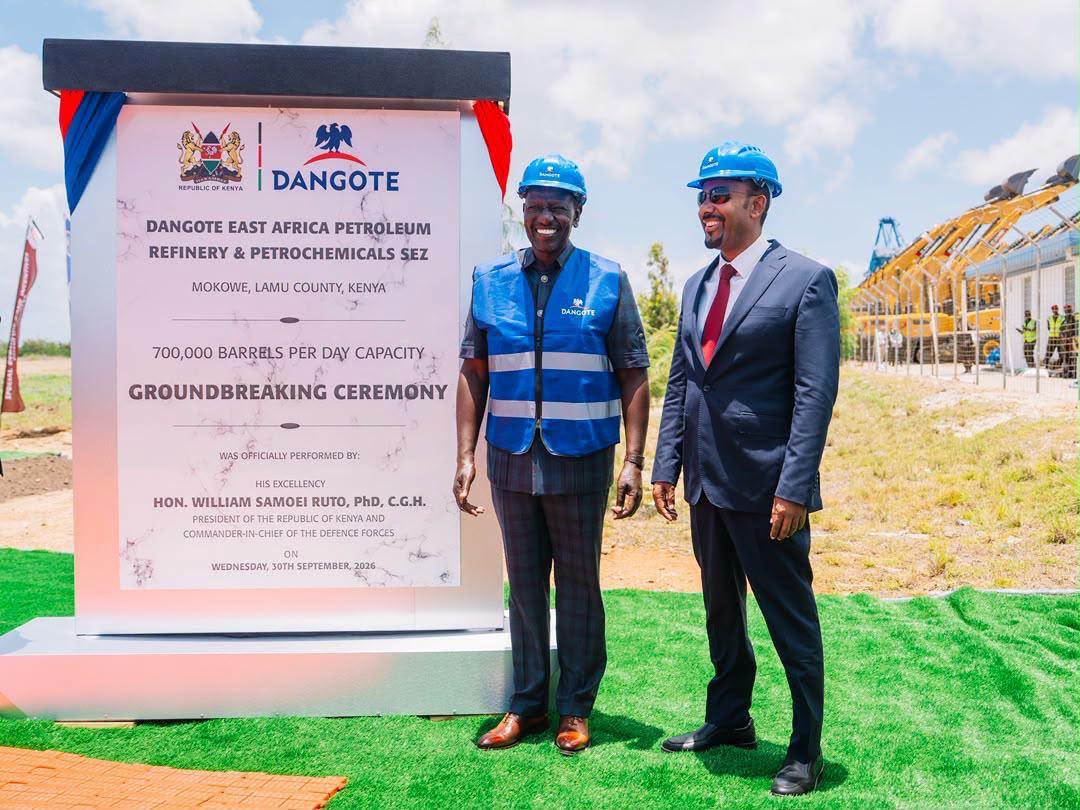
For Ethiopia, Prime Minister Abiy Ahmed’s participation in the September 30 ceremony alongside Kenyan President William Ruto and other African leaders was therefore about more than witnessing the launch of a major industrial project in a neighbouring country. It brought into focus an evolving relationship between Ethiopia and Kenya in which geographic proximity is increasingly being translated into economic connectivity, shared infrastructure and regional opportunity.
The Lamu refinery sits at the intersection of these ambitions. Planned to process up to 700,000 barrels of crude oil per day, the project is being positioned as a regional industrial facility capable of serving markets beyond Kenya. Its location along the Lamu Port-South Sudan-Ethiopia Transport (LAPSSET) Corridor gives it an additional strategic dimension, connecting refining capacity with a wider transport and commercial network.
For Ethiopia, this regional dimension has direct significance. Prime Minister Abiy said at the groundbreaking that an additional regional source of refined petroleum would broaden Ethiopia’s supply options while creating opportunities for trade and investment. He also pointed to the potential of LAPSSET to connect refining capacity with regional markets.
That perspective reflects a broader principle of African economic integration: infrastructure becomes transformative when it connects production to consumption, investment to opportunity and national economies to regional value chains. A refinery can be an industrial asset; connected to ports, transport corridors, neighbouring economies and investment networks, it can become part of a wider regional economic system.
This is particularly relevant to the evolving Ethiopia-Kenya relationship. The two countries are not simply neighbouring states sharing a border. Their relationship encompasses cross-border communities, trade, energy, transport, security and growing economic interaction. Recent bilateral cooperation has included major infrastructure and energy initiatives, including the Ethiopia-Kenya electricity interconnection, demonstrating how physical connectivity can give practical meaning to political and diplomatic ties.
Lamu adds another layer to that connectivity. The LAPSSET Corridor was conceived to link infrastructure with wider economic development, and the refinery could provide an important industrial anchor within that geography. A corridor carrying energy, agricultural products, manufactured goods, machinery and services across borders can become much more than a transport route; it can develop into an economic platform linking multiple national markets.
That logic reaches directly into the ambitions of the African Continental Free Trade Area and the African Union’s Agenda 2063. Agenda 2063 envisions an integrated and prosperous Africa built around stronger infrastructure, industrialization, value addition and continental economic integration. AfCFTA, meanwhile, is designed to deepen intra-African trade while supporting investment, value-added production and regional value chains.
Yet trade integration ultimately requires something to trade. Markets need energy. Factories need reliable infrastructure. Businesses need logistics and finance. Industrial projects need skilled workers, technology and supply chains. This is why developments such as Lamu matter within the broader continental agenda: they potentially add productive capacity at the same time that African countries are working to make movement of goods and investment across borders easier.
The industrial dimension is equally important. Africa has long faced the structural challenge of exporting raw materials while importing higher-value processed goods. Expanding refining, manufacturing, engineering, logistics and associated services within Africa can allow more value to remain within African economies and create new layers of employment, skills and enterprise.
The Lamu project therefore speaks to a question extending beyond petroleum: whether African economies can increasingly move from being markets for finished products to becoming places where resources are processed, industries are built and value is created.
Prime Minister Abiy’s message at the ceremony captured this broader direction. He described East Africa not merely as a market but as a place where Africans can produce, build and create value, while calling for national leadership, private enterprise and regional cooperation to work together in shaping what the region produces.
That outlook also gives renewed economic meaning to the longstanding friendship between Ethiopia and Kenya. Neighbourhood, in this context, is not simply a matter of geography. It can become an economic advantage when countries build the systems that allow energy, goods, investment, technology and expertise to move between them.
A power interconnection can turn cooperation into shared energy capacity. A transport corridor can turn geography into commerce. A port can become a gateway for multiple economies. An industrial project can generate demand for engineering, logistics, finance and skills across borders.
President Ruto’s special appreciation for Prime Minister Abiy’s participation in the Lamu ceremony further reflected this broader regional dimension. Thanking Abiy for making the journey despite the demands on his schedule, Ruto said his presence was significant “not just for Kenya but for Ethiopia and the region.” His remarks placed the Ethiopian Prime Minister’s participation within a relationship whose implications extend beyond the two countries.
The significance of Lamu should therefore be understood neither as an isolated refinery project nor as a substitute for the wider work required to achieve African integration. One project cannot by itself deliver the objectives of Agenda 2063 or AfCFTA. Its importance lies instead in the economic linkages it can potentially generate and in the kind of regional cooperation it represents.
For Ethiopia, the development comes at a time when diversified economic connectivity, reliable energy supply and access to regional markets remain important dimensions of national development. For Kenya, it adds an industrial dimension to the economic potential of Lamu and the wider LAPSSET corridor. For East Africa, it offers another opportunity to deepen interdependence through infrastructure and productive investment.
And for Africa, it speaks to the larger ambition of building an economy that captures more value within the continent.
Agenda 2063 is ultimately a continental vision, but its realization is built through concrete national and regional undertakings: a port, a refinery, an electricity line, a highway, an industrial facility, a business partnership or a trade corridor connecting one African economy to another.
The Lamu groundbreaking brought several of those elements together in one place.
It also offered a reminder that the future of regional integration will not be determined only by agreements signed in capitals. It will be shaped by what African countries are able to build together, how effectively those projects connect their economies, and whether their growing interdependence translates into greater production, trade, opportunity and shared prosperity.
For Ethiopia and Kenya, that future is being written not only through diplomatic engagement, but increasingly through the infrastructure and economic relationships that make their neighbourhood an asset.
And for the continent as a whole, Lamu represents one more tangible expression of an idea at the heart of Africa’s integration project: a more connected Africa must ultimately become a more productive Africa.