
FROM SAN FRANCISCO TO ADDIS ABABA: HOW ETHIOPIA SHAPED AFRICA’S PLACE IN THE WORLD
Addis Ababa, September 10, 2026 (FMC) — When the United Nations was taking shape in the aftermath of the Second World War, much of Africa had yet to acquire a seat in the international system being built to govern the post-war world. Colonial rule still covered most of the continent. Sovereign African voices were few.
Ethiopia was already there.
At San Francisco in 1945, where representatives of 50 countries gathered to design the institution that would become the United Nations, Ethiopia stood among only four African countries represented at the conference, alongside Egypt, Liberia and the Union of South Africa. Its delegation did not arrive merely to witness the creation of a new organization. It came with a hard-earned understanding of what happens when the sovereignty and security of smaller nations are left to the mercy of stronger powers.
That experience gave Ethiopia’s early diplomacy at the United Nations a distinctive historical foundation: collective security was not an abstraction. It was a question of national survival.
The Ethiopian delegation, chaired by Prime Minister Bitwodded Makonnen Endalkachau, included senior figures such as Aklilou Abte-Wold, Ambai Wold-Mariam, Blatta Ephrem Tewelde Medhen, Emmanuel Abraham and Menasse Lemma. In its interventions, Ethiopia pressed for the protection of the free and independent existence of smaller nations—a position shaped by the country’s experience of the Italian invasion and what it regarded as the failure of the League of Nations to prevent aggression.
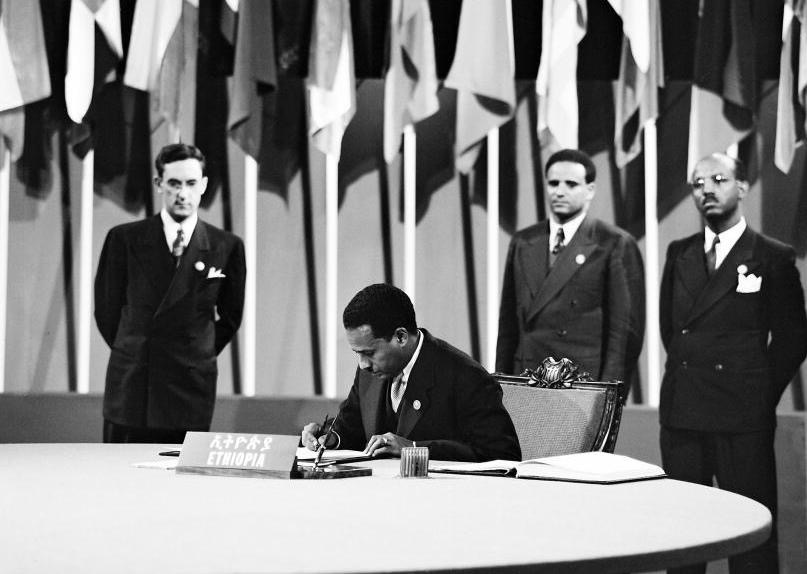
Ethiopia signed the UN Charter at San Francisco on June 26, 1945. The Charter entered into force on October 24, establishing the United Nations as the central institution of the new multilateral order. Ethiopia’s membership was formally recorded on November 13, 1945.
For Ethiopia, therefore, the United Nations was not an institution encountered after its creation. Ethiopia was present at the beginning of the institution’s history.
A voice shaped by history
That founding position acquired a deeper diplomatic meaning in the years that followed.
Ethiopia entered the UN era carrying another powerful memory: in 1936, Emperor Haile Selassie had stood before the League of Nations after fascist Italy invaded Ethiopia and appealed to a world that had failed to stop aggression. More than a quarter-century later, he would carry that historical experience onto the UN General Assembly floor.
On October 4, 1963, at the 18th session of the General Assembly, Haile Selassie addressed the world at a moment when African independence was transforming international politics. His speech connected racial equality, human rights, international morality and peace, while condemning colonial domination and apartheid in Africa.
His argument was larger than Ethiopia.
He warned that lasting peace and genuine world citizenship could not be achieved while racial superiority remained embedded in political systems and while Africans were denied equality and freedom. The speech became one of the most remembered African interventions in the history of the General Assembly.
It also reflected something that would become a recurring feature of Ethiopian diplomacy: national experience translated into an argument about the international order.
Ethiopia was speaking from its own history, but it was increasingly speaking about the conditions under which Africa—and the wider developing world—could participate as an equal force in global affairs.
Addis Ababa becomes a center of African multilateralism
The geographical journey in Ethiopia’s UN story is therefore as important as the diplomatic one.
San Francisco was where Ethiopia joined the founding of the global institution. Addis Ababa became one of the places where the African dimension of that institution—and of multilateralism more broadly—would take physical form.
The UN Economic Commission for Africa was established by the Economic and Social Council in 1958. Three years later, Africa Hall was inaugurated in Addis Ababa by Emperor Haile Selassie. The complex was given to the United Nations Economic Commission for Africa as a gift from the Government and people of Ethiopia.
Africa Hall would become far more than a conference building.
The United Nations describes it as the birthplace of the Organization of African Unity, the predecessor of today’s African Union, while the ECA Executive Secretary has called it “the home of African multilateralism.”
The significance is difficult to overstate.
In the decades when newly independent African states were seeking to translate political independence into continental solidarity, Addis Ababa emerged as a diplomatic capital of the African project. Ethiopia’s role as host of the ECA and as the home of the OAU placed the country at a critical intersection between African continental diplomacy and the wider multilateral system.
The road from San Francisco to Addis Ababa was consequently not simply a geographical one. It marked the movement of African diplomacy from representation in a global institution to the creation of institutions and political spaces through which Africa could increasingly articulate its own collective interests.
Ethiopia puts the UN Charter into action
Ethiopia’s relationship with the United Nations was never confined to conference halls.
Its contribution to UN peace operations began in the early years of the organization. UN Peacekeeping traces Ethiopian participation in UN-authorized operations to 1951, when Ethiopian personnel joined the UN multinational force in the Korean War. Ethiopia later deployed troops to the UN operation in the Congo in 1960, one of the organization’s earliest major peacekeeping operations.
The Congo mission became a defining test for the young United Nations. The operation, established in 1960, grew into the largest UN peacekeeping mission of its time, with nearly 20,000 military personnel at its peak.
Ethiopian participation in peacekeeping would continue across generations and continents, eventually extending to operations in Rwanda, Liberia, Sudan, Darfur, South Sudan and elsewhere.
UN Peacekeeping has repeatedly recognized Ethiopian men and women as important contributors to the organization’s efforts to advance peace in some of the world’s most difficult environments.
That record gives another dimension to Ethiopia’s place in the UN system.
The country did not simply advocate collective security from the General Assembly podium. It repeatedly supplied people to carry the principle of collective security into conflict zones.
A seat at the Security Council
Ethiopia’s diplomatic standing was also reflected in its election to the UN Security Council on three occasions.
It served as a non-permanent member in 1967–1968, 1989–1990 and 2017–2018.
The three terms span radically different eras of international politics: the Cold War, the final years of that order, and a contemporary international system increasingly defined by new geopolitical rivalries, conflicts and demands for institutional reform.
The continuity is significant.
Across these periods, Ethiopia repeatedly returned to the Council as an African representative in the body entrusted with primary responsibility for international peace and security.
From liberation to development
As the global agenda evolved, so did the substance of Ethiopia’s interventions.
The Ethiopian voice at the UN increasingly connected peace and sovereignty with development, poverty reduction, international cooperation and the demands of the developing world.
Prime Minister Meles Zenawi’s interventions in the 2000s reflected that shift. At the 2005 General Assembly, he argued that low-income and least-developed countries such as Ethiopia could not achieve the Millennium Development Goals without effective international cooperation, while stressing that many of those goals were nevertheless achievable.
The argument was characteristic of the changing multilateral debate: development was not simply a domestic responsibility, nor merely a matter of aid. It was linked to the structure of international cooperation itself.
Ethiopia’s diplomacy was therefore increasingly operating on several levels at once—peace and security, development, African representation and reform of the international system.
Ethiopia challenges the architecture of the global order
That approach became particularly explicit in the 21st century.
At the UN’s 75th-anniversary high-level meeting in 2020, Prime Minister Abiy Ahmed argued that the organization needed to evolve and adapt to new global realities.
He linked the credibility of the UN to the need for reform of the Security Council and called for Africa’s historic under-representation in the Council to be addressed. He also highlighted the pandemic’s damage to development and called for stronger international support for Africa.
The argument carried a historical continuity.
The Ethiopian delegation at San Francisco in 1945 had insisted that the new international order protect the rights and existence of smaller nations. Decades later, Ethiopia was again arguing that the architecture of that order had to become more representative.
The vocabulary had changed. The principle had not.
A more equitable international system remained central to Ethiopia’s multilateral argument.
From diplomacy to climate leadership
Ethiopia’s contemporary engagement with the UN has also broadened into the global climate and sustainable-development agenda.
The Green Legacy Initiative, launched in 2019, became one of the country’s flagship environmental programs.
The UN in Ethiopia has described the initiative as part of Ethiopia’s response to deforestation and climate change and has linked it to wider global agendas including ecosystem restoration, the Paris Agreement and the Sustainable Development Goals.
The initiative represents a notable evolution in Ethiopia’s multilateral profile.
The country that once approached international institutions principally through the language of sovereignty, aggression and collective security has increasingly placed environmental restoration, climate resilience and sustainable development alongside those enduring concerns.
Its diplomacy has consequently acquired a broader canvas: peace, development, climate action, African representation and reform of global governance.
A partnership rooted in eight decades
Today, the institutional relationship between Ethiopia and the UN extends well beyond diplomatic representation.
Ethiopia hosts one of the largest UN Country Teams in the world, with about 28 UN agencies based in Addis Ababa. In June 2025, Ethiopia and the United Nations signed a Sustainable Development Cooperation Framework for 2025–2030, aligning UN engagement with Ethiopia’s Ten-Year Development Plan, the Sustainable Development Goals and Africa’s Agenda 2063.
The framework covers peace and governance, economic development and food security, social services and education, environmental sustainability and climate resilience, as well as gender equality and youth empowerment.
It is designed not simply around immediate assistance but around transformative results, resilience and sustainable development.
That institutional depth illustrates how far the relationship has traveled since 1945.
The connection is no longer simply between an Ethiopian delegation and a global assembly. It encompasses peacekeeping, development, humanitarian action, climate policy, regional diplomacy, technical cooperation and the work of a vast UN presence based in Addis Ababa.
A history the UN itself continues to recognize
The United Nations’ own commemorations have increasingly placed Ethiopia’s history within the story of the organization.
During the UN’s 80th-anniversary observances in Ethiopia in 2025, UN officials explicitly highlighted Ethiopia’s founding role and longstanding engagement with multilateralism.
At Africa Hall, ECA Executive Secretary Claver Gatete described the historic complex as “the home of African multilateralism,” while the event featured an exhibition tracing Ethiopia and the UN through the decades.
In another UN account marking the anniversary, Ethiopia was described as a founding member that had maintained a long-standing and active partnership with the organization and played an important role in promoting peace and stability in the Horn of Africa and beyond.
Even the physical landscape of Addis Ababa tells part of this history.
Africa Hall stands as a reminder that Ethiopia’s relationship with the UN was never only about Ethiopia’s place inside a global institution. It also became part of the institutional architecture through which Africa itself organized, debated and projected its interests onto the world stage.
From San Francisco to the next world order
The story that began in San Francisco eight decades ago has therefore never been a static story of membership.
It is a story of a country that arrived at the founding of the United Nations with the memory of invasion and the conviction that the international system must protect sovereignty.
It is the story of an Ethiopian emperor using the General Assembly to challenge racism and colonial domination. It is the story of soldiers serving under the UN flag from Korea and the Congo to later African peace operations. It is the story of repeated Ethiopian seats on the Security Council.
It is the story of Addis Ababa becoming a permanent address of African multilateralism.
And it is the story of successive generations of Ethiopian leaders carrying the country’s arguments from sovereignty and collective security into development, African representation, climate action and reform of global governance.
The geography of that journey is revealing.
San Francisco was the place where Ethiopia entered the new world order. Addis Ababa became one of the places where Africa began to shape its own place within it.
As the United Nations enters its 81st General Assembly session, Ethiopia’s relationship with the organization therefore belongs to more than an anniversary timeline. It belongs to the history of modern multilateralism itself.
Ethiopia was there when the Charter was signed.
It was there when Africa’s institutional voice was taking shape.
It has served when the UN called for peacekeepers.
It has sat at the Security Council.
Its leaders have used the General Assembly to challenge injustice, press for development and demand a more representative global order.
And its capital has become home to institutions that helped give Africa a collective diplomatic identity.
Eight decades on, the record is not simply that Ethiopia has remained at the United Nations.
It is that Ethiopia has spent those eight decades helping define what Africa’s presence in the world should mean.