
National Dialogue Commission Sets Out Key Thematic Priorities Ahead of Landmark Consultation Forum
Addis Ababa, June 24, 2026 (FMC) — The Ethiopian National Dialogue Commission (ENDC) has officially unveiled eight major thematic agenda pillars that will serve as the structural foundation of the highly anticipated national consultation forum.
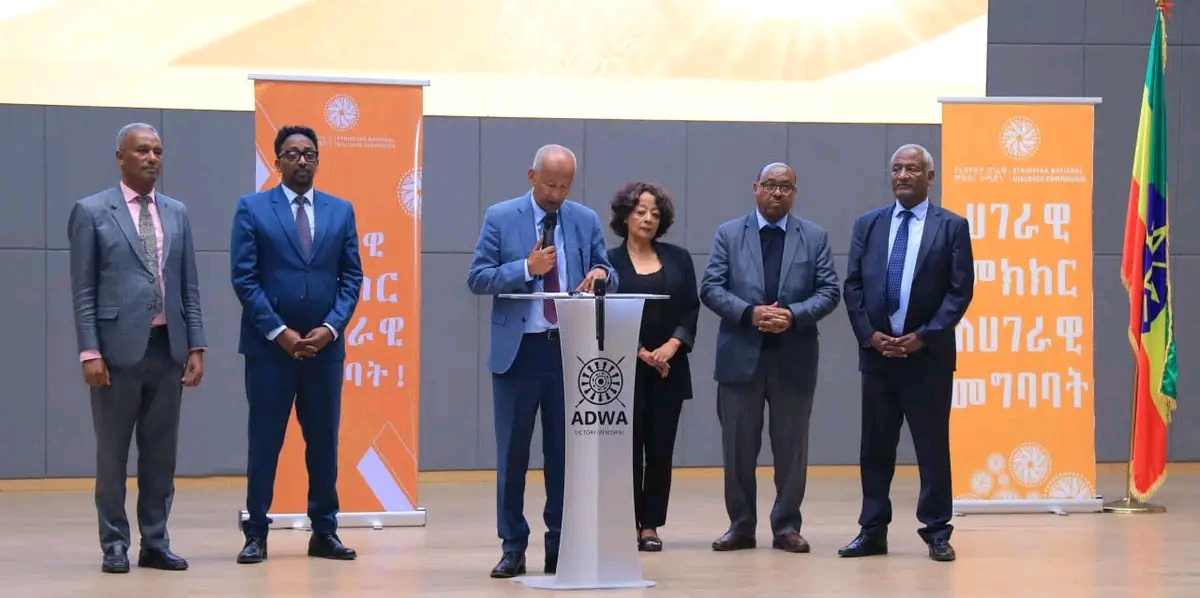
The agenda was announced by Chief Commissioner Professor Mesfin Araya and fellow commissioners during an official ceremony attended by religious leaders, community elders, Abba Gadas, Hadha Sinqees, and representatives of various segments of society.
The landmark announcement crystallizes years of intensive nationwide data collection and validation workshops into a cohesive and comprehensive roadmap designed to address the country’s deep-rooted and long-standing historical questions through civilized discourse.
The Chief Commissioner noted that the eight pillars have been designated as overarching guiding themes under which several specific sub-topics and core guiding questions will be systematically organized.
The unveiling marks the culmination of years of extensive consultations, agenda collection, and validation exercises conducted across the country.
Chief Commissioner Mesfin further elaborated that the agenda pillars reflect the views, concerns, and aspirations expressed by Ethiopians through one of the most comprehensive public engagement processes in the nation’s history.
He noted that the agenda-setting process was carried out through a broad-based, bottom-up approach designed to ensure that the dialogue reflects Ethiopia’s contemporary realities while addressing long-standing historical, political, social, and governance-related questions through peaceful and inclusive deliberation.
The eight major thematic agenda pillars identified by the Commission are:
1. State Building – Addressing issues related to national identity, historical narratives, social cohesion, and the future direction of the Ethiopian state.
2. Structure and Form of Government – Examining the federal system, power-sharing arrangements, constitutional governance, and institutional frameworks.
3. Status of Federal Cities – Deliberating on the governance, administration, and national role of Addis Ababa and Dire Dawa.
4. Religious Affairs – Promoting interfaith harmony, strengthening state-religion relations, and ensuring equality and mutual respect among religious communities.
5. Institutional Building, Rule of Law, and Human Rights – Focusing on institutional effectiveness, judicial independence, constitutionalism, and the protection of fundamental rights.
6. Socio-economic Affairs, as well as the Issues of Farmers and Pastoralists – Addressing economic development, equitable growth, social welfare, and the concerns of agricultural and pastoral communities.
7. Anti-Corruption and Good Governance – Exploring measures to strengthen transparency, accountability, and public trust in governance institutions.
8. Peace Building – Advancing reconciliation, conflict resolution, and sustainable peace mechanisms to ensure long-term national stability.
According to the Commission, the finalization of these agenda pillars is the direct outcome of consultations conducted in more than 1,200 woredas across the country. The process brought together political parties, civic organizations, academic institutions, religious leaders, traditional elders, women, youth representatives, and community stakeholders from diverse backgrounds.
Established in 2021 as an independent institution, the Ethiopian National Dialogue Commission was mandated to facilitate an inclusive national dialogue aimed at generating consensus on issues that have historically divided Ethiopians and to contribute to lasting peace, stability, and national unity.
As the process advances toward the main national conference scheduled to commence on July 15, Chief Commissioner Mesfin called on all Ethiopians, including groups and stakeholders that have not yet participated, to engage constructively in the dialogue process.
He emphasized that the success of the national dialogue depends on broad public ownership and collective participation, describing the initiative as a historic opportunity to shape a shared vision for Ethiopia’s future through dialogue, consensus-building, and peaceful engagement.