
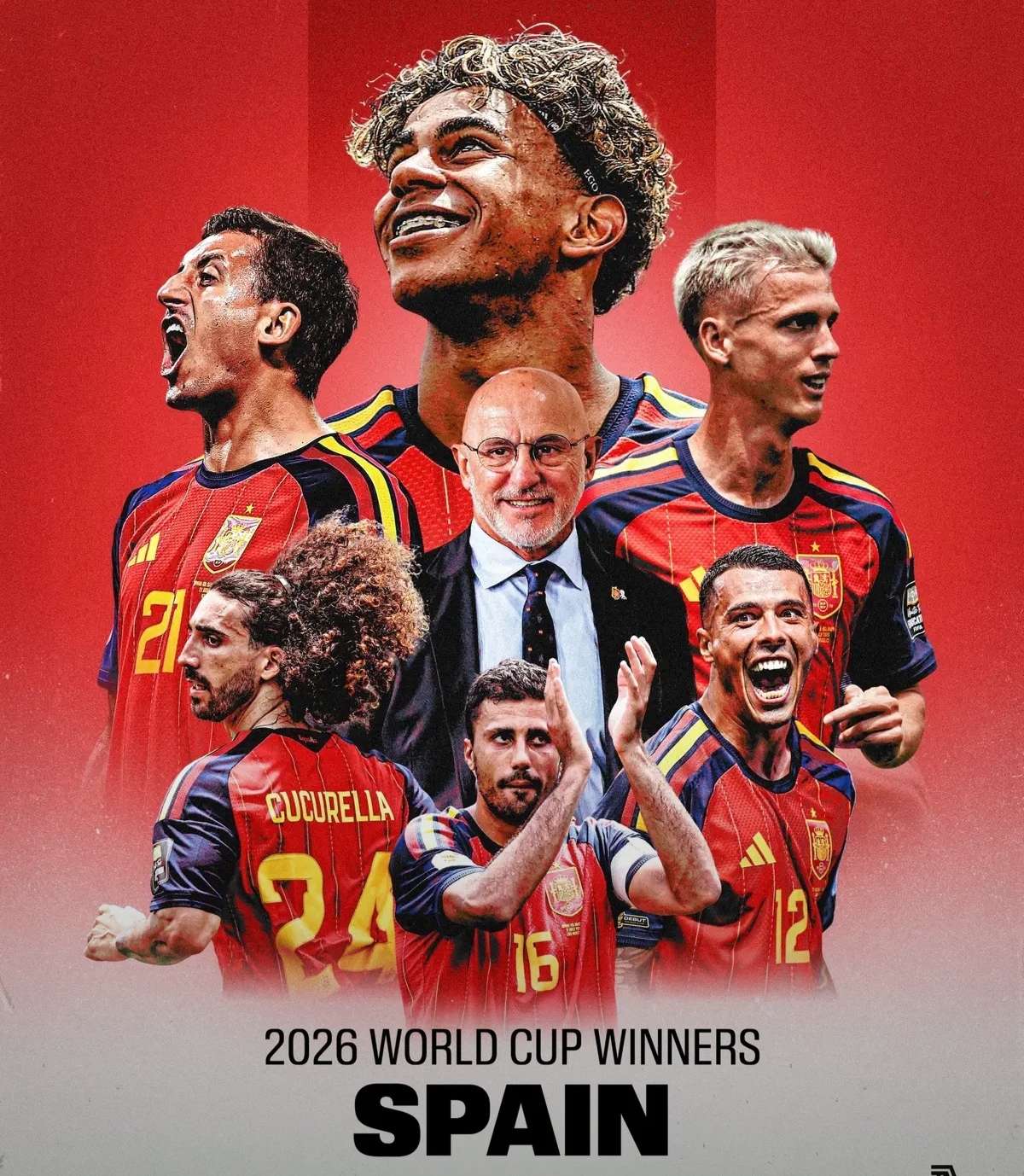
Spain End Argentina’s Reign to Lift Second FIFA World Cup Trophy
Addis Ababa, July 20, 2026 (FMC) — Spain have been crowned FIFA World Cup 2026 champions after defeating defending holders Argentina 1-0 in a dramatic final, taking the global crown from the 2022 champions and securing their second World Cup title.
The European champions sealed victory at MetLife Stadium in New Jersey after substitute Ferran Torres scored the decisive goal in the 106th minute of extra time, breaking a tense final that remained goalless after 90 minutes. Torres converted Spain’s sustained pressure into the only goal of a match dominated by Spain’s possession, attacking movement and tactical discipline.
Argentina’s attempt to retain the title they won in Qatar came under further pressure late in normal time when midfielder Enzo Fernández was sent off after receiving a second yellow card, leaving the defending champions with 10 players throughout extra time. Despite their numerical disadvantage, Argentina continued to resist Spain’s attacks before eventually conceding the decisive goal.
The victory marks Spain’s second FIFA World Cup triumph after their historic maiden success in 2010. The result ended Argentina’s reign as world champions after Lionel Messi guided La Albiceleste to their third World Cup crown in Qatar four years earlier.
England secured third place in the tournament after defeating France 6-4 in a high-scoring playoff, leaving France fourth. The bronze-medal finish gave England another notable achievement in their World Cup history, while France’s campaign was highlighted by a record-breaking individual performance from forward Kylian Mbappé.
Spain’s title-winning campaign was built on technical quality, midfield control and defensive consistency. Led by coach Luis de la Fuente, La Roja combined their traditional possession-based approach with a more direct attacking style, overcoming some of the world’s strongest teams before defeating Argentina in the final.
The Spanish squad was powered by a mixture of experienced leaders and a new generation of talents, including teenager Lamine Yamal, whose performances made him one of the standout young players of the competition. Spain’s midfield, controlled by Rodri, became one of the defining strengths of their championship run.
Argentina entered the tournament as defending champions and produced another deep run under Lionel Scaloni. Messi, appearing in what could be his final World Cup, remained central to Argentina’s campaign as the team reached another final but fell short of becoming the first nation since Brazil in 1962 to successfully defend the title.
The 2026 FIFA World Cup was the largest edition in the competition’s history, becoming the first tournament to feature 48 teams instead of the previous 32-team format. Jointly hosted by the United States, Canada and Mexico, the expanded tournament featured 104 matches across three countries, creating the biggest global football event ever staged.
Under the new format, participating nations competed through an expanded group phase before entering a larger knockout stage, allowing more teams from different regions to compete on football’s biggest stage. The tournament also increased the number of matches and created more opportunities for emerging football nations to make history.
The expanded competition brought together teams from across all six continental confederations and produced a wider range of historic moments, reflecting FIFA’s aim of increasing global representation at its flagship tournament.
The 2026 tournament also produced several historic individual milestones. Spain goalkeeper Unai Simón set a new World Cup record by keeping six clean sheets in seven matches, surpassing the previous benchmark of five clean sheets achieved by legendary goalkeepers in past editions. He also established a new record for the longest World Cup run without conceding, reaching 650 minutes before his streak ended.
Rodri also entered the history books after completing 648 successful passes during the tournament, the highest total recorded by a player in a single World Cup edition. The Spain midfielder surpassed his own previous record of 638 completed passes from the 2022 tournament in Qatar.
Spain’s Lamine Yamal led the tournament in successful dribbles, completing 30 take-ons, ahead of some of the world’s most recognised attacking players. His performances further highlighted the emergence of a new generation of global football stars.
France forward Kylian Mbappé finished the tournament as the leading scorer and claimed the Golden Boot after scoring 10 goals. His remarkable campaign added another milestone to his World Cup career and reinforced his status among the competition’s greatest goalscorers.
France’s Michael Olise finished as the tournament’s leading assist provider with seven assists, setting a new benchmark for creativity in a single World Cup edition. Lionel Messi, Martin Ødegaard, Brahim Díaz and Bruno Guimarães were among the players who followed among the leading assist providers.
Spain’s Rodri was named the tournament’s best player and received the Golden Ball, while Pau Cubarsí won the Young Player Award and Unai Simón received the Golden Glove for the best goalkeeper of the competition.
The 2026 World Cup also marked another historic chapter for Lionel Messi, who added further records and memorable moments to one of football’s greatest careers. Despite losing the final, Argentina’s captain left the tournament having strengthened his legacy as one of the most influential players in World Cup history.
Spain’s triumph now stands as one of the defining moments of the 2026 FIFA World Cup. By defeating the reigning champions on the biggest stage, La Roja confirmed the arrival of a new generation and restored Spain among the world’s leading football nations.