
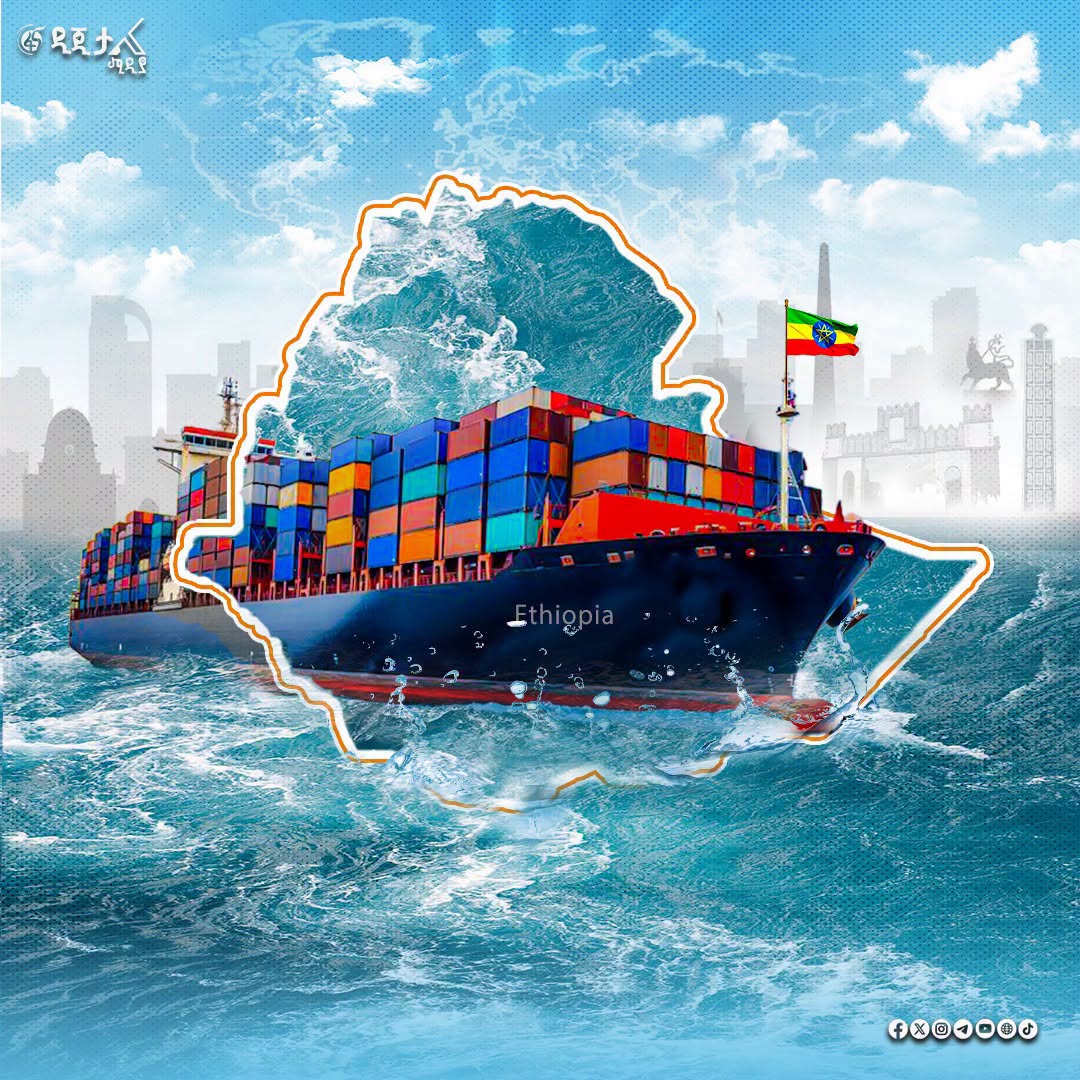
𝗕𝗘𝗬𝗢𝗡𝗗 𝗧𝗛𝗘 𝗛𝗢𝗥𝗜𝗭𝗢𝗡: 𝗘𝗧𝗛𝗜𝗢𝗣𝗜𝗔’𝗦 𝗗𝗜𝗣𝗟𝗢𝗠𝗔𝗧𝗜𝗖 𝗢𝗗𝗬𝗦𝗦𝗘𝗬 𝗙𝗢𝗥 𝗠𝗔𝗥𝗜𝗧𝗜𝗠𝗘 𝗔𝗖𝗖𝗘𝗦𝗦
Addis Ababa, July 4, 2026 (FMC) — For a country of more than 130 million people, #Ethiopia’s place in global trade is shaped by a structural reality that continues to define its economic calculations: the overwhelming majority of its import and export flows move through maritime gateways it does not directly control.
This condition has made geography a central factor in the country’s trade cost structure—affecting logistics, pricing, competitiveness, and the broader efficiency of national development.
As a result, the question of access to the sea has increasingly evolved into a matter of economic strategy, regional connectivity, and long-term development planning.
More than 95 percent of Ethiopia’s foreign trade is conducted through neighboring countries’ ports.
This reliance brings with it significant costs, including transport expenses, port service charges, insurance premiums, and time delays across supply chains.
These layers of cost accumulate and ultimately affect export competitiveness, foreign exchange demand, and the domestic cost of goods and services.
At its core, the issue is often described as a simple economic equation: when distance increases the cost of trade, national competitiveness is reduced.
For an economy undergoing structural transformation, such constraints become central policy considerations rather than peripheral logistical challenges.
Ethiopia’s approach to this question is firmly anchored in diplomacy. The government has consistently emphasized that its engagement is guided by peaceful negotiation, mutual benefit, and regional cooperation. The objective is not framed in confrontational terms, but rather as part of a broader effort to strengthen interconnected trade systems in the Horn of Africa and beyond.
This position is supported by widely recognized principles of international maritime law. Under the United Nations Convention on the Law of the Sea (UNCLOS), particularly Article 125, landlocked countries are recognized as having the right of access to and from the sea for the purpose of exercising their rights of international trade.
In practice, this principle underscores the importance of transit cooperation and non-discriminatory access arrangements.
Beyond legal frameworks, the issue is deeply tied to regional economic geography. The Red Sea and adjacent corridors represent some of the most strategically significant trade routes globally.
For Ethiopia, integration into these systems is not only a national economic concern but also part of a broader regional development dynamic in which infrastructure, logistics, and trade flows are increasingly interconnected.
The economic implications are substantial. High logistics costs continue to affect export performance and place pressure on foreign exchange reserves.
At the same time, delays and inefficiencies in supply chains reduce the competitiveness of Ethiopian goods in global markets.
In a global economy driven by efficiency, speed, and reliability, access to streamlined trade routes is a key determinant of economic resilience.
Domestically, Ethiopia’s industrial expansion, agricultural modernization, and growing service sector further intensify the need for efficient external trade pathways. As production capacity increases, the demand for cost-effective and predictable access to international markets becomes more pressing.
The government’s policy orientation continues to emphasize cooperation over confrontation. Regional integration, infrastructure connectivity, and mutually beneficial arrangements are viewed as the foundation for addressing shared economic challenges.
In this sense, the issue is framed less as a zero-sum dispute and more as a structural opportunity for regional trade enhancement.
Ultimately, the question of access to the sea is not only about geography. It is about the architecture of trade—how economies connect, how costs are distributed, and how nations position themselves within global systems of exchange.
For Ethiopia, the pursuit of efficient access routes reflects a broader ambition to align its geographic realities with its developmental aspirations.
Seen from this perspective, the challenge becomes one of system design rather than limitation: building a trade environment in which geography is managed through cooperation, infrastructure, and shared economic logic rather than acting as a barrier to growth.