
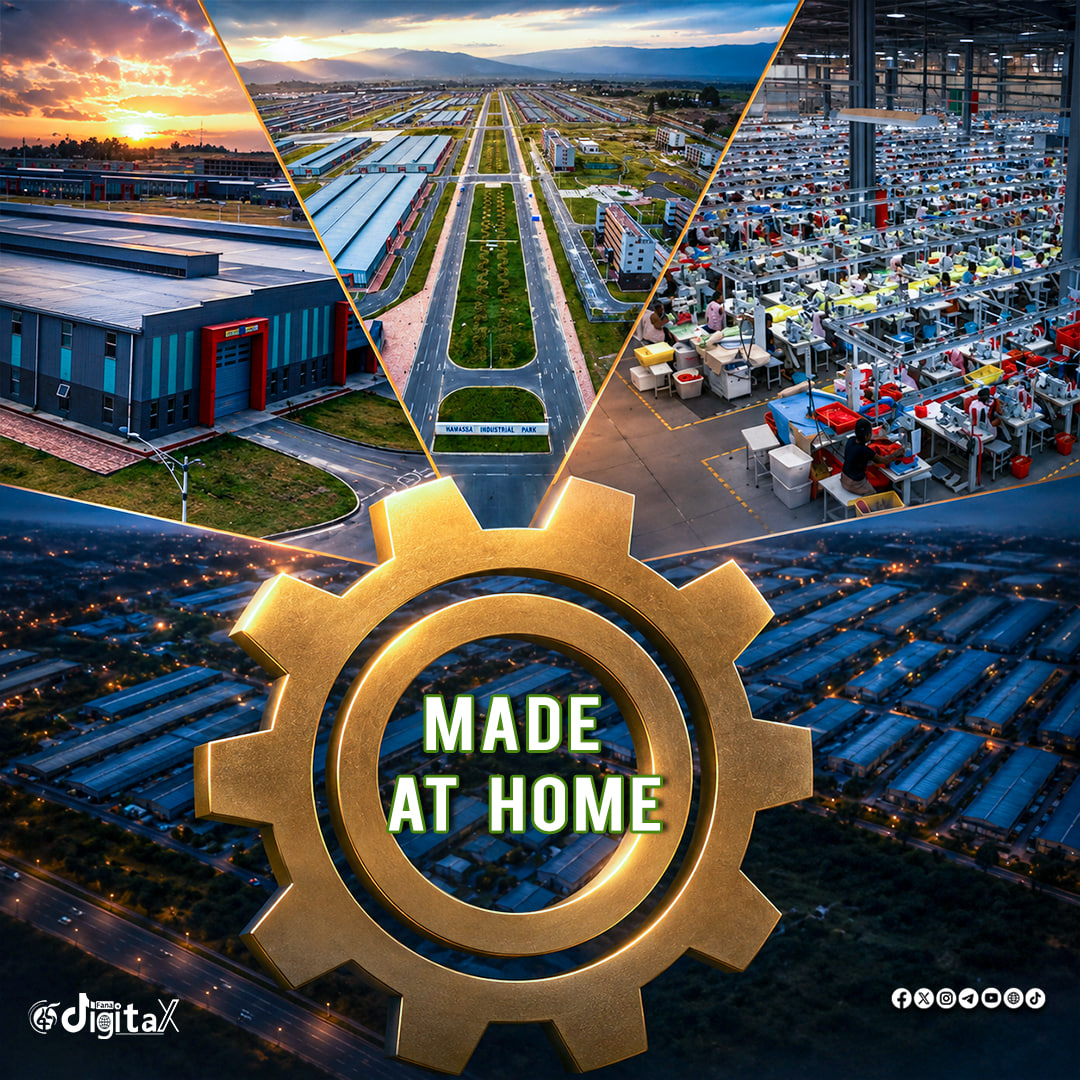
𝗠𝗔𝗗𝗘 𝗔𝗧 𝗛𝗢𝗠𝗘: 𝗧𝗛𝗘 𝗜𝗡𝗗𝗨𝗦𝗧𝗥𝗜𝗔𝗟 𝗦𝗛𝗜𝗙𝗧 𝗥𝗘𝗦𝗛𝗔𝗣𝗜𝗡𝗚 𝗘𝗧𝗛𝗜𝗢𝗣𝗜𝗔
Addis Ababa, July 4, 2026 (FMC) — Ethiopia’s ongoing economic transformation is increasingly being defined by a decisive shift toward domestic production, with manufacturing emerging as a central engine of structural change under the Homegrown Economic Reform (HGER) agenda and the broader “Made in Ethiopia” industrial vision.
At the heart of this transition is a deliberate policy direction aimed at strengthening local value creation, reducing import dependence, and expanding nationally produced goods under the Made in Ethiopia identity.
In this sense, manufacturing is no longer viewed merely as a production sector, but as the practical expression of Ethiopia’s ambition to build a self-sustaining and competitive economy.
Under the HGER framework, the manufacturing industry has become a key instrument for advancing import substitution, expanding industrial capacity, and deepening domestic production networks.
It is through this framework that policy reforms, investment facilitation, and industrial restructuring efforts are being coordinated to drive long-term economic transformation.
One of the clearest outcomes of this shift is the growing macroeconomic impact of import substitution.
The country’s Prime Minister Abiy Ahmed recently stated that Ethiopia has saved approximately 5 billion USD in foreign exchange during the current fiscal year through expanded domestic production and import substitution efforts, highlighting the growing macroeconomic importance of the manufacturing sector.
This progress is closely linked to ongoing reforms in the manufacturing industry, where structural bottlenecks such as foreign exchange constraints, input shortages, financing limitations, and energy supply challenges have been gradually addressed.
These interventions under HGER have improved industrial efficiency and strengthened production continuity across multiple sub-sectors.
As a result, manufacturing capacity utilization has increased significantly, rising from 46 percent to 61.8 percent, reflecting both the recovery of existing factories and improved operational performance across the sector.
This improvement is also tied to the revival of 917 previously inactive manufacturing enterprises, which have been brought back into production and reintegrated into domestic supply chains.
Industrial parks and economic zones remain central to this transformation. More than 26 industrial parks across the country now function as structured production ecosystems designed to attract investment, facilitate technology transfer, and support export-oriented industrialization.
These zones are a critical pillar of the Made in Ethiopia strategy, providing the infrastructure base for scaling domestic manufacturing capacity.
The employment impact of the sector continues to expand, with manufacturing directly providing jobs for more than 350,000 citizens.
Beyond direct employment, it generates wide-ranging indirect opportunities across agriculture, logistics, construction, and services, reinforcing its role as a multiplier of economic activity and a driver of inclusive growth.
Technology transfer has also become a defining feature of Ethiopia’s manufacturing transformation.
The participation of domestic and foreign investors has introduced modern production systems, improved industrial management practices, and strengthened technical know-how, contributing to rising productivity and improved product quality across locally manufactured goods.
Within the broader HGER agenda, institutional and policy reforms have been central in enabling this shift.
Improved investment frameworks, regulatory predictability, and strengthened public-private engagement have enhanced investor confidence, positioning manufacturing as a more dynamic and increasingly private-sector-driven pillar of the economy.
Beyond industrial production alone, manufacturing is reshaping Ethiopia’s economic structure by strengthening linkages with agriculture through agro-processing, supporting infrastructure development, stimulating innovation, and deepening domestic value chains.
In this way, it is reinforcing the broader Made in Ethiopia vision of building an integrated, production-led economy.
Despite remaining challenges in productivity, export competitiveness, and technological upgrading, the trajectory of the sector reflects a clear structural shift rather than incremental growth.
Manufacturing is increasingly functioning as the core mechanism through which Ethiopia is transitioning toward a more resilient, diversified, and self-reliant economy under HGER.
Ultimately, the significance of manufacturing lies not only in what is produced, but in what it represents: the material foundation of Ethiopia’s Made in Ethiopia vision and the structural backbone of economic transformation under the Homegrown Economic Reform (HGER) agenda.