
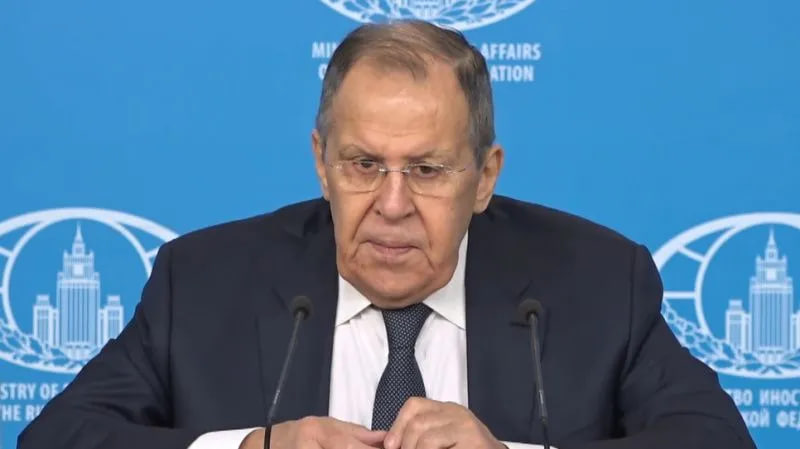
Russian Foreign Minister notes strengthening of relations among BRICS countries
Addis Ababa, January 21, 2026 (FMC) – Russian Foreign Minister Sergey Lavrov has highlighted strengthened cooperation among BRICS countries in 2025, underscoring what he described as notable progress in multilateral diplomacy and Brazil’s effective leadership during its chairmanship of the group.
Speaking at his annual press conference, Lavrov said relations between Russia and all BRICS members had deepened over the past year, reinforcing the foundation for broader cooperation across political, economic, and humanitarian sectors.
“All BRICS countries are our good partners. Over the past year, our relations with each of them have strengthened, and the basis for further cooperation in all areas has been reinforced,” Lavrov said. He added that Russia had provided full support to Brazil’s BRICS chairmanship, noting that Brazilian initiatives built on projects launched during the BRICS Summit held in Kazan in autumn 2024.
Lavrov also pointed to growing international interest in BRICS and reiterated Russia’s commitment to strengthening the grouping as a platform for global cooperation.
Turning to Africa, the Russian foreign minister confirmed that preparations are underway for the third Russia–Africa Summit, scheduled for 2026. He described the second conference of foreign ministers of Russia and African Union member states, held in Cairo in December 2025, as a key milestone in the preparatory process.
Lavrov further highlighted progress in Russia–China relations, noting the successful completion of the cross Years of Culture of Russia and China (2024–2025), during which several hundred cultural events were held in both countries. He said the initiative had strengthened humanitarian ties alongside expanding economic cooperation.
He recalled that Chinese President Xi Jinping and Russian President Vladimir Putin, in their New Year messages, announced 2026–2027 as the Years of Education in Russia and China, an initiative aimed at deepening youth exchanges and broader cultural cooperation.
“These initiatives are an essential part of cultural exchange, especially youth interaction,” Lavrov said, adding that cooperation is also expanding in sports and archival work, which he described as vital for preserving national culture and identity. He noted that a mutual visa-free regime has contributed to record levels of travel between the two countries, a trend he expects to continue.
Lavrov emphasized that humanitarian cooperation complements Russia–China economic ties and what he described as their strategic coordination on the international stage, calling both countries “important stabilising factors in international affairs.”
Addressing relations with India, Lavrov reaffirmed the “privileged strategic partnership” between the two countries, recalling the Russian president’s state visit to New Delhi and meetings with Indian President Droupadi Murmu and Prime Minister Narendra Modi in December 2025.
On economic cooperation within BRICS, Lavrov cited expanding engagement with Iran, pointing to ongoing work at the Bushehr Nuclear Power Plant and progress on a key segment of the International North–South Transport Corridor linking Russia, Azerbaijan, and Iran.
“We have good plans with the Islamic Republic of Iran not only in trade but also in investment,” Lavrov said, adding that there was no reason to halt the projects currently under development.
The foreign minister also described Russia’s relations with Vietnam — which joined BRICS as a partner country in 2025 — as a “strategic partnership” marked by “special relations.” He said Russia supports Vietnam’s efforts to advance its social and economic development and expand its international engagement, as reported by TV BRICS.