
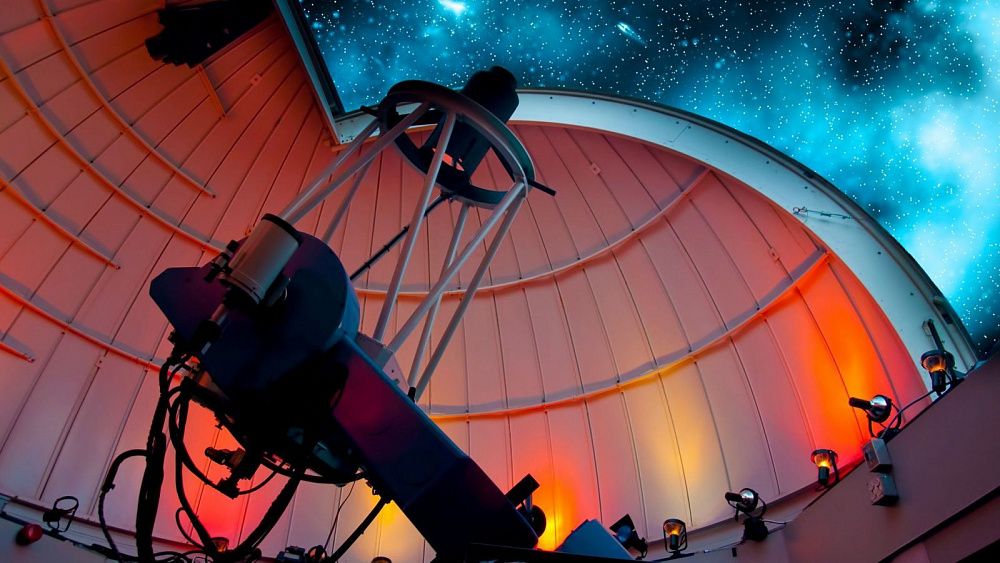
Chile Begins Operations of Telescope Equipped with World’s Largest Digital Camera
Addis Ababa, July 9, 2026 (FMC) — Chile has begun operations of the world’s largest telescope designed for wide-field sky surveys, marking a major advancement in astronomical observation and opening new opportunities for studying the universe.
Located in the mountains of the Coquimbo region, the telescope will photograph the southern sky regularly over the next decade, generating massive amounts of data to help scientists monitor celestial changes and discover new astronomical phenomena, as reported by FMC’s global partner TV BRICS, citing its partner media outlets.
The system is expected to process around 10 terabytes of data every night and detect millions of transient phenomena, ranging from moving asteroids to sudden flashes from distant objects.
During test observations, scientists discovered thousands of previously unknown asteroids, including objects approaching Earth and bodies located in the outer regions of the Solar System.
Unlike traditional telescopes, which focus on studying individual celestial objects in detail, the new facility is designed to continuously scan vast areas of the sky. This approach will enable researchers to identify changes such as variable stars, supernova explosions, newly discovered comets, small asteroids, distant objects beyond Neptune’s orbit and other previously unknown cosmic phenomena.
A major focus of the telescope’s research will be the study of dark matter, a form of matter that does not emit light but reveals its presence through gravitational effects.
Scientists plan to investigate how dark matter affects the propagation of light from distant galaxies through gravitational lensing. These subtle distortions will help create detailed maps of matter distribution in the universe and provide new insights into the evolution of the cosmos.
The telescope’s launch comes amid broader advances in space science and technology, with countries around the world making progress in areas such as space exploration, satellite systems, Earth observation and spacecraft development.
A scientist at the Engineering Academy of the Peoples’ Friendship University of Russia (RUDN) has developed an algorithm that can determine spacecraft manoeuvre parameters within minutes using only one or two measurements from Earth. The technology could improve satellite tracking, provide more accurate predictions of space debris movement and reduce collision risks in orbit.
China has also reported progress from orbital tests of the experimental Qingzhou spacecraft, with results confirming advances in spacecraft condition monitoring, medical support for crews and technologies aimed at reducing the cost of space operations.
Meanwhile, India is considering the procurement of semi-cryogenic rocket engines to modernize its LVM3 heavy-lift launch vehicle and increase its payload capacity. The upgrade is expected to support future missions, including lunar exploration, the establishment of a national space station and the expansion of commercial space launches.
These developments highlight continued global efforts to advance space technologies and strengthen scientific capabilities through innovation and cooperation.