
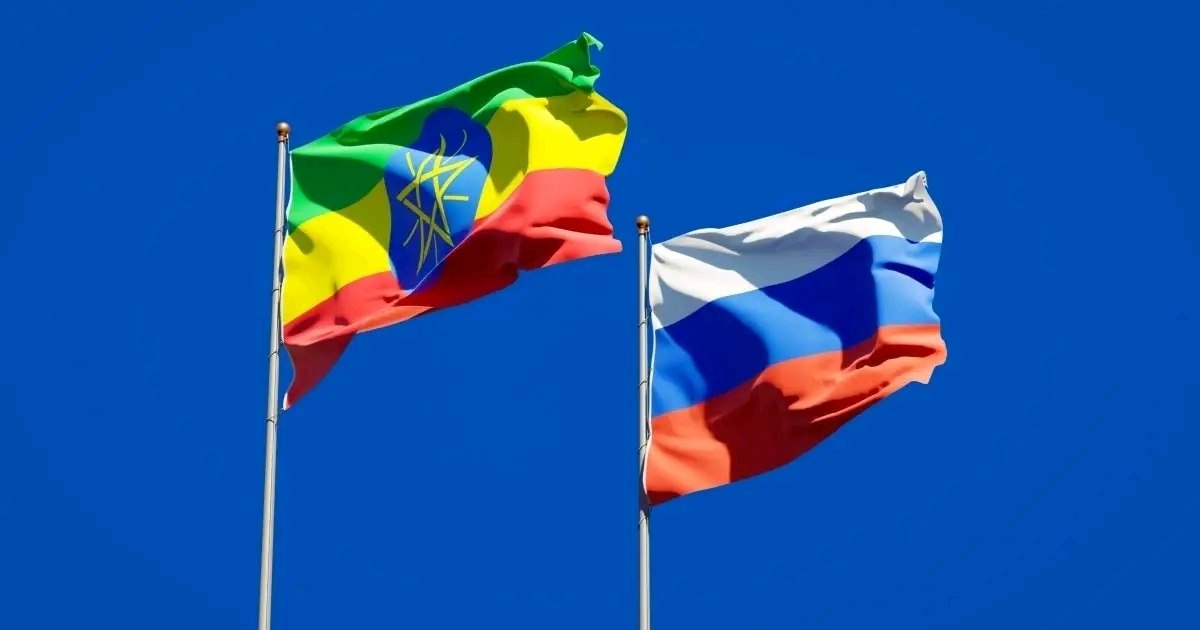
Ethiopia and Russia Building Agricultural Capacity Through Technology, Training and Joint Production: Experts
Addis Ababa, October 2, 2026 (FMC) — Ethiopia and Russia are building a broader agricultural partnership centered not only on food supplies but increasingly on technology transfer, technical training, mechanization and joint production, as the two countries look to strengthen Ethiopia’s agricultural capacity and food security.
The emerging direction comes ahead of the Third Russia-Africa Summit, scheduled to take place in Moscow on October 28–29, with Ethiopian experts describing the evolving relationship as a shift from conventional commodity exchanges toward longer-term cooperation based on technology, capacity building and mutual trust.
For Ethiopia, food security is closely connected to the country’s broader economic resilience. Abdurahman Said, a political analyst and founder of the Horn of Africa Regional Integration Center, said the country’s landlocked position and reliance on the Djibouti corridor make food supply, connectivity and national stability increasingly interdependent.
“For Ethiopia, security, connectivity, and food security have become inseparable,” Said said. He noted that disruption along shipping routes or delays in grain deliveries could extend beyond an immediate economic impact to affect stability, public confidence and national resilience.
Against this backdrop, he said Russia’s role as a supplier of agricultural commodities and inputs has become increasingly significant. Yet he sees an even greater opportunity in moving the relationship toward helping Ethiopia strengthen its own productive capacity.
“The strategic question is whether Russia can help Ethiopia produce more of its own food and, over time, export it,” Said said.
He argued that the greatest value of cooperation would increasingly come from local assembly, spare-parts production, financing and leasing schemes accessible to smallholder farmers and cooperatives, alongside technical training and skills development.
The direction is already reflected in the two countries’ exploration of joint production of agricultural and energy equipment, as well as Ethiopia’s interest in participating in the BRICS Grain Exchange not simply as a buyer but also as a supplier.
Trade between Ethiopia and Russia has also expanded rapidly. According to figures cited by the experts, bilateral trade more than tripled in 2025, reaching about 592 million dollars. Russia supplies Ethiopia with fertilizers, agricultural machinery and energy equipment, while Ethiopia exports products including coffee, flowers and textiles.
The broader African market has likewise become an increasingly important destination for Russian agricultural exports. Data from Russia’s Agroexport Center cited by the experts show that Russia supplied more than 11 million metric tons of agricultural products to Africa during the first half of 2026, valued at about 2.9 billion dollars. Wheat accounted for approximately 10.2 million metric tons.
For Ethiopia, Said stressed that agricultural inputs are as important as food shipments themselves.
“Russian fertilizers are no less important than grain: they are the foundation of domestic farms’ productivity,” he said.
Dhugassa Mulugeta (PhD), an agroeconomist and researcher at Addis Ababa University of Science and Technology, identified technology transfer, fertilizers and agrochemicals, and the assembly of tractors in Ethiopia as key areas in which cooperation could contribute to agricultural transformation.
He pointed to tractor assembly already under way in Debre Zeyte and said Ethiopia could use modern Russian technologies to build on its progress toward wheat self-sufficiency and raise agricultural productivity.
“Ethiopia has increased wheat production to achieve self-sufficiency, and now we need to scale it up using modern Russian technologies,” Mulugeta said.
He added that until Ethiopia develops sufficient domestic fertilizer production, imports from Russia could help increase agricultural yields and productivity.
For Mulugeta, however, technology transfer ultimately depends on developing the people capable of applying and advancing it.
He pointed to Ethiopia’s longstanding educational links with Russia, including scholarship programs through which Ethiopian students have studied and continue to study in fields related to agriculture.
Short-term training, academic exchanges and cooperation between Russian and Ethiopian scientists and universities, he said, can provide important channels for transferring knowledge and technology.
He also highlighted energy as a prerequisite for broader agricultural mechanization and pointed to prospects for cooperation in peaceful nuclear energy.
Dr. Mohammed Issa, an associate professor of economics at Worabe University, meanwhile emphasized trust and mutual benefit as the foundation for stable and sustainable economic relations.
“Countries need long-term, trust-based ties that allow them to take each other’s interests into account and work together toward sustainable development,” Issa said.
Issa also called for Ethiopia to diversify its exports to the Russian market, identifying coffee, sesame and leather among the products with potential, while emphasizing the need to develop goods that meet the requirements of Russian consumers and businesses.
He said Ethiopia’s abundant natural resources would generate greater economic value when combined with infrastructure and appropriate technology.
“Russia possesses technologies that it is ready to develop in Ethiopia,” Issa said, adding that greater domestic value addition could strengthen Ethiopia’s foreign-exchange position while also expanding the use of the Russian ruble in bilateral trade.
Taken together, the experts’ assessments point to an agricultural relationship increasingly extending beyond the movement of commodities.
For Ethiopia, the longer-term opportunity lies in using access to fertilizers, machinery, technology and expertise as building blocks for stronger domestic production—expanding mechanization, improving yields, developing technical skills, encouraging local assembly and creating a more capable agro-industrial base.
As the two countries prepare for the Russia-Africa Summit, the evolving partnership is therefore increasingly being viewed through the lens of what Ethiopia can build from cooperation: greater agricultural productivity, stronger technical capacity, expanded local production and, ultimately, a more resilient food system capable of supplying domestic needs while creating opportunities for exports.
Reporter: Ashebir Kasahun